Autobidder
An autobidder for Wildberries that never pays more per order than the product earns
An autobidder, also spelled autobider or bidder, is a program that changes the bids in your Wildberries ad campaigns by itself, following your rules. The WB auction is recalculated every hour and nobody can follow a dozen campaigns by hand. A regular bidder holds a position and raises the bid after competitors; the Parus Seller autobidder works out how much an order may cost at your margin and lowers the bid to that ceiling every hour.
Most WB bidders hold a position and raise the bid after competitors. Ours works the other way round: it calculates what an order may cost at your margin and lowers the bid to that ceiling once an hour. Below: the formula, the guards and data from 235 campaigns on what a bid without a ceiling costs.
- The bid ceiling comes from product profit and phrase conversion, not from a desired position.
- The autobidder only lowers bids. Raising is done by Bid Autopilot and Promotion, and that is your choice.
- In our data, 8.5 % of ad budget goes to phrases with clicks and zero orders.
- It starts in test mode: calculates and shows, but does not touch bids in WB.
What an autobidder is and why a seller needs one
An autobidder, also called a bidder, is software that changes bids in Wildberries ad campaigns for you. The WB auction is recalculated every hour, competitors move their bids, and nobody manages a dozen campaigns by hand. The robot does it by the rules you set.
A typical bidder solves one task: keep the product card at a given place in the results. Position becomes the goal instead of profit, and the bid climbs after competitors until the ads sell at a loss. The seller learns about it from a report, after the money is spent.
The Parus Seller autobidder asks a different question: how much may an order cost for the product to stay profitable. The bid ceiling is derived from that amount. The position ends up wherever your economics can afford, and not a rouble higher.
How the autobidder calculates a bid
The bid ceiling for a phrase equals the acceptable cost per order multiplied by the phrase conversion and by a thousand. It is then cut by a safety factor and clamped into your min-max corridor. That is the whole calculation; it is open and logged for every phrase.
Acceptable cost per order
From cost price, commission, logistics and the target margin the service calculates how many roubles an order may cost in ads without a loss. You fill in cost prices in the Cost section, the rest comes from your WB account via API.
Conversion of each phrase
Campaign statistics give the orders per thousand impressions for each keyword cluster. A phrase with one order per thousand impressions and a phrase with ten get different ceilings even inside one campaign.
Safety factor
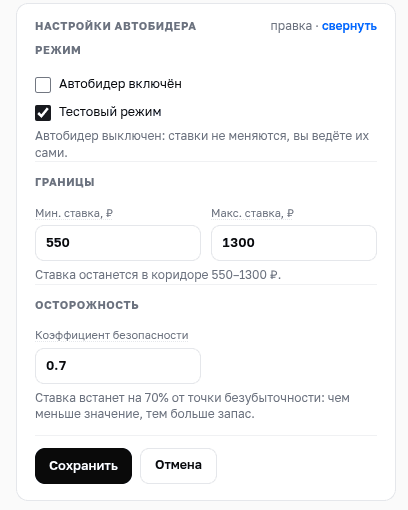
The ceiling is multiplied by a factor, 0.7 by default: the bid lands at 70 % of the break-even point. The lower the value, the bigger the margin for noisy statistics and auction jumps.
Corridor and the WB floor
The result is clamped between the minimum and maximum bid you set, for example 550 and 1,300 ₽. The autobidder cannot go below the live WB auction minimum. Changes under 5 % are not applied, so the campaign is not jerked around.
Every hour at :00 Moscow time the autobidder walks the phrases and logs what it did and why: “economics allows a lower bid”, “phrase is learning, no orders yet”, “spend without orders, phrase switched off”, “unprofitable even at the minimum bid”.
What protects the budget
The autobidder cannot raise bids, so the worst it can do is lower a bid too far and lose impressions. Four settings guard against that, and all of them are yours.
Lowering only
The robot lowers the bid towards the economic ceiling and never raises it. Raising is left to Bid Autopilot and Promotion, which you enable separately.
Bid corridor
Minimum and maximum bid in roubles. The autobidder stays inside the corridor and keeps phrases without orders at the minimum until they gather statistics.
Test mode
On by default. The autobidder calculates bids and writes decisions to the log, but sends nothing to WB until you untick the box yourself.
Switching off empty phrases
A phrase that spent money without orders, or is unprofitable even at the minimum bid, is switched off. The reason stays in the log and the phrase can be brought back by hand.
What a bid without a ceiling costs: data from 235 campaigns
We exported eight months of daily statistics for 235 ad campaigns of eighteen stores: 1,515,434 ₽ of spend and 4,537 orders. The overall ad-to-revenue ratio was 45.3 %, so almost half of the ad revenue went back into ads.
42 phrases collected twenty or more clicks each and zero orders. Together 128,555 ₽, 8.5 % of the sample budget. The most expensive one brought 3,273 clicks for 30,829 ₽ and not a single sale. These are exactly the phrases the autobidder switches off under the “spend without orders” rule.
40 of the 235 campaigns had spend and zero orders over their whole life, 49,841 ₽ in total. Campaigns with CTR below 2 % paid 1,343 ₽ per order, campaigns with CTR above 4 % paid 242 ₽. A ceiling derived from conversion separates these two cases automatically.
How the autobidder differs from manual bids and a position bidder
| Criterion | Manual | Position bidder | Parus Seller autobidder |
|---|---|---|---|
| What drives the bid | Gut feeling and spare time | Whatever it takes to hold place N | Acceptable cost per order and phrase conversion |
| A competitor raises the bid | You learn tomorrow from the report | The bid climbs as long as the position holds | The bid stays under the ceiling, the position may drop |
| Phrases with no orders | Keep spending until you notice | Keep spending, position matters more | Held at the minimum, switched off after spend without orders |
| Different phrases in one campaign | One bid for all | One bid for all | Its own ceiling for every keyword cluster |
| What you see afterwards | Nothing but the spend | Position and budget | A log: phrase, old and new bid, reason |
What the autobidder for Wildberries costs
It is not sold separately: the autobidder is included in every Parus Seller plan together with analytics, auto pricing and AI review replies. The Start plan for one store is 4,490 ₽ per month, 20 % cheaper when paid yearly.
With the promo code PARUS60 the first two months are free, no card needed. A Wildberries API token is enough to connect: the store owner creates it in the WB account and revokes it in one click; the service never asks for a login or password.
Frequently asked questions about the autobidder
What is an autobidder in plain words?
Software that changes your Wildberries ad bids for you. Our autobidder checks campaign phrases every hour and lowers the bid to the amount at which an order still pays off at your margin.
Can the autobidder burn my budget?
It cannot raise a bid, so it cannot inflate spend. It can only lower a bid, and the bid corridor plus the test mode it starts in by default protect against lowering too far.
How is it different from the automatic bids in the Wildberries account?
The built-in WB tools optimise impressions and position and do not know your margin. The Parus Seller autobidder derives the ceiling from the acceptable cost per order given by your cost prices, separately for every keyword cluster.
Is there a free bidder for Wildberries?
We know of no free bidders that calculate from product economics, and the free “position holders” are exactly what drives bids up. The Parus Seller autobidder is free for two months with the promo code PARUS60, then it is part of a plan from 4,490 ₽ per month.
How often does the autobidder change bids?
Once an hour, at :00 Moscow time. A bid changes only when the new calculation differs from the current bid by more than 5 %, and every change is logged with its reason.
What is needed to connect the autobidder?
A Wildberries API token with the Promotion category and filled-in product cost prices. The token is created in the WB account in a minute; without cost prices the acceptable cost per order uses defaults and the ceiling comes out rough.
Try the autobidder in test mode
Connect your account with a token, watch a week of the robot's decisions in the log and untick test mode once you trust the maths. The first two months are free with the promo code PARUS60.
Get 2 months free