What Wildberries logistics costs in 2026: an item under a litre is 23–32 ₽ per trip across five volume steps, from a litre it is 46 ₽ for the first litre and 14 ₽ for each one after, all multiplied by the warehouse coefficient, a unified 170% for Russian warehouses since 15 August. A 30 × 20 × 10 cm box is 6 L and 116 ₽ base, 197.2 ₽ at 170%. The return trip of a refusal goes at the base rate without the coefficient. Work out your own box in the calculator below.
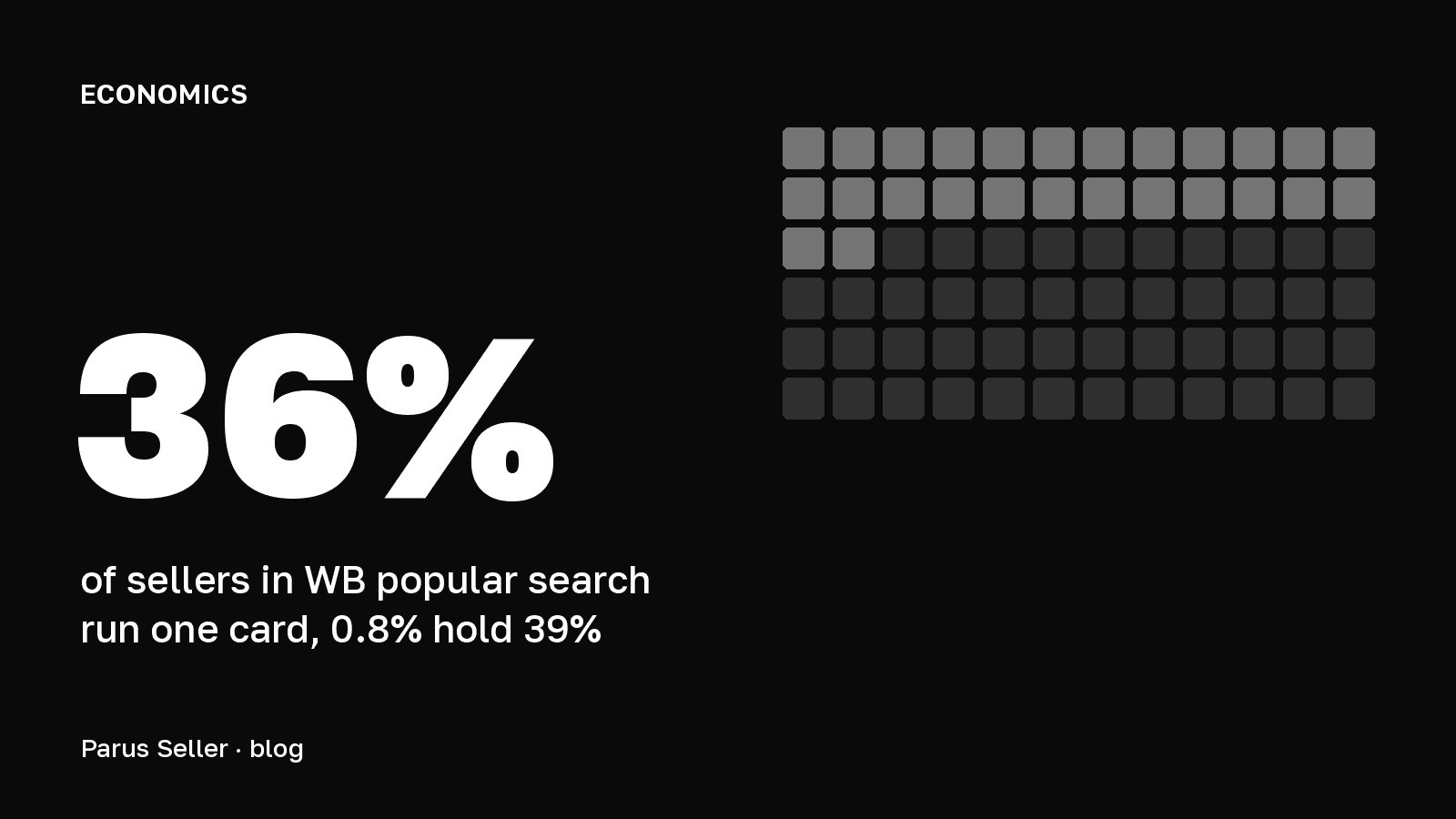
The Wildberries logistics cost is what you pay to move an item from a WB warehouse to the customer and back. It is not "a rate": it is a formula of three multipliers, the base rate for volume, the warehouse delivery coefficient and the localisation index for supplies created before 15 August 2026. We read three WB instructions dated 27 August and 3 September, pulled live rates through the seller API on 7 September and checked the formula against the line-item detail of two weekly reports from one store. Below is the whole mechanic with numbers. There is a surprise in it too: the flat 170% coefficient WB announced on 15 August barely shows up in the reports for late August.
In short: an item under a litre costs 23–32 ₽ to deliver across five volume steps, and from a litre it is 46 ₽ for the first litre plus 14 ₽ for each one after. That base is multiplied by the warehouse coefficient, and for supplies before 15 August by the localisation index as well. The trip back after a refusal or a return goes at the bare base with no coefficients. The rate is locked when a supply is created, for 60 or 90 days, so the new 170% will not reach your report until the lock on the old supplies runs out. Storage: 0.08 ₽ per litre per day, multiplied by the warehouse coefficient.
Logistics by litre and warehouse coefficient together with commission, buyout rate and tax per sale is worked out by the Wildberries profit calculator.
What Wildberries logistics costs for your box: calculator
Enter the package dimensions, pick the warehouse coefficient and sales model. The calculator works out the base by WB steps, delivery to the buyer, the return trip and logistics per completed sale adjusted for the buyout rate, and the table below shows how the same box gets pricier from a 100% to a 200% coefficient.
WB logistics calculator: your own box
Steps under a litre and the 46 + 14 ₽/L base from the WB manual, warehouse coefficients from the tariffs API as of 11.09.2026. Runs in your browser, sends nothing.
- Volume
- 6.00 L
- Base for the volume, no coefficients
- 116.0 ₽
- Delivery to the buyer at 170%
- 197.2 ₽
- Return trip of a refusal (base)
- 116.0 ₽
- Logistics per sale at a 90% buyout rate
- 232.0 ₽
- Storage per unit for 30 days at 0.08 ₽/L/day
- 24.48 ₽
Each sale carries 0.11 refusals: 197.2 ₽ to the buyer plus (197.2 ₽ + 116.0 ₽) per refusal
Delivery to the buyer by volume and warehouse coefficient, ₽
The 170% column is the unified rate of Russian warehouses. The return trip of a refusal always follows the 100% column.
| Volume | 100 % | 150 % | 170 % | 200 % |
|---|---|---|---|---|
| 0.2 L | 23.0 | 34.5 | 39.1 | 46.0 |
| 0.5 L | 29.0 | 43.5 | 49.3 | 58.0 |
| 1.0 L | 32.0 | 48.0 | 54.4 | 64.0 |
| 2.0 L | 60.0 | 90.0 | 102.0 | 120.0 |
| 5.0 L | 102.0 | 153.0 | 173.4 | 204.0 |
| 10.0 L | 172.0 | 258.0 | 292.4 | 344.0 |
What the Wildberries logistics cost is made of: the delivery formula
The WB instruction "Delivery: types and how the cost is calculated" dated 3 September 2026 sets two bases. For items under a litre there is a stepped table. Up to 0.2 litres costs 23 ₽, up to 0.4 litres 26 ₽, up to 0.6 litres 29 ₽, up to 0.8 litres 30 ₽, up to a litre 32 ₽. Inside a step the volume does not matter: a 0.45 litre case and a 0.55 litre mug both ship for 29 ₽. From a litre up the base is linear, 46 ₽ for the first litre and 14 ₽ for every extra one. A 1.8 litre blanket gives 46 + 0.8 × 14 = 57.2 ₽.
Then the base is multiplied by the warehouse delivery coefficient, which WB publishes under "Warehouse rates" and changes with the load. Until 15 August it was multiplied by the localisation index as well, more on that below. For oversized and extra-oversized goods and large household appliances the index does not apply, but there is a corridor. The sum of the first and the extra litres cannot be lower than 1,000 ₽ or higher than 3,000 ₽: a 65 litre wardrobe would come to 942 ₽ on the base, but 1,000 ₽ goes into the calculation.
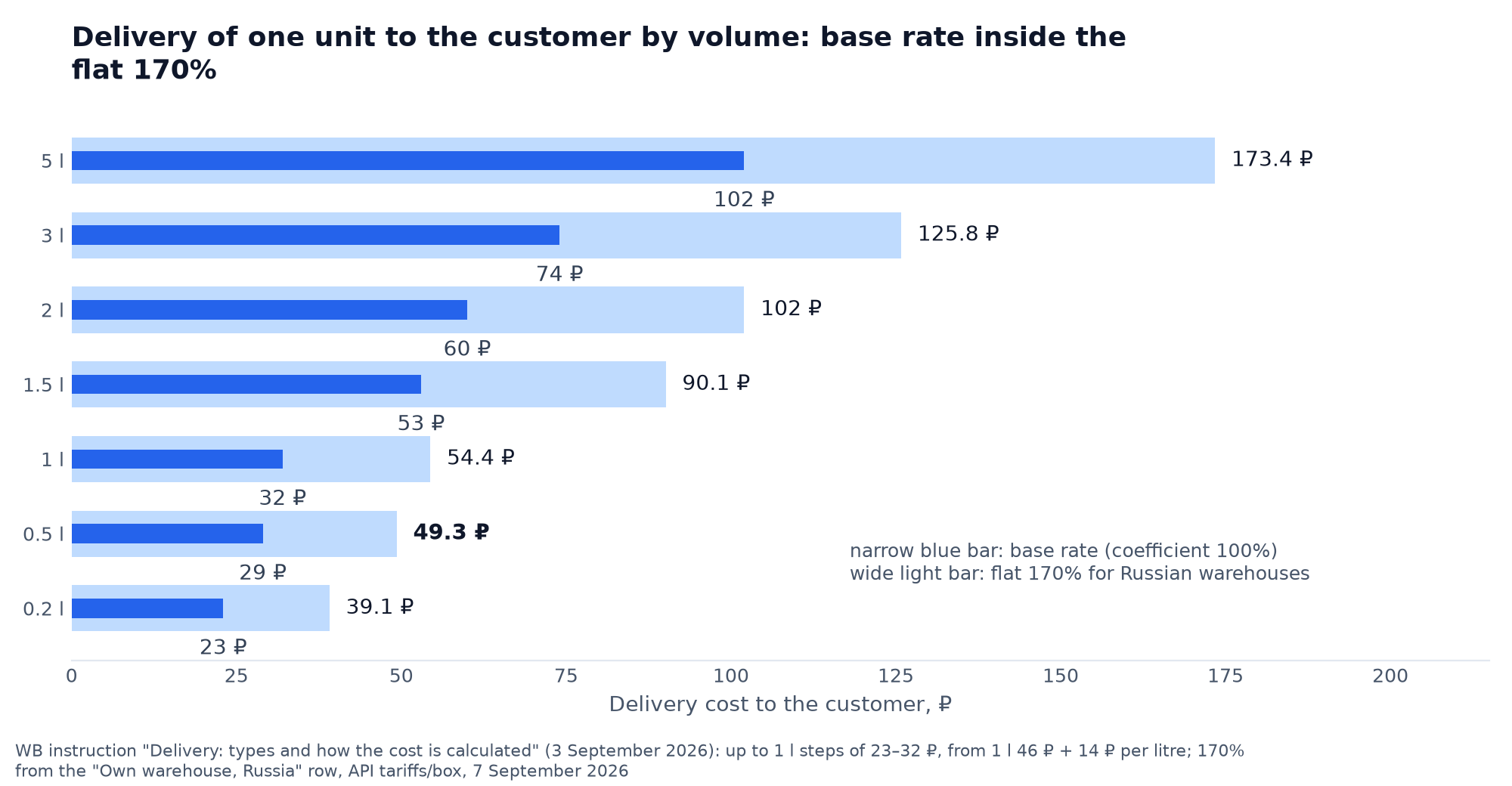
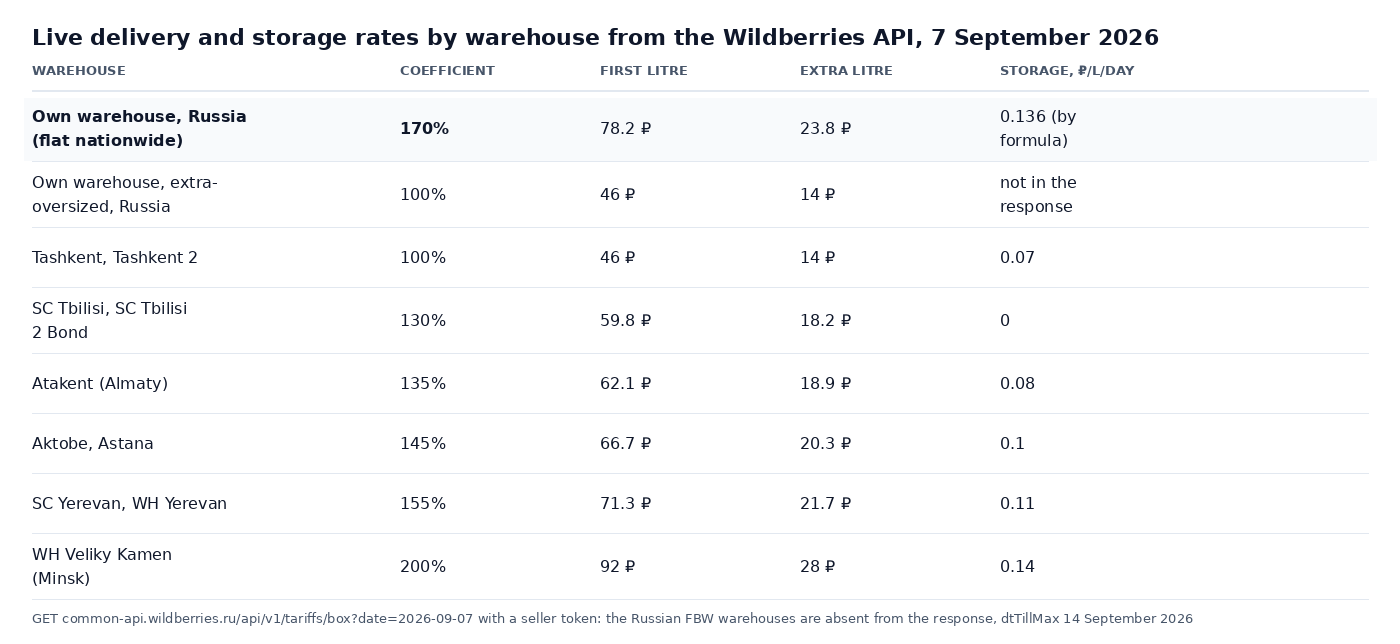
The only thing that changed in the formula on 15 August 2026 is the multipliers. In the rates and the reports the Russian warehouses are folded into one summary row, "WB warehouse, Russia", the localisation index is cancelled for new supplies, and the delivery and storage coefficient for every warehouse in Russia became a flat 170%. Live calls to the rate methods on 7 and 9 September show it literally. In the box rates for Russia two rows are left, "Own warehouse, Russia" and "Own warehouse, extra-oversized, Russia", and both return a dash instead of figures, while the list of warehouses holds only CIS ones. The flat coefficient itself is visible in the return rates: 233.2 ₽ for the first litre to the seller's pickup point is 46 ₽ × 170% plus a fixed 155 ₽, and 23.8 ₽ for an extra litre is 14 ₽ × 170%. That the acceptance coefficient API was switched off along with it we wrote in our breakdown of inbound acceptance.
How return logistics is calculated and why it costs less than delivery
The trip back after a refusal or a customer return is charged on the base rate alone. Neither the warehouse coefficient nor the localisation index takes part in it, and the instruction says so in plain words. A 0.55 litre item goes back for 29 ₽, a 1.8 litre blanket for 57.2 ₽. The line-item detail of the reports confirms this without a single exception. Every "From the customer on cancellation" row holds exactly 23 ₽ for items under 0.2 litres and exactly 26 ₽ for items from 0.2 to 0.4 litres, the bare steps of the table.
Hence the rule that lives in all our calculations: one refused order means two paid trips, out to the customer on the full formula and back on the base. Logistics per completed sale is counted like this. To the delivery you add the sum of delivery and return, multiplied by the share of refusals and divided by the share of buyouts. For a 0.5 litre item at a coefficient of 170% that is 49.3 ₽ out to the customer and 29 ₽ back.
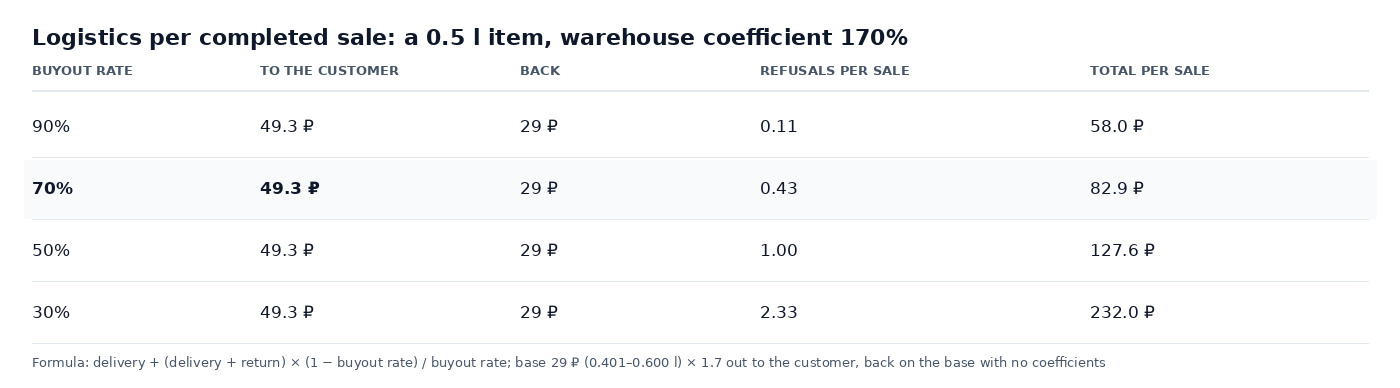
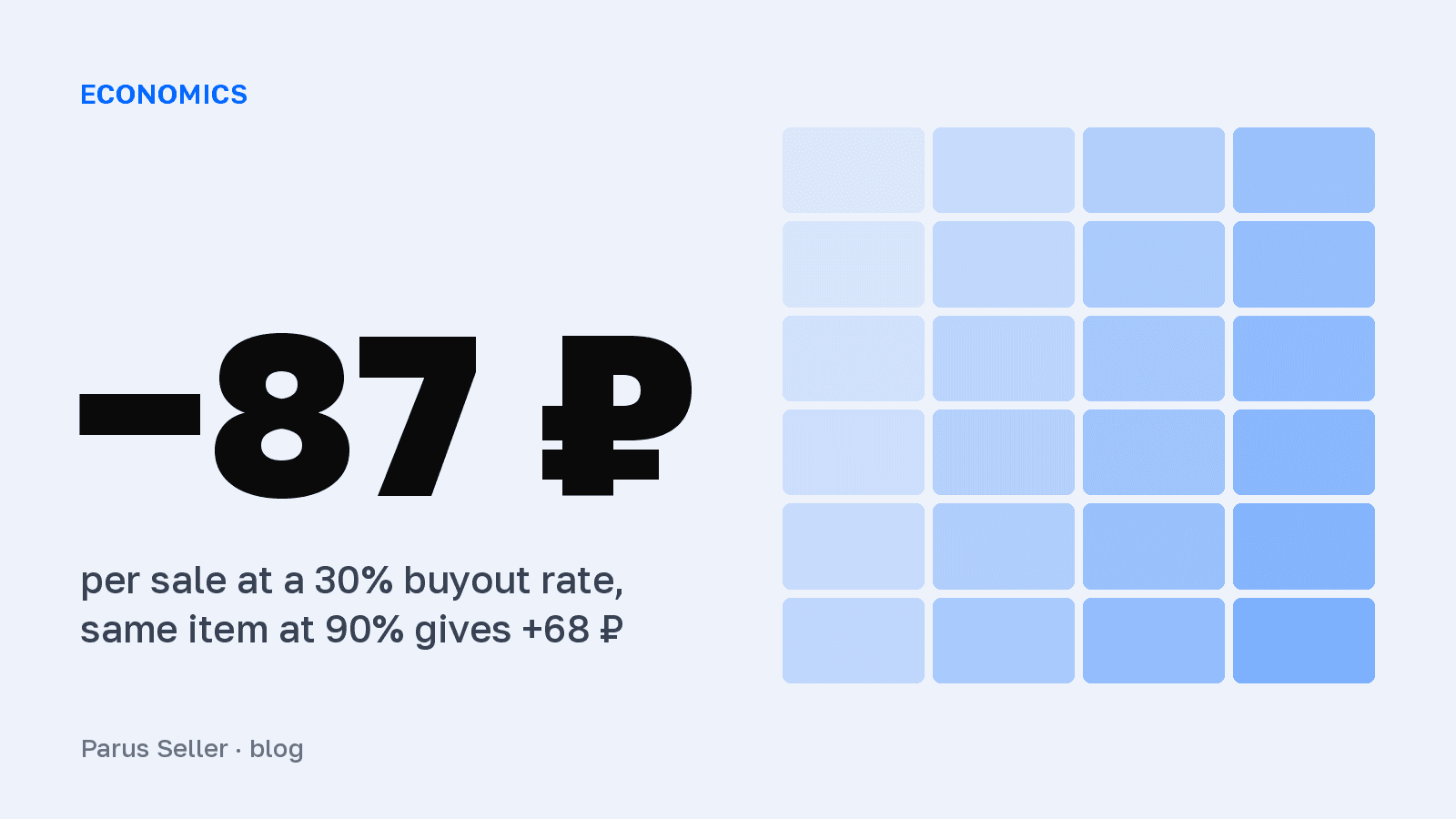
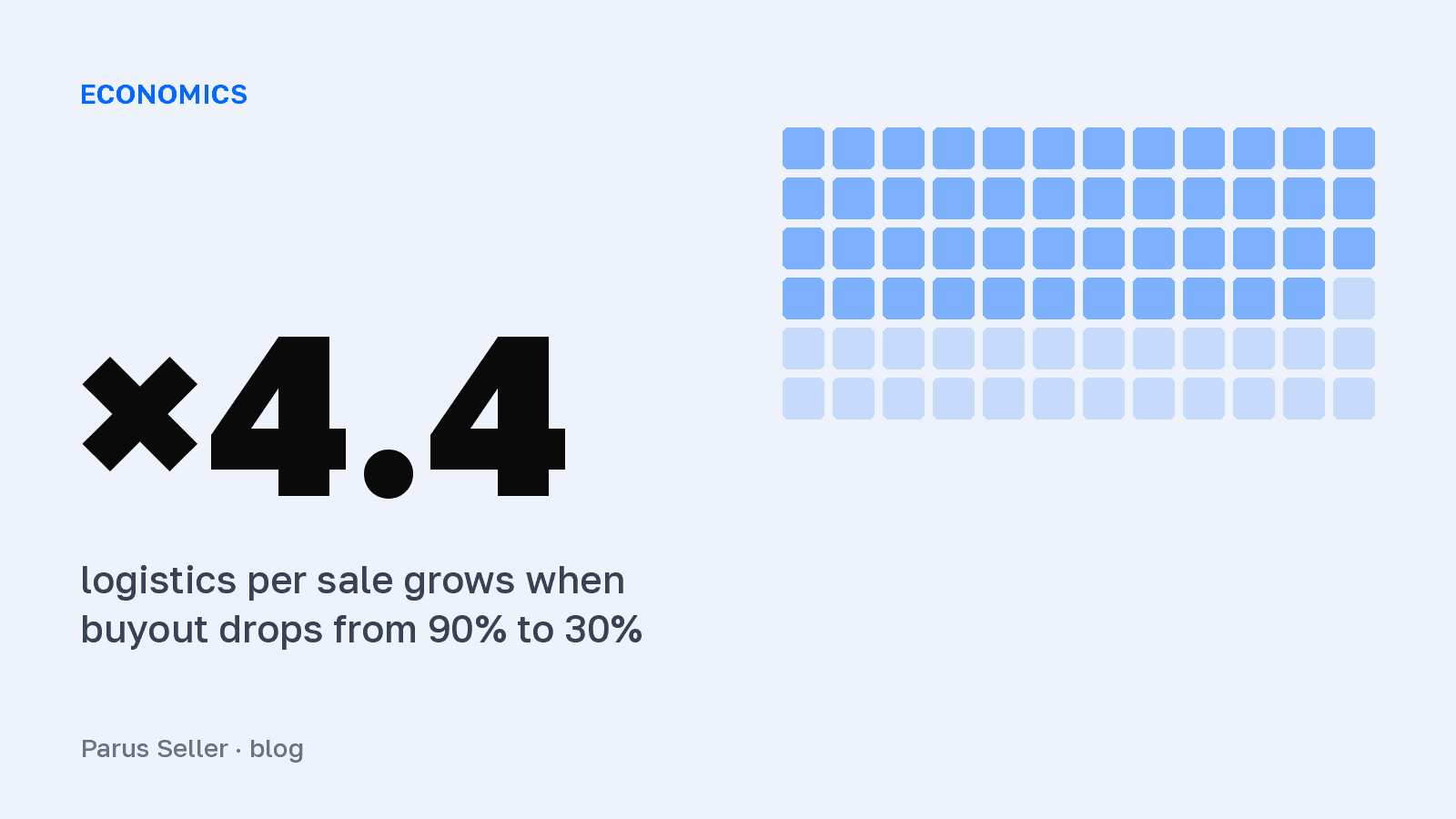
At a buyout rate of 90% one sale costs 58 ₽ of logistics, at 70% it is 82.9 ₽, at 50% 127.6 ₽, and at 30% 232 ₽. Between a category with a 90% buyout rate and clothing at 30% the gap is fourfold on one and the same rate. How to lift the buyout rate and what it does to the economics we covered in the article on the buyout rate.
What the warehouse coefficient is and what reports show after 15 August
The warehouse delivery coefficient is the multiplier WB uses to manage load: 150–200% at a crowded warehouse, 100% or less at an empty one. Its value is visible before you create a supply under "Warehouse rates", in the calendar at the date step and on the page of a supply already created. The main property of the coefficient, which not one article in the top of the search results mentions, is the lock. When a supply is created, the delivery and storage rate is fixed to it for 60 or 90 days depending on the category. In the line-item detail of the report every logistics row carries the start and the end date of that lock.
We took the line-item detail of two weekly reports from a home textiles store, which we will call Versta Dom, for the week before the flat rate and the week after it. In the week of 10 to 16 August, 39% of the logistics rows out to the customer went at a coefficient of 1.95, another 31% at 1.0 and 29% at 1.5. In the week of 24 to 30 August the picture shifted. Now 61% of the rows go at 1.5, 18% at 1.0, and 6–7% each at 1.95 and 2.2. Rows at a coefficient of 1.7 do not exist at all. The median delivery of one unit for items of 0.16–0.28 litres fell from 55.4 to 49 ₽.
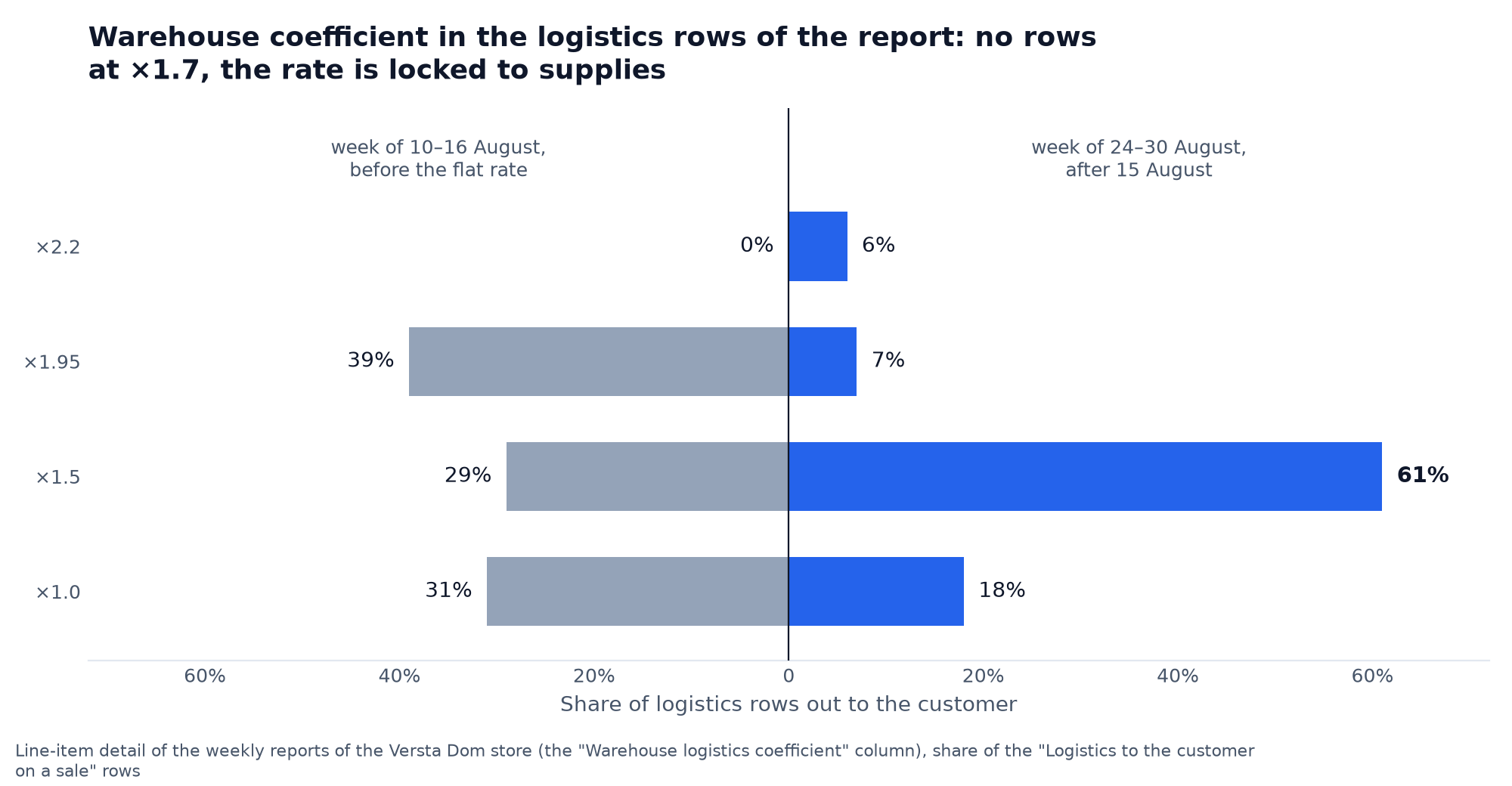
The explanation is simple. Goods that sold in late August arrived at the warehouse in June and July with the coefficient locked back then, and the 170% does not touch them until the lock ends. For supplies created in July that is mid-November. So logistics at the flat rate can be counted right now only for goods from fresh supplies. For the rest of the stock the real price shows up in the line-item detail of the report and nowhere else. That is exactly why today we moved the logistics calculation in pseller from the rate formula to the fact from the detail. The service takes the average delivery to the customer for each vendor code over the last four weeks, and keeps the 170% formula as a fallback for items with no sales.
The formula itself matches to the kopeck. A 0.16 litre item on a 23 ₽ base stands at 34.5 ₽ in the report at a coefficient of 1.5 and no index. The same 23 ₽, multiplied by 1.5 and by a localisation index of 1.07, give 36.9 ₽, and exactly that sum sits in the rows of the older supplies. You can check your own store the same way: in the line-item detail of the weekly report you need the columns with the warehouse logistics coefficient and the rate lock dates.
The Wildberries localisation index: how it works and who still needs it
The localisation index is a coefficient that shows how close to your customers your stock sits across the warehouses. Under the instruction dated 27 August 2026 it is still calculated only for supplies created and planned before 15 August, and does not apply to the rest. Since the rate lock lasts 60 or 90 days, the old supplies with the index will keep selling down until November, and until then it is worth understanding.
The index is worked out in three steps. First, for every vendor code the localisation share is found: the percentage of orders where the shipping warehouse and the collection point lie in the same federal district or joint zone. Koledino and a pickup point in Moscow is a local order, Koledino and Ufa is not. Then the share is matched to a territorial distribution coefficient from the table under "Warehouse rates". Finally the index is the average distribution coefficient across all orders over 13 weeks, weighted by the number of orders. It is recalculated once a week, overnight from Sunday to Monday, Moscow time.
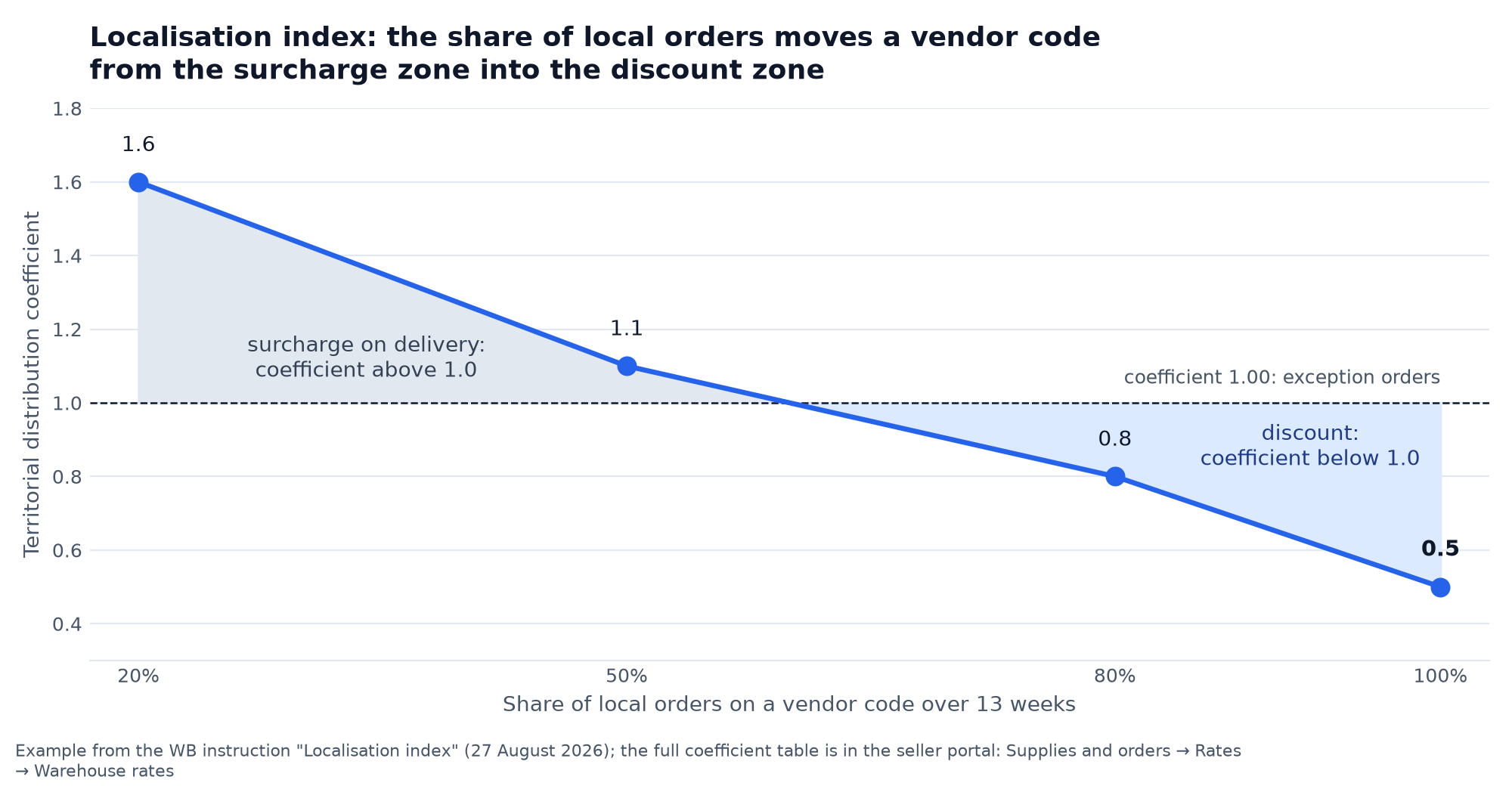
In the example from the instruction a vendor code with a localisation share of 20% gets a distribution coefficient of 1.6, at 50% it is 1.1, at 80% it is 0.8 and at 100% it is 0.5. Exception orders go at 1.00: oversized and extra-oversized goods, large household appliances, mono-pallet and supersafe positions, goods with special storage conditions and FBS orders. If more than 35% of the orders on a vendor code are exceptions, the whole vendor code counts as an exception.
An index below one gives a discount on delivery, above one a surcharge. The detail of the calculation for any date in the last two years can be exported to Excel from the "Localisation index" widget.
What storage and a return of goods to the seller cost
Storage at a WB warehouse is charged under the instruction dated 3 September at 0.08 ₽ per litre per day, multiplied by the warehouse storage coefficient. A mono-pallet costs 25 ₽ a day per pallet at the same coefficient. At a coefficient of 150% a litre works out at 0.12 ₽ a day, at the flat 170% it is 0.136 ₽. The rate is locked together with delivery for 60 or 90 days, and once the lock ends, separate rates on the remaining stock kick in.
WB works out the exact sum after acceptance, from the actual dimensions. You can see it in the "Paid storage" report, in the line-item detail of the weekly report under the "Storage" reason, and in the balance widget on the main page. On FBS there is one paid exception: an extra-oversized item brought in before the shipping date is stored at 1 ₽ per litre per day, with a floor of 100 ₽.
A return of goods from the warehouse to the seller is charged differently from the return logistics of a refusal. On top of the base rate for volume multiplied by the warehouse coefficient comes a fixed part: 155 ₽ for delivery to your pickup point, 255 ₽ for delivery to an address, 1,000 ₽ for an extra-oversized item. The instruction gives an example on 2.7 litres at a coefficient of 110%: 69.8 ₽ × 1.1 + 155 = 231.78 ₽. Goods the warehouse cannot identify go back at 255 ₽ per unit with no coefficients at all.
An FBS return to a pickup point got cheaper on 7 August, down to 25 ₽ for the first litre and 4 ₽ for an extra one. An uncollected return is kept at the pickup point for 7 days, the first 3 free, then 10 ₽ per unit per day. On the eighth day it leaves for the warehouse, where disposal under the WB instruction dated 22 July 2026 costs 38 ₽ per unit, while the return tariffs API on 7 September already returns 44 ₽ (the articles in the top of the search results still hold on to the old 33 ₽).
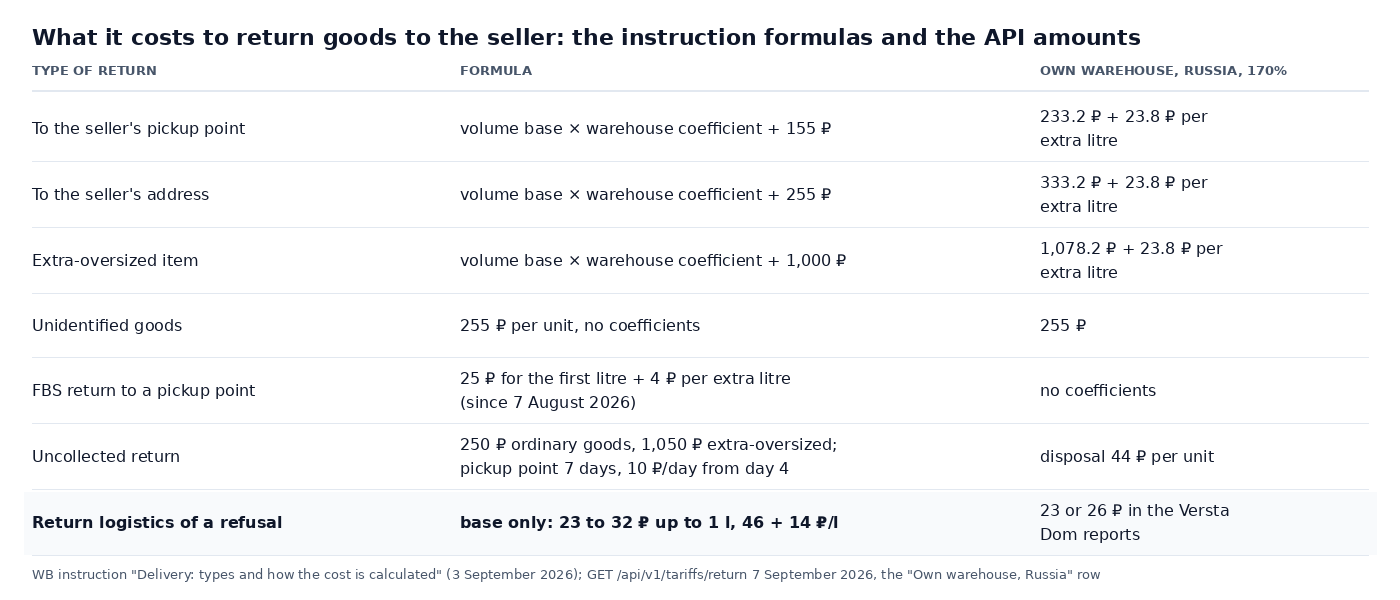
The live rates from the API add figures to the instruction. For the "Own warehouse, Russia" row a return to the seller's pickup point costs 233.2 ₽ for the first litre and 23.8 ₽ for an extra one, to an address 333.2 ₽. An uncollected return costs 250 ₽ per unit for an ordinary item and 1,050 ₽ for an extra-oversized one. The first two numbers add up from a base of 46 ₽ × 170% and the fixed part, so the formula from the instruction and the API response describe one and the same thing.
Wildberries logistics cost on FBS: how it is calculated
On FBS the item travels to the customer on the same base for volume with the warehouse delivery coefficient. At the flat 170% that is 78.2 ₽ for the first litre and 23.8 ₽ for every extra one. In the box rate method the "Own warehouse, Russia" row returns a dash, so these figures are visible only through the return rates: 233.2 ₽ for the first litre to the seller's pickup point is 78.2 ₽ plus the fixed 155 ₽. The localisation index does not apply to FBS orders, they go at a distribution coefficient of 1.00. The trip back for a refused order to your pickup point has cost 25 ₽ for the first litre and 4 ₽ for an extra one since 7 August, with no coefficients, and for a small item that is cheaper than a return to a WB warehouse. Paid storage on FBS is one thing only: an extra-oversized item brought in before the shipping date, 1 ₽ per litre per day, with a floor of 100 ₽.
How to cut your Wildberries logistics cost: four levers
The first lever is the volume in the product card. The base is counted from the dimensions of the packaging, and an error of 1 cm on each side moves the item from the 26 ₽ step into the 29 ₽ step or adds a litre to the linear part. We advise checking the dimensions in the card against the fact at the warehouse, because WB measures the item on acceptance and charges storage on its own figures.
The second lever is the buyout rate. At a coefficient of 170% every refused order on a 0.5 litre item costs 78.3 ₽ of two trips. Cutting refusals from 30 to 20% saves more than 25,000 ₽ of logistics per 1,000 sales. The third lever is the choice of warehouse and supply date: the coefficient is locked for 60–90 days, and a supply on a day with a low coefficient feeds the economics for the whole quarter. While the Russian warehouses are folded into a flat 170%, this lever works for the CIS only. There, by the API on 7 September, the coefficients run from 100% in Tashkent to 200% in Veliky Kamen. The fourth lever is the model: on FBS the trip back to your pickup point costs 25 ₽ plus 4 ₽ per litre, which for a small item is cheaper than a return to a WB warehouse.
In pseller the logistics for each vendor code comes from the line-item detail of the reports and not from the rate, and together with the commission, storage and deductions it lands in the unit economics of the card. Connecting by API token takes two minutes.
FAQ
How is the Wildberries logistics cost calculated? The base for the volume (23–32 ₽ steps under a litre or 46 ₽ + 14 ₽ for each litre above the first) is multiplied by the warehouse delivery coefficient, 170% for Russian warehouses. The return trip of a refusal is charged at the base without the coefficient. Logistics per sale = delivery + (delivery + return) × (1 − buyout rate) / buyout rate; a 6 L box at 170% and a 90% buyout rate costs 232 ₽ per sale.
Where can I see the Wildberries logistics cost for my own item? Before a supply, under "Supplies and orders", "Rates", "Warehouse rates" on the "Inbound supply rates" tab: it shows the price of the first and the extra litre with the warehouse coefficient already applied. After a sale the exact sum sits in the line-item detail of the weekly report in the "Logistics" rows.
What is the Wildberries localisation index in plain terms? A multiplier on delivery that shows how close your goods sit to your customers. Local orders inside one federal district push it below one, distant ones lift it. Since 15 August 2026 it applies only to supplies created before that date.
How much does return logistics on Wildberries cost? The same as the base rate for volume with no coefficients: 23–32 ₽ for an item under a litre, 46 ₽ for the first litre and 14 ₽ for an extra one above a litre. A customer refusal costs the seller two trips, out on the full formula and back on the base.
Why is there no 170% coefficient in the report if the rate is flat? Because the rate is locked when the supply is created, for 60 or 90 days. Goods from July supplies sell down at July coefficients until November, and only new supplies go at 170%.