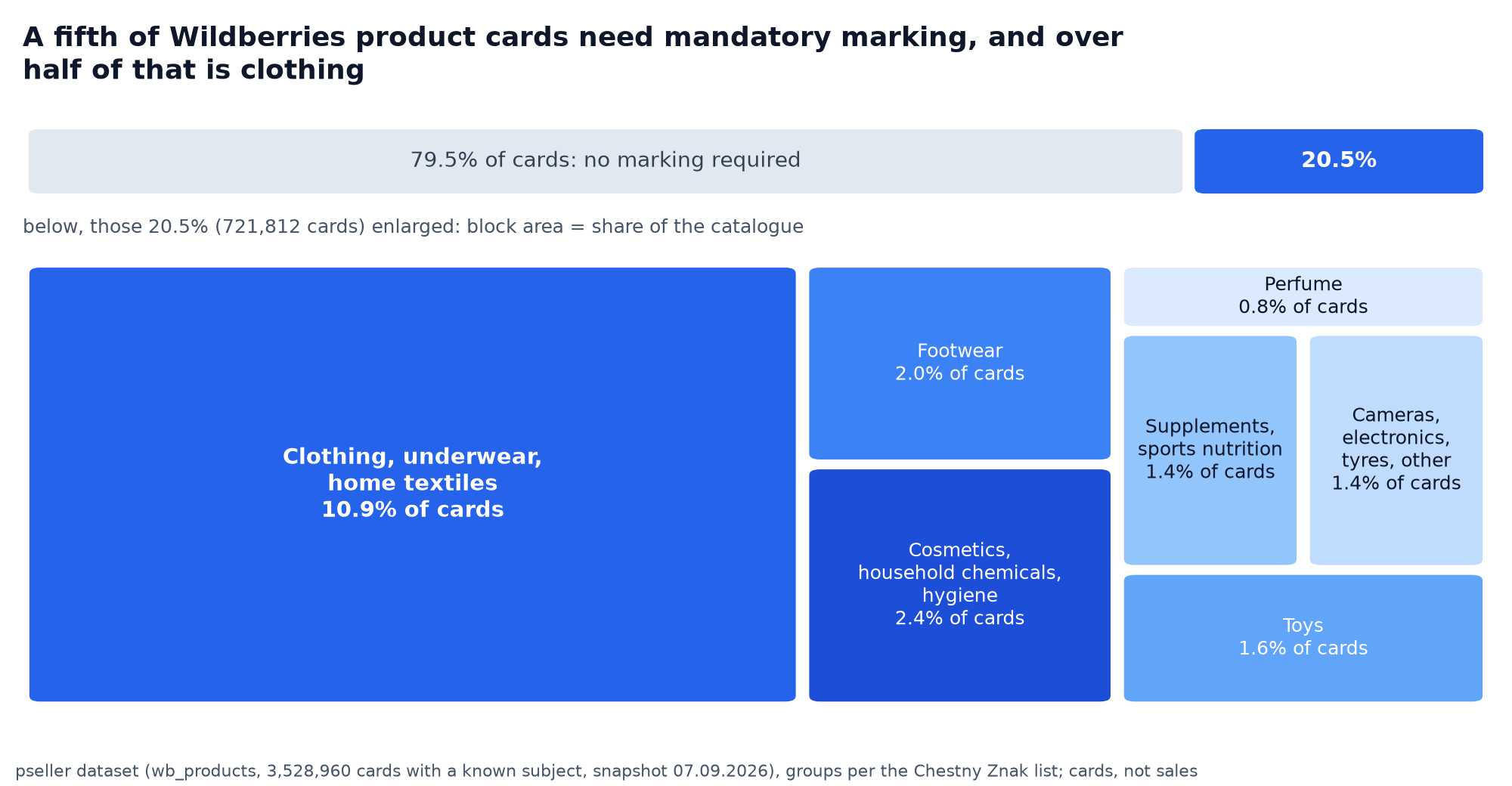
Chestny Znak, the Russian product marking system, puts a Data Matrix code on the item. Wildberries checks that code at inbound supply, and the state tracks the item from the factory to the customer. In our dataset of 3.53 million product cards with a known subject, 721,812 fall under mandatory marking, which is 20.5%. More than half of them are clothing and underwear.
We read eight WB instructions updated between May and September 2026, the Chestny Znak auto-penalty page and the text of the Code of Administrative Offences after law 120-FZ. Below they are gathered in one place, and every mistake has a price on it.
In short: at a WB warehouse the marketplace retires the code itself, but only if you handed the codes over in a UPD "DOP" after the acceptance report. On FBS, DBS and Click and Collect you retire the code yourself within 3 working days of the sale, the day of the sale included. A forgotten code in an FBS assembly task means a paid return to a pickup point, 10 ₽ a day from the fourth day and disposal on the eighth. The state fine for selling unmarked goods runs to 50,000–300,000 ₽ for a company with the goods confiscated, reporting late costs 50,000–100,000 ₽, and auto-penalties started on 1 September 2026.
Which goods on Wildberries need Chestny Znak: one card in five
The official Chestny Znak list as of September 2026 covers more than forty product groups, but ten of them matter to a marketplace seller. We mapped WB subjects to CRPT groups by parent category and subject name and counted the cards in our dataset snapshot as of 7 September.
Light-industry goods, that is clothing, underwear, headwear, workwear and home textiles, give 385,341 cards, or 10.9% of the catalogue with a known subject. Cosmetics, household chemicals and hygiene add 84,699 cards, footwear 71,723, children's toys 57,796, dietary supplements with antiseptics 34,227, perfume and eau de toilette 26,623. Then come cameras, consumer electronics, sports nutrition, tyres, bicycles, pet food and marked food products. That is 721,812 cards in total, one in five on the platform.
Three caveats, without which the number misleads. The dataset counts cards, not sales, and clothing weighs more in it than it does in the platform's revenue. One HS code can cover goods that need marking and goods that do not. WB writes plainly that in such cases it is the seller who has to watch whether a code is needed, and gives L-carnitine as the example. Finally, testers of 3 ml and under need no marking, but the card has to use the subject "Perfume testers", otherwise the system will keep waiting for a code.
The answer to "does costume jewellery need Chestny Znak" is short: no. Costume jewellery is not on the list, unlike fine jewellery with its own separate system.
You can check a specific product two ways. In the WB seller portal, while you fill in the card, the system shows whether the subject falls under mandatory marking by HS code and OKPD2, and the Chestny Znak site has a lookup by product code. Do not rely on what other people's articles remember: two pages in the top of search for this query quote dates that contradict the official calendar and each other.
What a marking code (KIZ) is and where it goes on the item
A KIZ, or identification code, is that black and white Data Matrix square on the label. Inside it are the GTIN product code, the serial number of the unit, a verification key and a crypto tail, and between the blocks sit hidden characters called GS separators. It differs from a WB barcode in principle: a barcode stands for a model and a size, a KIZ stands for one specific unit. No two codes are alike, and the system will not let you sell an item a second time on a code that has already been retired.
Codes are ordered in the GIS MT account, the state marking system, after you register with a qualified electronic signature and describe the product in the National Catalogue. Marking services quote 50 kopecks for issuing one code, but that figure never appeared on the CRPT pages we scraped, so treat it as a guide rather than a rule. The code is then printed on the label, applied to the item and put into circulation. Only after that does it get the status "In circulation", the one WB agrees to accept.
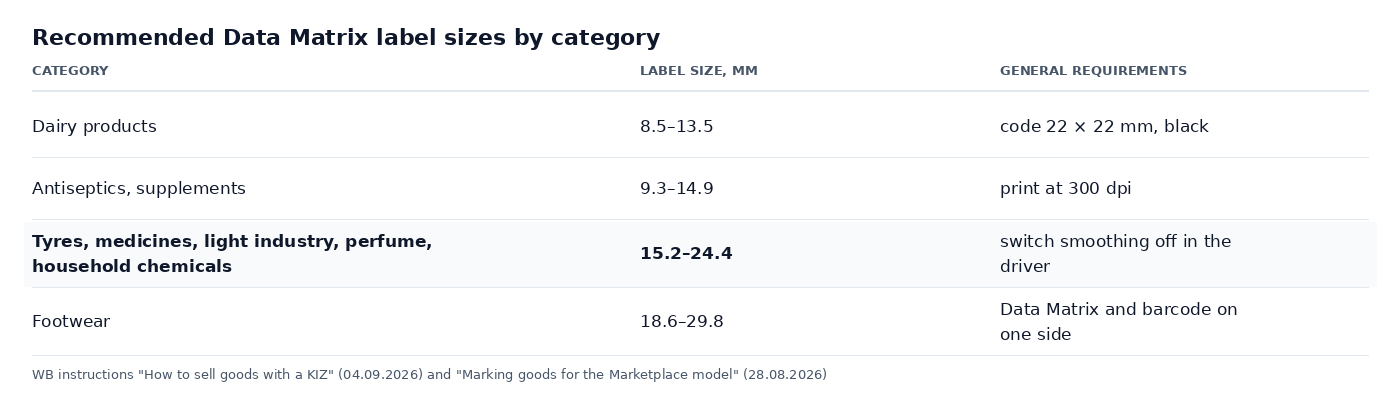
The WB instruction "Marking goods for the Marketplace model" dated 28 August 2026 sets the rules for applying it. The recommended Data Matrix size is 22 × 22 mm, black, printed at 300 dpi, and smoothing has to be switched off in the printer driver. The code goes in a visible spot on the inner layer of the individual packaging, and if it cannot be read through the outer layer, it is duplicated outside. Only one barcode may be visible on the item, and it must not be stuck next to the order label. WB recommends label sizes by category, and they differ noticeably.
Readability with a phone camera guarantees nothing. WB warns separately that an industrial scanner at the warehouse can fail on a code your phone reads without trouble, and advises 2D code verifiers. They give the code a quality grade from 0 to 4, and the standard allows only grade 2 and above. For a store shipping a few thousand units a month, a verifier pays for itself the first time a supply is not turned away.
Who retires the code from circulation: WB warehouse, FBS and DBS
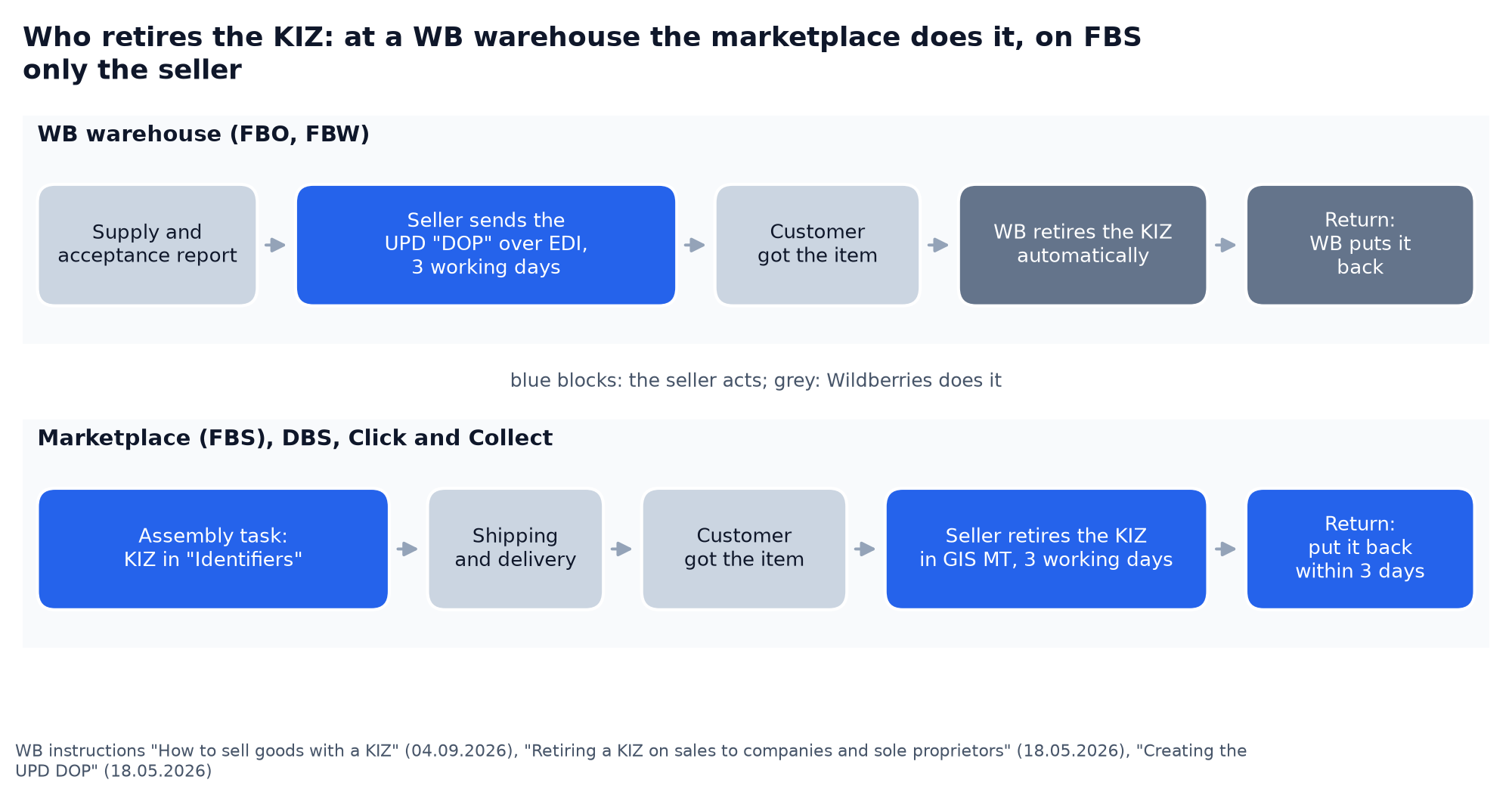
This is where the main line between the models runs. At a WB warehouse, that is on FBO, the marketplace retires the code itself. The instruction "How to sell goods with a KIZ" dated 4 September 2026 puts it with no reservations. Once the customer has received the item, the code moves automatically to the status "Retired from circulation". On a return the code is scanned and put back into circulation, and the seller does nothing. There is one condition: the codes must have been handed to Wildberries in a UPD "DOP". If the document was never sent, or the codes in it do not match the goods, WB cannot retire them, and the responsibility stays with the seller.
On FBS, DBS and Click and Collect it works the other way round. The seller retires the code in Chestny Znak within 3 working days of the sale, the date of the sale included. On a return the same seller puts the code back inside the same 3 working days. The instruction for sales to businesses dated 18 May 2026 adds a detail people rarely notice. If a returned item is not put back into circulation in time, its code will still read "Retired from circulation" when you pack the next order. The warehouse will treat that item as unidentified and send it back to your pickup point.
There is a third scenario few people know about: a sale to a company or a sole proprietor. Such an order carries a "legal entity" icon in the assembly tasks, and a column "Sale to a legal entity" appears in the export and in the report. On FBW Wildberries draws up the UPD to retire the codes itself when they cannot be handed to the buyer. On FBS the seller retires the code with turnover type "Sale" and operation "Use for the buyer's own needs". In orders placed before 26 February 2025 this flag always reads "no", even when a business was buying.
How to hand the codes over: UPD "DOP" for the WB warehouse, assembly task for FBS
For a supply to a WB warehouse the codes travel as a document. Under the instruction dated 18 May 2026, within a day of the acceptance report a draft "Marking UPD" in XML appears in the "Documents" section, numbered the same as the report. You send it through your own EDI operator. The recommended deadline is 3 working days from the date of the report. If you miss it, WB keeps waiting for the document, but no longer than 3 months.
The buyer's details in the UPD are RVB LLC, tax ID 9714053621: the rights under the offer agreement passed to it from Wildberries LLC on 5 August 2024, and the old details are invalid. Since 1 April 2025 the exchange format has been set by Federal Tax Service order No. ED-7-26/970@. Mono-pallets have an instruction of their own: one pallet may carry up to three barcodes and exactly one aggregated code, and that code cannot be duplicated across several pallets.
WB does have a deduction for codes never handed over, but it lives in the penalty schedule to the offer agreement dated 14 August 2026, clause 5, not in the instruction: 1 ₽ for every unit of markable goods whose code was not passed to Wildberries in the UPD. The sum is symbolic, and the real consequence is a different one. Without the document the marketplace will not retire your codes, and from there it turns into a state risk under article 15.12.1 of the Code of Administrative Offences. Since 4 September 2026 there is a physical limit too: goods with a marking code cannot be dropped off at goods reception points, only at a pickup point or the warehouse.
For FBS the code goes into every assembly task at the "In assembly" stage through the "Identifiers" button. Three ways: by hand, with an XLSX template or with a scanner in the picking list. WB recommends the scanner outright. The code is long, and copying it out of Excel or the UPD loses the GS separators, so the check fails.
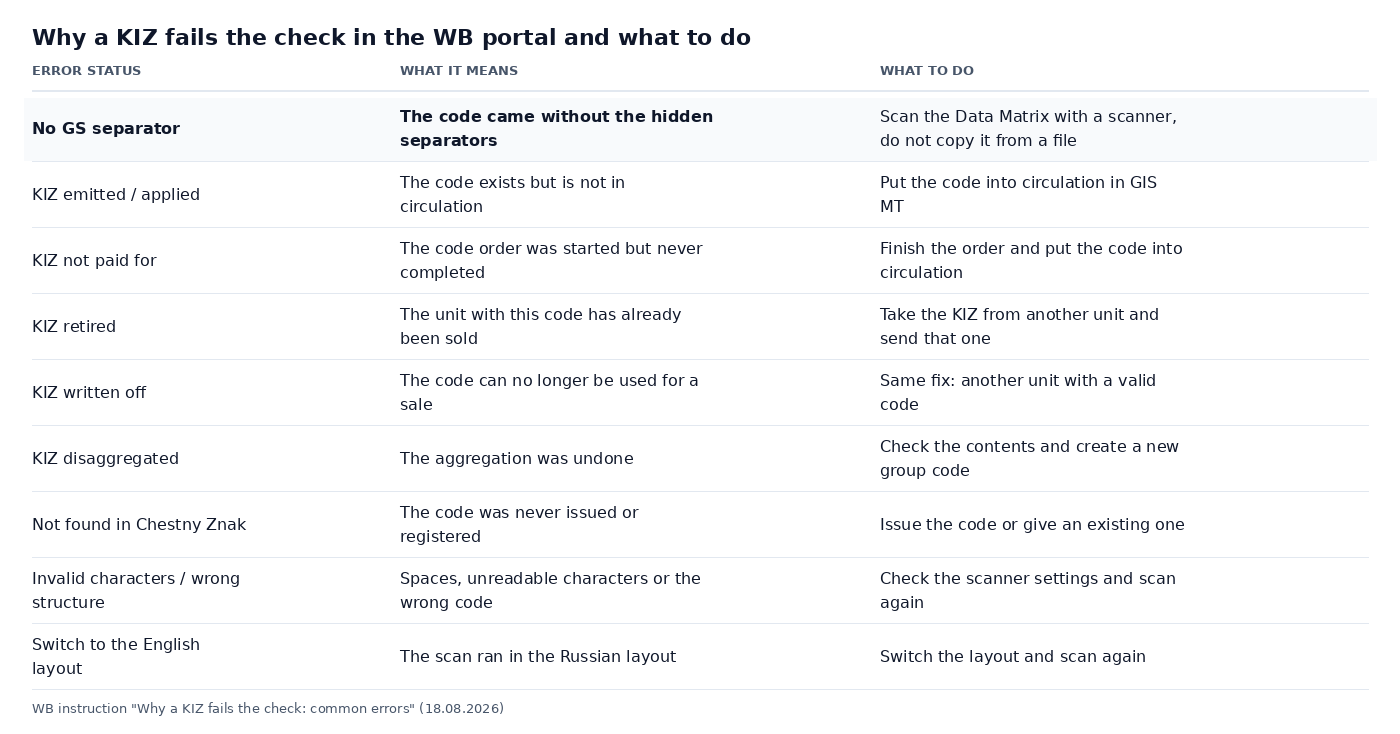
There are four check statuses: "Being checked", "Checked", "Error" and "Not checked". You can still ship a supply on the last one, but if the error is confirmed, the goods will fail acceptance and come back. The instruction about errors dated 18 August 2026 gives the full dictionary of statuses, and most of them are cured by a single action.
A separate trade-off concerns the length of the code. WB accepts a KIZ without the crypto tail, but warns that on a refused order or a return for defects such an item will not go back on sale, it will go back to the seller. A full code with the crypto tail and the separators passes the check more reliably, and a second sale on it is possible. The portal has a "Test scanner" button, and the test neither sends the code to the national service nor spoils its status.
What happens if you forget the code: return to a pickup point, disposal and fines
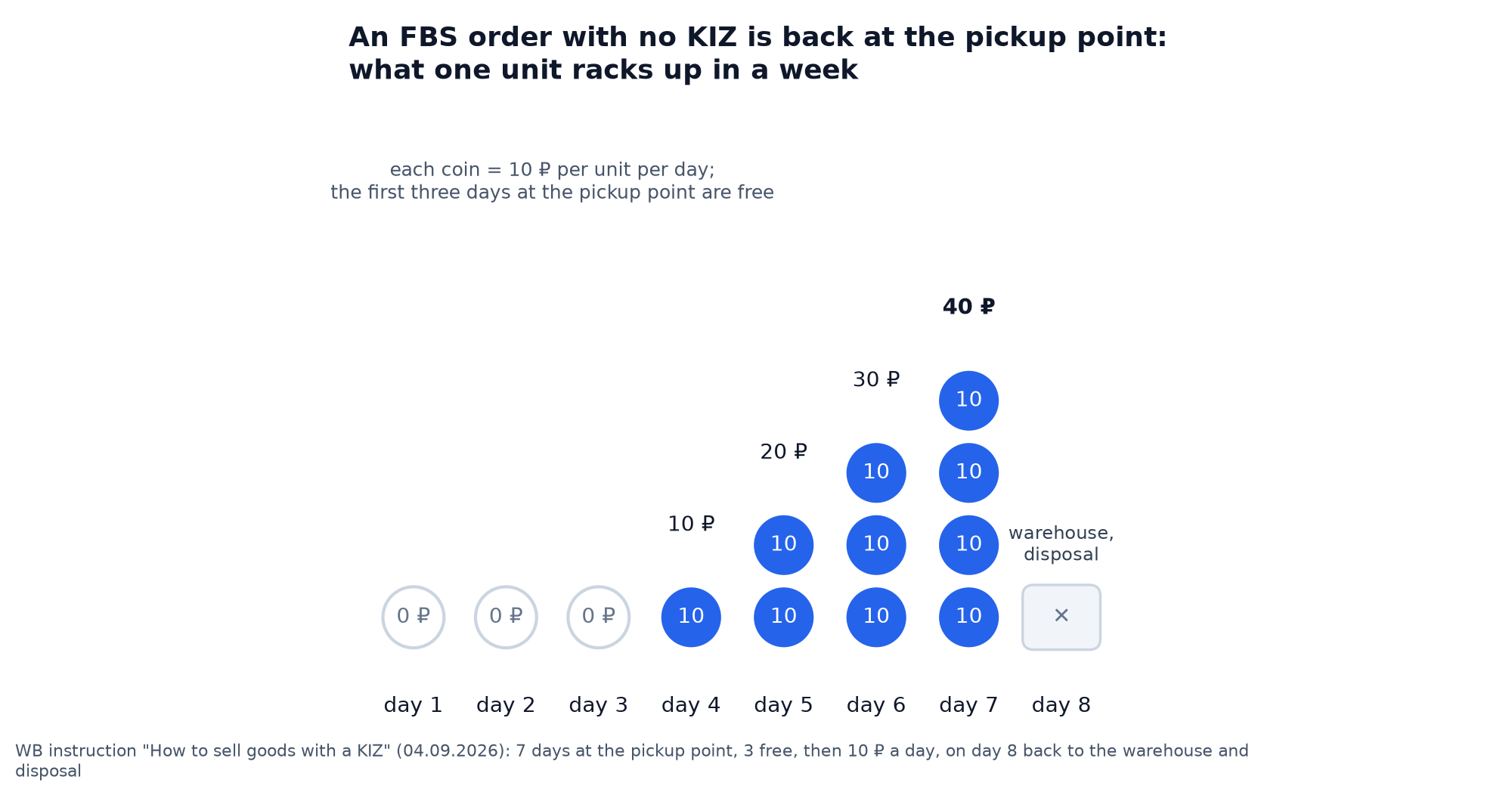
The first consequence comes not from the state but from Wildberries. The instruction on packing FBS orders dated 27 August 2026 describes the whole scenario. The code was not entered at packing, auto-return is switched off, the customer refused the order: the goods go back to the pickup point you chose, not to the warehouse, and that return is paid. Then the meter starts. Goods sit at the pickup point for 7 days, the first 3 free, then 10 ₽ a day per unit, and on the eighth day they go back to the warehouse and are disposed of. For a batch of 200 units forgotten for a week that is 8,000 ₽ of storage on top of the return logistics, and on the eighth day the goods are gone for good.
The second level is WB's own deduction for marking that is missing or unreadable at the warehouse. You see it in the "Product marking" report in the analytics section and through the API: the goods-labeling method returns the date, the vendor code, the amount deducted and a photo of the item from the warehouse. We checked the method with a live call on a store token on 7 September, and the answer comes back as a report structure, empty for a store with no markable goods. In the weekly report such a deduction sits on a line of its own, and matching it against the week's sales is easier somewhere other than Excel.
The third level is the state, and here search results mix up two different offences. Selling, storing or transporting unmarked goods is part 2 of article 15.12 of the Code of Administrative Offences. Individuals pay 2,000–4,000 ₽, officials and sole proprietors 5,000–10,000 ₽, companies 50,000–300,000 ₽, and in every case the goods are confiscated. A code not retired in time is a different offence, article 15.12.1 on failing to report to GIS MT. After law 120-FZ of 2 May 2026 it reads like this: a warning or a fine of 1,000–10,000 ₽ for officials and 50,000–100,000 ₽ for companies.
CRPT singles out small business on its own penalties page: 25,000–50,000 ₽ for a small company. The rule about tripling the fine for a repeat offence, which two articles from the top of search keep repeating, is not in the code at all.
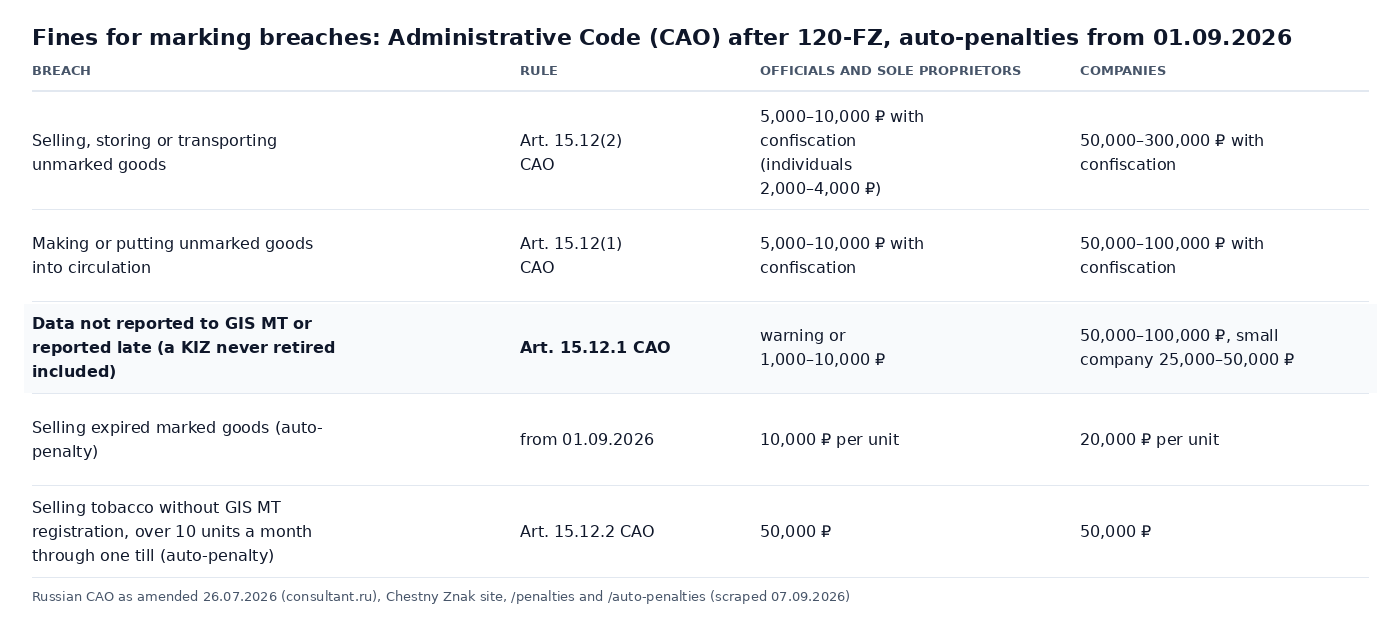
Auto-penalties started on 1 September 2026, and this is another place where the top of search is half a year out. The mechanism covers four offences, and two of them touch a marketplace seller. The first: selling tobacco and nicotine products without registering in GIS MT, if more than 10 units went through one till in a month. The second: selling expired marked goods, 10,000 ₽ per unit for a sole proprietor and 20,000 ₽ for a company. Two more offences are about tobacco and nicotine prices, selling above the maximum or below the minimum retail price, with a fine of 5,000, 50,000 or 500,000 ₽ depending on how many units went in a day. No auto-penalty arrives for a code you failed to retire, and that one still needs a human inspection. Rulings land in your Gosuslugi account and are duplicated in GIS MT.
What changes in 2026 and 2027: the calendar for a WB seller
The marking calendar lives on the Chestny Znak site and changes without warning, so we scraped the "Event list" tab on 7 September and kept only the dates that touch a marketplace assortment. The fourth wave of light industry started on 1 March 2026. From 1 July customs stopped releasing unmarked goods from that list, from 1 August selling unmarked stock is banned, and marking what is left has to be finished by 1 December.
Cosmetics and hygiene have been reporting retirement at retail since 1 July 2026, registration of participants became mandatory on 1 September, and household and sanitary goods are marked from 1 October. Consumer electronics, laptops and smartphones included, are marked by manufacturers and importers from 1 May 2026, and the ban on circulation without a code lands on 1 December.
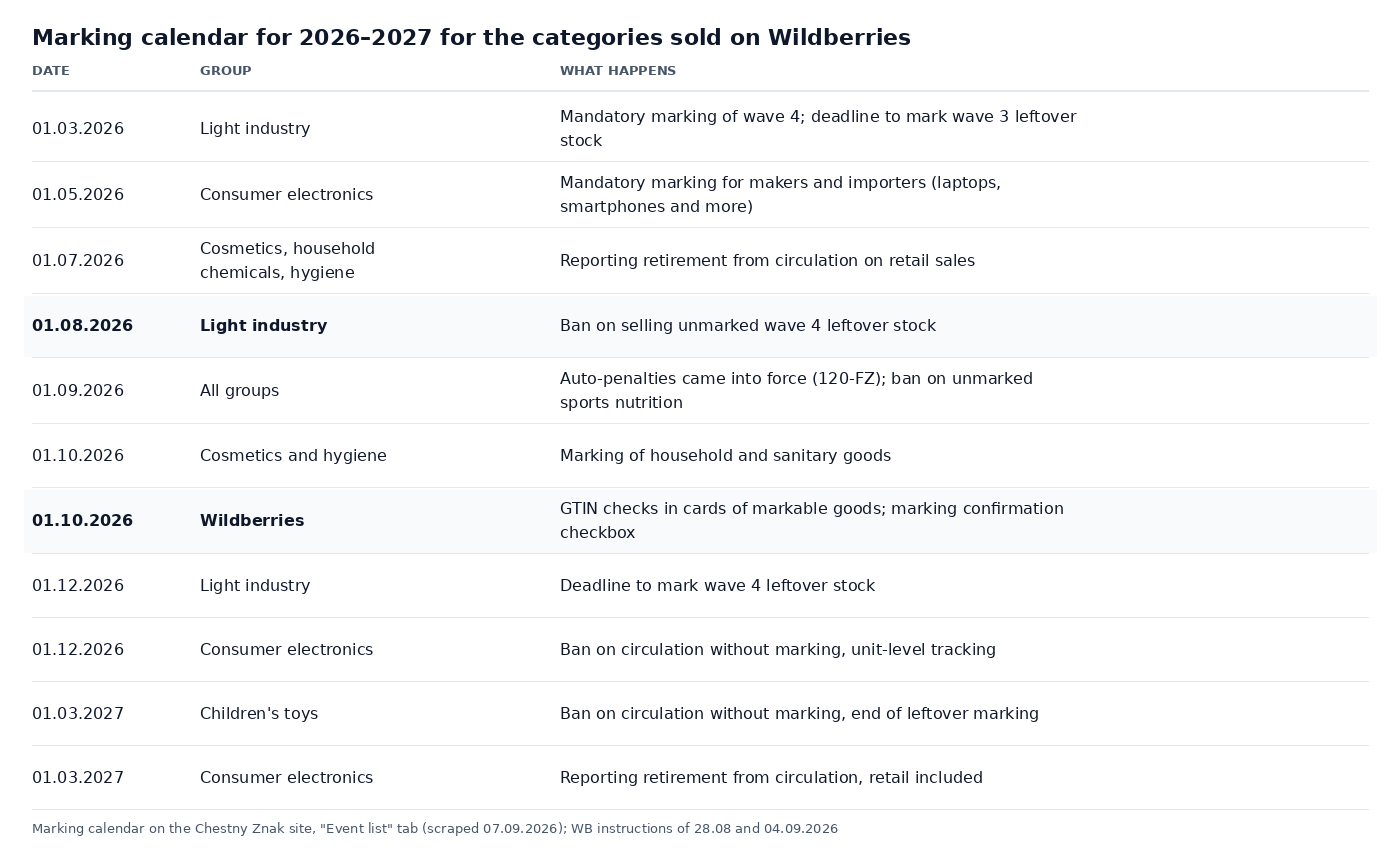
Two dates concern Wildberries itself. From 1 October the platform starts checking the GTIN in the cards of goods subject to mandatory marking for sellers from Russia, and blocks cards with no number or with an invalid one. The instruction does not name the year, but it was updated on 28 August 2026. The Platform Economy Law comes into force at the same time, and for it WB added a checkbox "I confirm the goods carry the required marking". A card without the tick will not be blocked, but over time goods like that will start being hidden from customers in Russia.
How to keep marking under control without Excel by hand
The tool that marking services sell for 25,000–50,000 ₽ a month does one thing at its core. It takes the codes of sold units out of WB and retires them in GIS MT before the three days run out. Half of that work Wildberries gives away free over the API. The code is set on the assembly task programmatically in all four models, and for FBS that is the sgtin field in the order metadata. The API tells you itself whether an order needs a code, because the field appears only on goods that need marking. The excise-report method returns operations with marked goods, where type 1 means retirement from circulation and type 2 means a return to sale. Its limit is hard, 10 requests per 5 hours. A live call on 7 September returned a response.data structure, empty for a store with no codes.
What the API does not have is Chestny Znak itself. Ordering codes and moving them into or out of circulation happen only in GIS MT or through an EDI operator, and that is a sensible boundary of responsibility. Hence the practical routine for an FBS store with markable goods. A scanner at packing. A daily export of sold codes over the API or from the "goods subject to mandatory marking" report in the analytics section. Retirement in GIS MT by the end of the next working day, not on the third day. And a check on WB deductions in the "Product marking" report.
Our service stays out of marking and retires no codes, but it closes the gap next door: reconciling the weekly report, where the marking deduction, the penalty and the return logistics out of the pickup point arrive as separate lines. Connecting takes two minutes with an API token that the store owner creates.
FAQ
Do you need Chestny Znak to sell on WB if you are self-employed? A self-employed seller does not count as a participant in the circulation of marked goods and cannot register in GIS MT, so the markable categories are closed to them on the marketplace. Clothing, footwear, cosmetics and toys need sole proprietor or company status.
How do you hand the codes over for a supply to a WB warehouse? Through a UPD "DOP": the XML draft appears in the "Documents" section within a day of the acceptance report, and you sign it and send it through an EDI operator. The recommended deadline is 3 working days, the hard limit 3 months. FBS does not need this document.
How do you retire a code from circulation on an FBS sale? In the GIS MT account or through an EDI service, with turnover type "Retail sale", within 3 working days of the sale, its own date included. On a return the code goes back into circulation inside the same window.
What do you do if a code fails the check in the WB portal? First scan the Data Matrix off the label with a scanner instead of copying the code out of a file. If the status "Error" repeats, read its name: "emitted" means the code was never put into circulation, "retired" means this unit has already been sold, "no GS separator" means the scanner is set up wrong.
What is the fine for selling without Chestny Znak on WB? Under part 2 of article 15.12 of the Code of Administrative Offences officials and sole proprietors pay 5,000–10,000 ₽ and companies 50,000–300,000 ₽, with the goods confiscated. For retiring a code late, article 15.12.1 threatens a company with 50,000–100,000 ₽, a small company with 25,000–50,000 ₽, and a sole proprietor with a warning or 1,000–10,000 ₽.