The query "how to sell on Wildberries" is typed 8,000 times a month, and half of those people want to resell their own things. This article is for the other half, for those about to come to Wildberries with their own product as a seller. We walked the path through four WB instructions updated at the end of August and the beginning of September 2026, and compared them with the bank guides at the top of search. Then we looked at 93,183 sellers from the popular-query slice of the catalogue to see what people actually start with.
In short: an LLC, a sole proprietor and a self-employed person can sell on Wildberries, a private individual with no status will not get an account. Registration goes by phone number and tax ID, WB calls the 5,000 ₽ payment a licence fee, returns the whole sum as advertising bonuses, and deletes the account if it is not paid within 14 days. The account is usually activated within a day. The first payout arrives two weeks after the first sale. Our data shows 36% of sellers in the popular slice run a single card, and the reviews go to stores with 11–50 cards.
Who can sell on Wildberries and what you need before registering
Legal entities, sole proprietors and self-employed people who are Russian tax residents can register on the WB Partners portal. That is what the WB instruction "Registering a new seller", updated on 1 September 2026, says. Private individuals with no status and Russian branches of foreign companies will not be given an account. A foreign legal entity from a country where WB operates registers by choosing its own country.
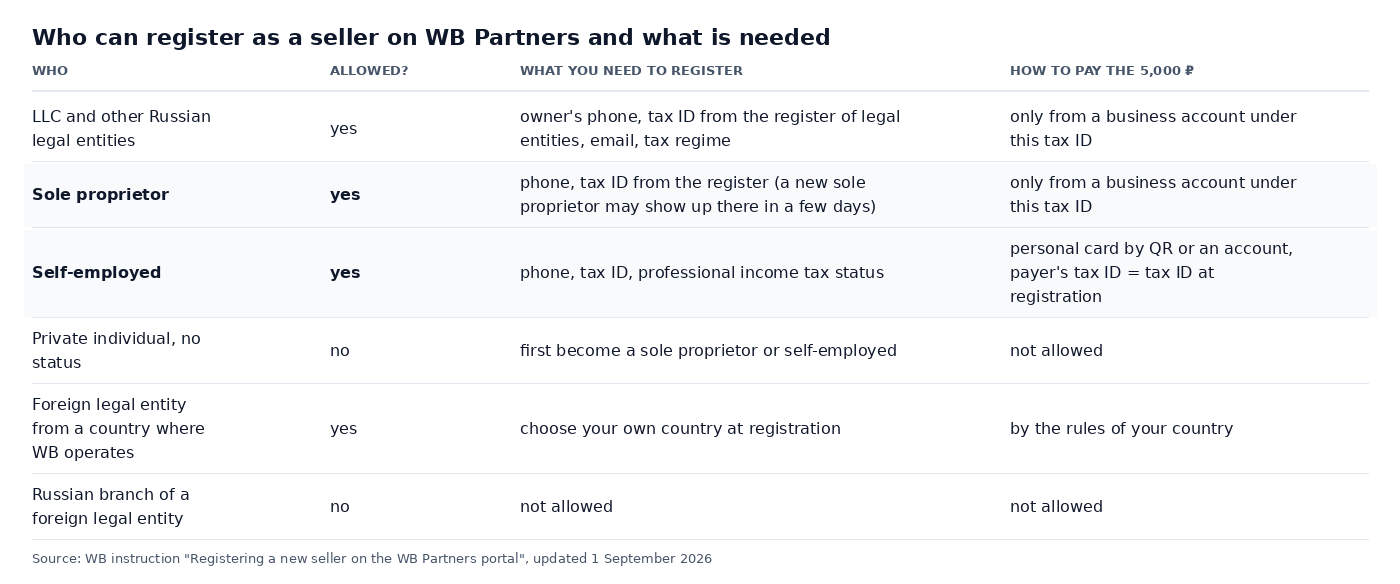
Three things are needed: the business owner's phone number, a tax ID and the account the payment will go from. The phone has to be the owner's, not a manager's, because the confirmation codes for every important action come to it. WB checks the tax ID against the Federal Tax Service registers, and a company registered a moment ago may not be in the state register of legal entities or of sole proprietors yet. The instruction advises waiting a few days rather than trying again every hour.
A self-employed seller has it easiest: they pay from a personal card by QR code, as long as the payer's tax ID matches the one used at registration. Sole proprietors and LLCs pay only from a business bank account opened under that tax ID. WB will not accept a transfer from the director's personal card or from another company's account, and the account will stay inactive.
Before registration WB asks for four things, and this is not a formality. Read the offer agreement, because it changes with 45 days' notice, and sometimes without it, which we took apart in the article on the WB offer agreement 2026. Settle on a product and check whether it needs Chestny Znak marking, a certificate or a declaration. Choose a sales model. And count what is left after commission, logistics and storage. For the last point we have a Wildberries calculator that counts by the marketplace's own formulas.
What it costs to start on Wildberries in 2026: the 5,000 ₽ licence fee
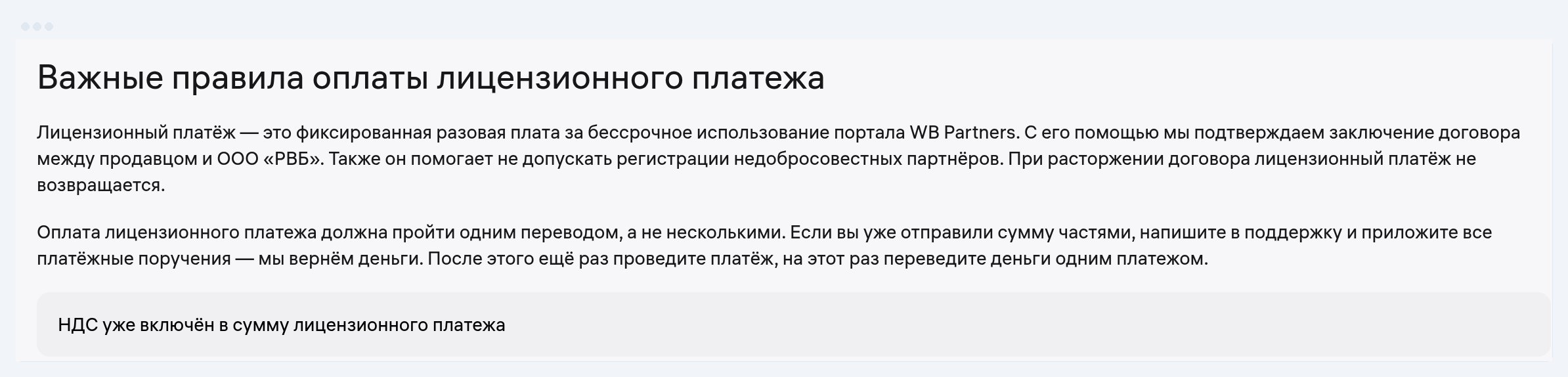
The only mandatory payment to the marketplace at the start is 5,000 ₽, and WB calls it a licence fee, not a guarantee deposit. It is a one-off payment for perpetual use of the portal, with VAT at 22% already inside the sum. WB credits the whole amount as promo bonuses to the "WB Promotion" advertising account, and they can be spent within a year. If the contract is terminated, the money is not returned.
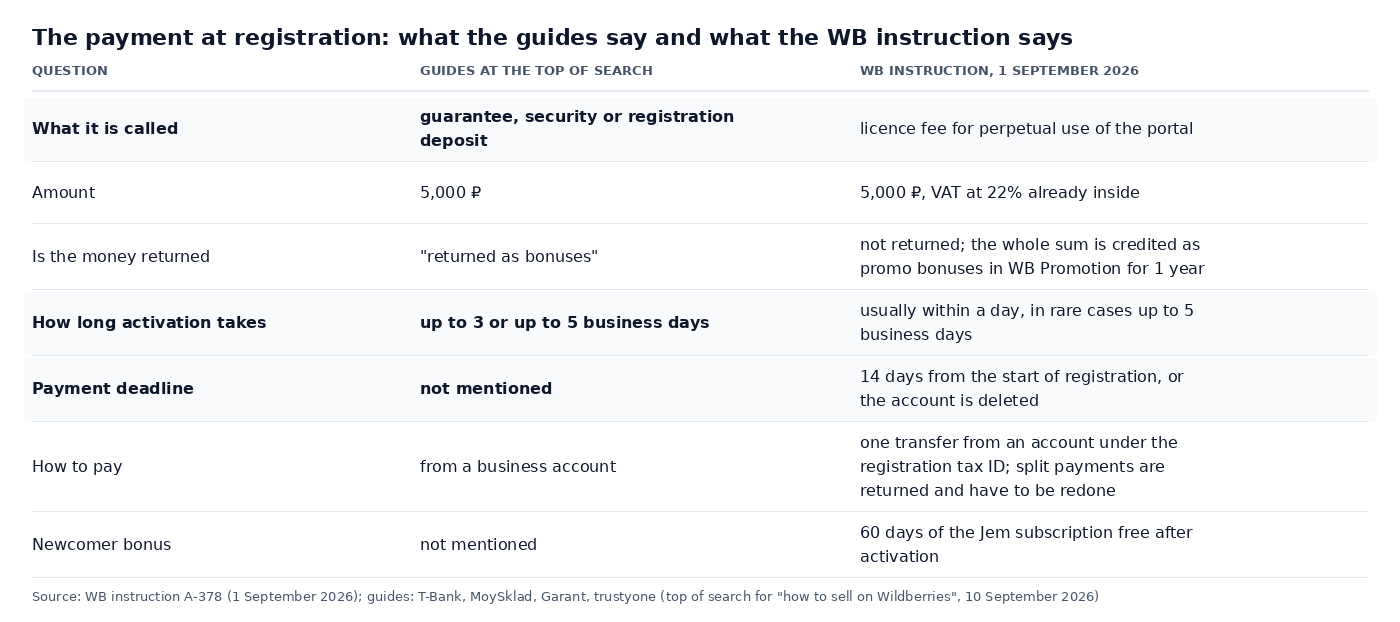
We read four guides from the top of search, from T-Bank, MoySklad, Garant and trustyone. All of them call the payment a guarantee or security deposit and promise account activation in three or five business days. The WB instruction says otherwise: activation usually takes a day, up to five business days only in rare cases. Not one of the guides mentions the deadline, and there is one. If the fee is not paid within 14 days of starting registration, the account is deleted and registration has to be done again.
Pay in a single transfer. If you send the sum in two payments, WB returns the money after a support request and asks you to transfer it again. Seven days after the money is credited, a UPD "DOP" transfer document confirming payment appears in the "Documents" section. Along with activation a newcomer gets 60 days of the Jem subscription free, which is access to the extended analytics you will later have to buy for 22,990 ₽ a month. What of it is free and needs no subscription we took apart in the article on free Wildberries analytics.
Five thousand roubles is the price of entry, not the price of a start. The marketplace does not pay for the first batch of goods, the packaging, the photography or the advertising. T-Bank puts the minimum start budget at 80,000–100,000 ₽ and a comfortable one at 300,000–500,000 ₽. We would not argue with the order of magnitude, but we would add that the budget depends on the category more than on the marketplace, and below we show on data where the one-card sellers start.
How to register as a Wildberries seller: 12 steps from the WB instruction
Registration takes about fifteen minutes if the phone, the tax ID and the email are to hand, and the payment goes separately. The path starts on wildberries.ru through the "For business" → "Become a seller" menu, or straight on the WB Partners portal. Then step by step, per the instruction dated 1 September 2026.
- Enter the business owner's phone number and the code from the SMS.
- Press "Go to registration" and choose the country where the business is registered.
- Choose the form: legal entity, sole proprietor or self-employed.
- Enter the tax ID, WB will check it against the state registers.
- Check the company details and press "Continue".
- Enter the email and confirm it with a code, it lives 10 minutes and can be requested 5 times a day.
- Choose the tax regime if you are a legal entity or a sole proprietor.
- Pay the 5,000 ₽ licence fee in a single transfer from an account under your tax ID.
- Wait for the money to be credited, usually within a day, and for the account to be activated.
- Check the payout details in the profile, only the account owner can change them.
- Seven days later collect the UPD payment document in the "Documents" section.
- Find the promo bonuses in "Promotion" → "WB Promotion" → "Finance".
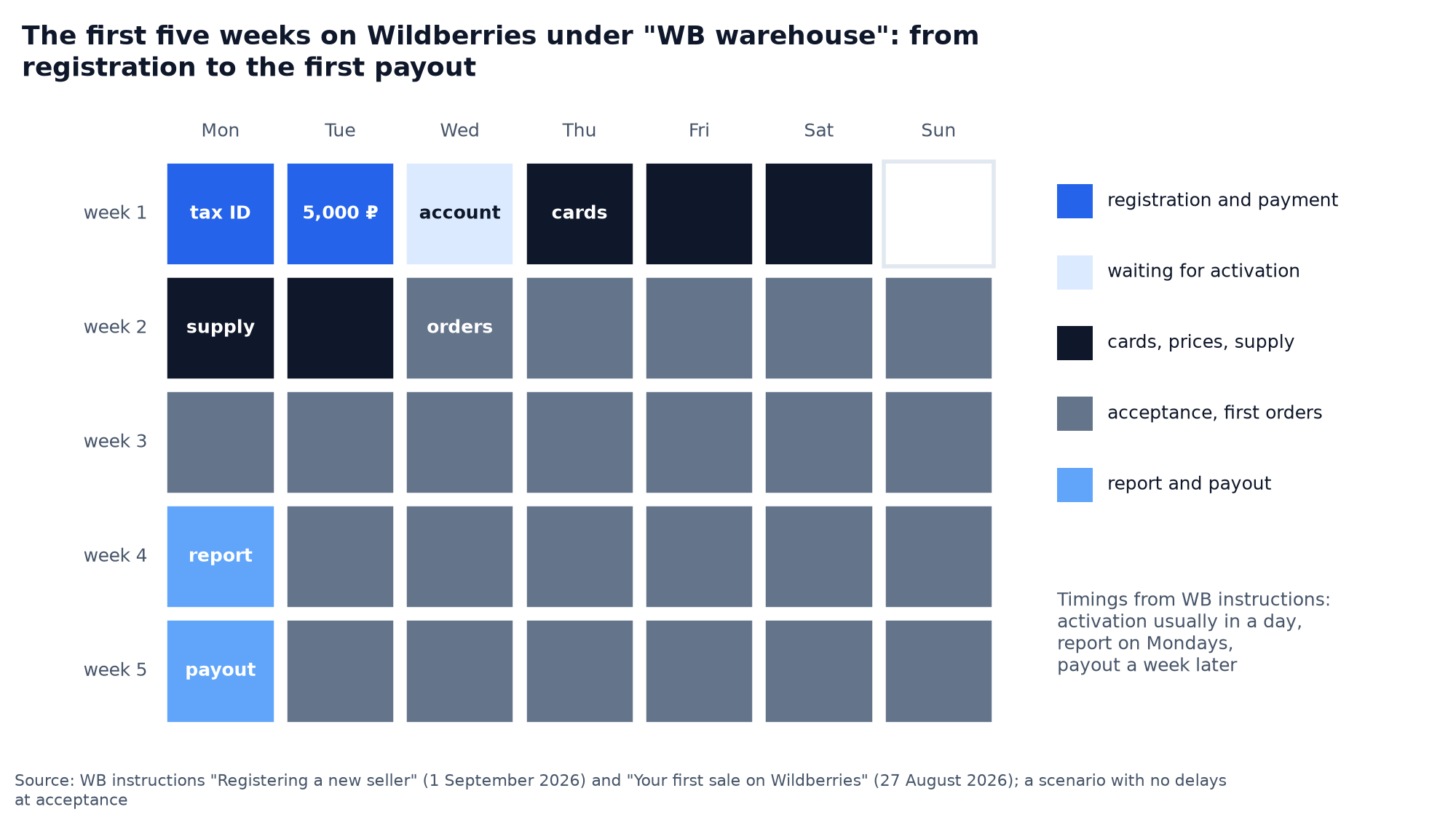
We put the deadlines from the instructions into a calendar. Register on Monday and pay on Tuesday, and the account opens on Wednesday. By the end of the week you can create cards and set prices, and at the start of the second week take a supply to the warehouse. The first orders come after inbound acceptance. WB builds the settlement report for a week of sales on Monday, and the money from it can only be withdrawn the following Monday. Two weeks pass between the first sale and the first money in the account, and that is a scenario with no delays at acceptance.
Which sales model to choose as a beginner on Wildberries
For a first batch of a product that moves, "WB warehouse" fits; for a trial batch with unclear demand, "Marketplace"; and "Showcase" is chosen by those who have no other option. WB has six models and they can be combined. The difference is where the goods sit, who carries the order and how much the marketplace takes for it. The descriptions of the models come from the WB instruction "How to choose a sales model", updated on 27 August 2026.
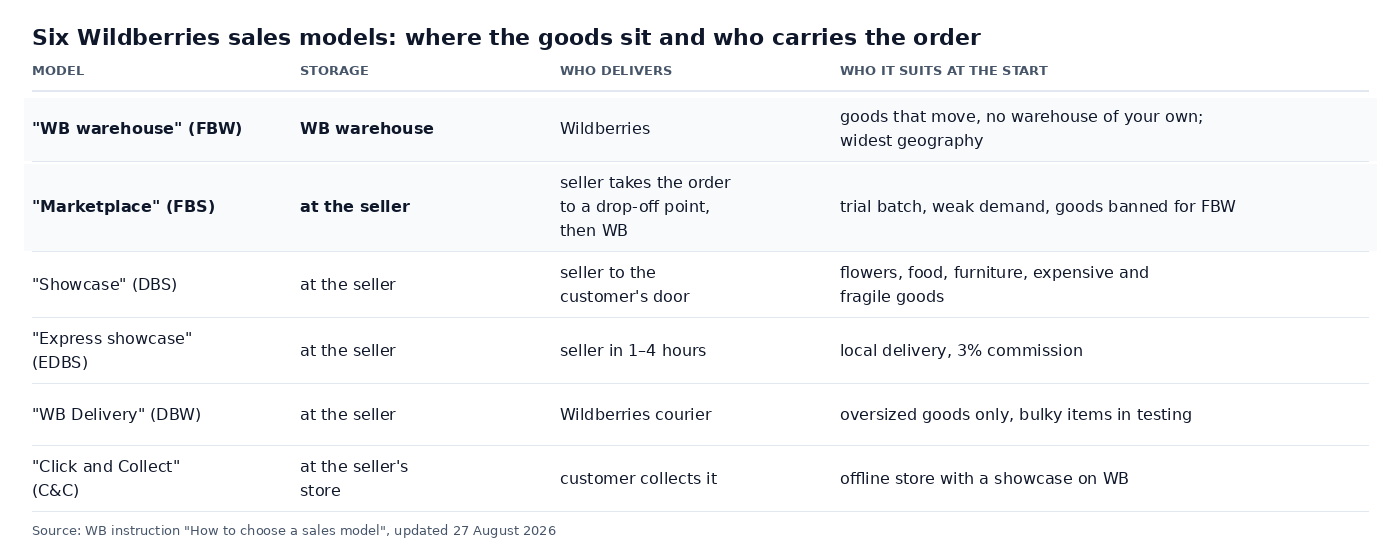
Under the "WB warehouse" model (FBW) you bring a batch to a drop-off point, and the marketplace takes on storage, picking and delivery. This model has the widest geography and the fastest delivery, but storage is charged by the day, and for a product with weak demand that does not pay off. Under "Marketplace" (FBS) the goods sit with you, and for every order you pack it yourself and carry it to the drop-off point. Here the assortment is wider, part of the goods banned for FBW can be sold, and you pay nothing for storage.
The FBS commission is higher. The median in the commission schedule is 34% for the WB warehouse against 38% for FBS, and the breakdown across 5,989 subjects is in the article on Wildberries commissions by category. On top of the commission come logistics both ways, inbound acceptance and storage, and the marketplace's final share of the customer's money reaches half. We counted that on a real store in the article on how much Wildberries takes from a seller.
"Showcase" (DBS) is for those who carry the order themselves: flowers, food, furniture, expensive and fragile things. "Express showcase" promises delivery in 1–4 hours and takes 3% commission, but penalises delays of more than 15 minutes. "WB Delivery" is so far only for oversized goods. For a start with an ordinary product the choice is between the first two. Our advice is simple. Take a first batch of 50–100 units through FBS, and send to the WB warehouse what already sells.
What sellers on Wildberries actually start with: 93,183 stores
More than a third of the sellers customers see in the popular slice run a single card, and the median seller holds two. That is how our crawler's snapshot looks across 1,191,063 cards taken from the Wildberries catalogue between 27 August and 10 September 2026 from category pages sorted by "popular". The snapshot caught 93,183 sellers. It is skewed towards those who already sell, because a card with no sales does not get into the popular slice, and that is worth holding in mind.
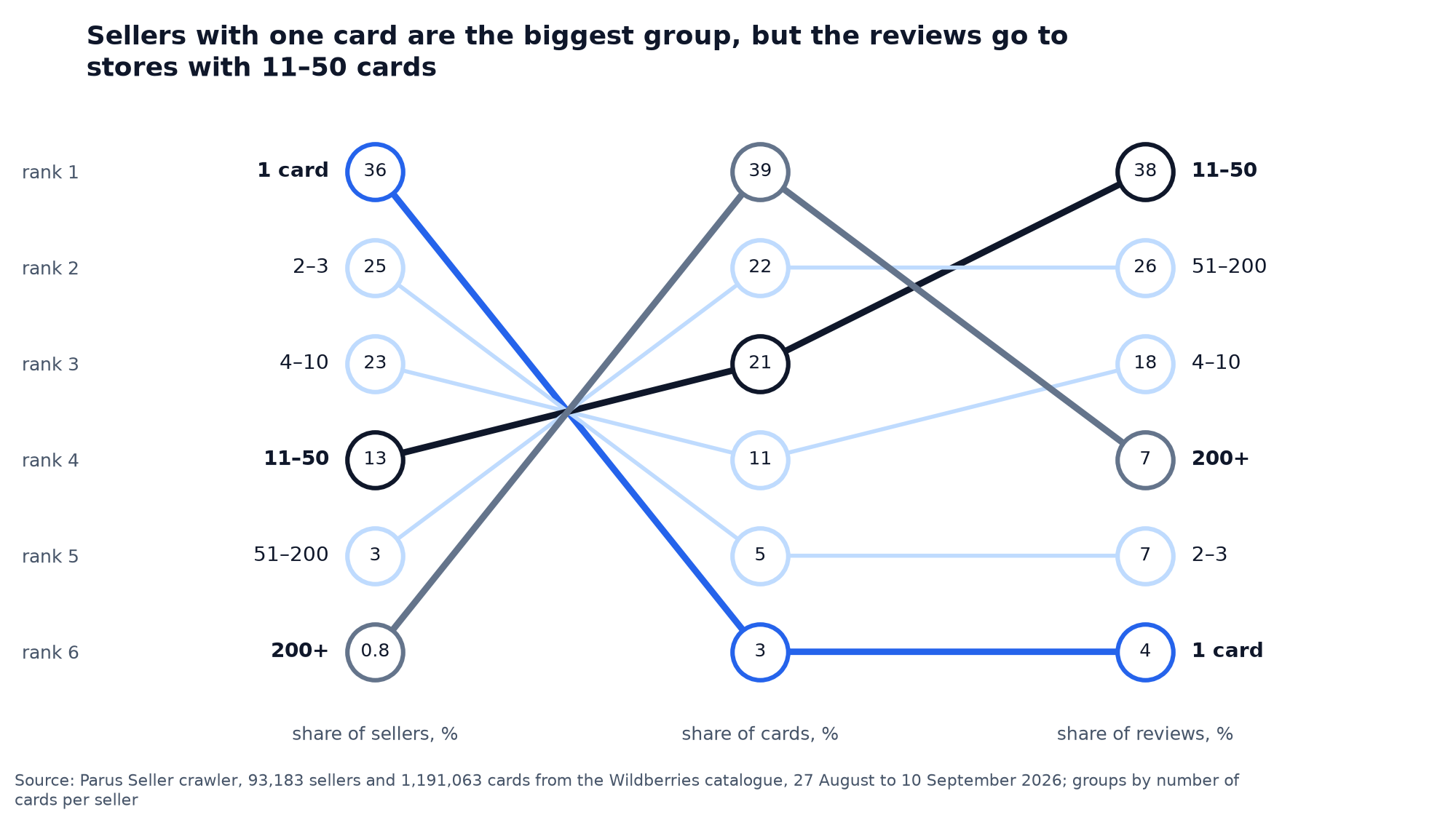
The picture turned out upside down. Sellers with one card are 36%, but their cards are 2.8% of the catalogue and 3.6% of the reviews. Stores with 200 cards and more are 0.8% of sellers and hold 39% of the cards, yet collect only 7% of the reviews. The best at turning cards into reviews are mid-size stores with 11–50 cards: 12.6% of sellers, 21% of cards and 38.5% of reviews. If reviews are a proxy for sales, the model that works on WB is neither the giant nor the loner, but a store with a couple of dozen products.
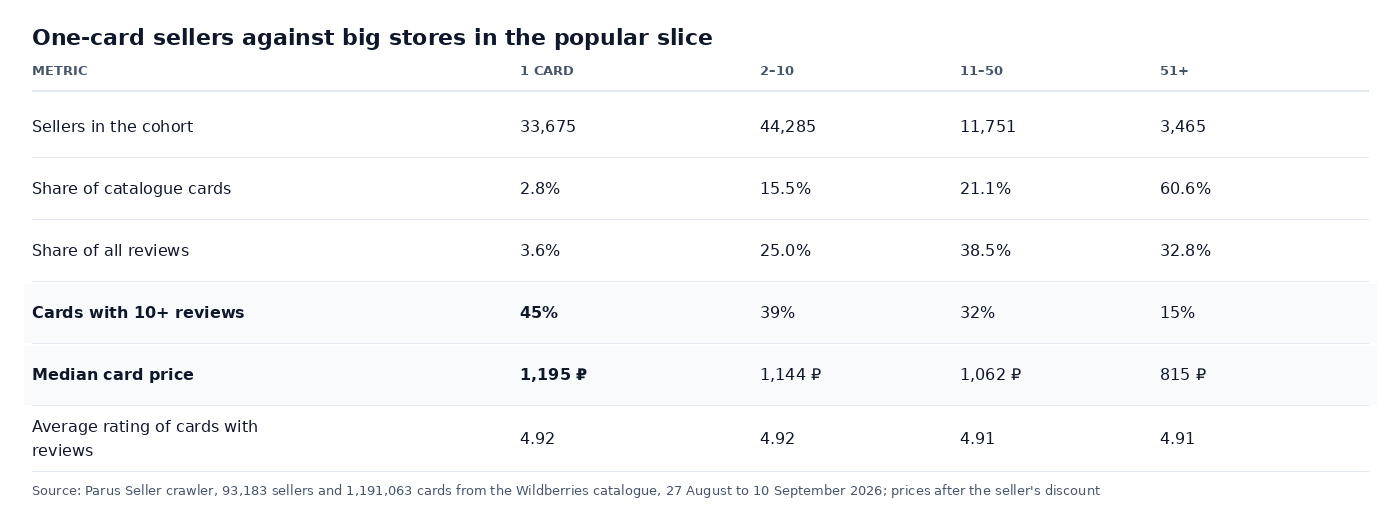
The loners have an advantage of their own. Among their cards 45% have 10 reviews or more, and among the big stores such cards are 15%. Selection is at work here: a loner's card gets into the popular slice only if it sells, while a store with 700 cards has its tail hanging there too. The loner's median price is 1,195 ₽ against 815 ₽ for the big ones, so newcomers are not undercutting, they come in with a pricier product. The rating is the same, 4.9 in every group.
The starting categories show up too. Among the loners' cards 13% are clothing, while in the whole catalogue clothing is 3.9%. Next come beauty with 6.6% against 3.3% and accessories with 2.8% against 1.1%. The most common subjects for sellers with one card are creams, dresses, T-shirts, suits, trainers, supplements, trousers and backpacks. These are the most competitive shelves on WB, and a loner with a dress competes with stores that have hundreds of dresses and reviews. Stationery, on the contrary, takes 15% of the catalogue and only 4.6% of the loners' cards: the big ones start there.
How to make the first supply and get the first payout
After the account is activated, four things stand between you and the first sale: study the rates, create the cards, set the prices, get ready for orders. That is how the WB instruction "Your first sale on Wildberries" dated 27 August 2026 lists them. The "Rates" section is worth opening before the cards: the calculator there counts inbound acceptance, delivery and storage by the product's dimensions and the warehouse, and the "Commission" tab shows the rate for the category.
A product card is created in "Products and prices" → "Product card", one at a time or in bulk through a table. How to fill it in so that it sells we took apart in the article on the product card. The figure about photos is there too: the share of cards with 50 reviews or more rises from 4.5% with one photo to 33% with twenty. Prices and discounts are set separately, and the calculator comes in handy here, because the commission is taken from the price after your discount.
From here the paths split by model. For "WB warehouse" you create a supply and take it to the warehouse, and the goods appear in the store after inbound acceptance. For FBS and the other models a seller warehouse is created in "Supplies and orders" → "My warehouse", and then the stock is uploaded: by hand through "Stock management" or through the API. The API token is created only by the account owner in "Profile" → "API integrations", and we wrote about the token types and their limits in the article on the API token. As soon as the stock is uploaded, customers see the goods and the orders start.
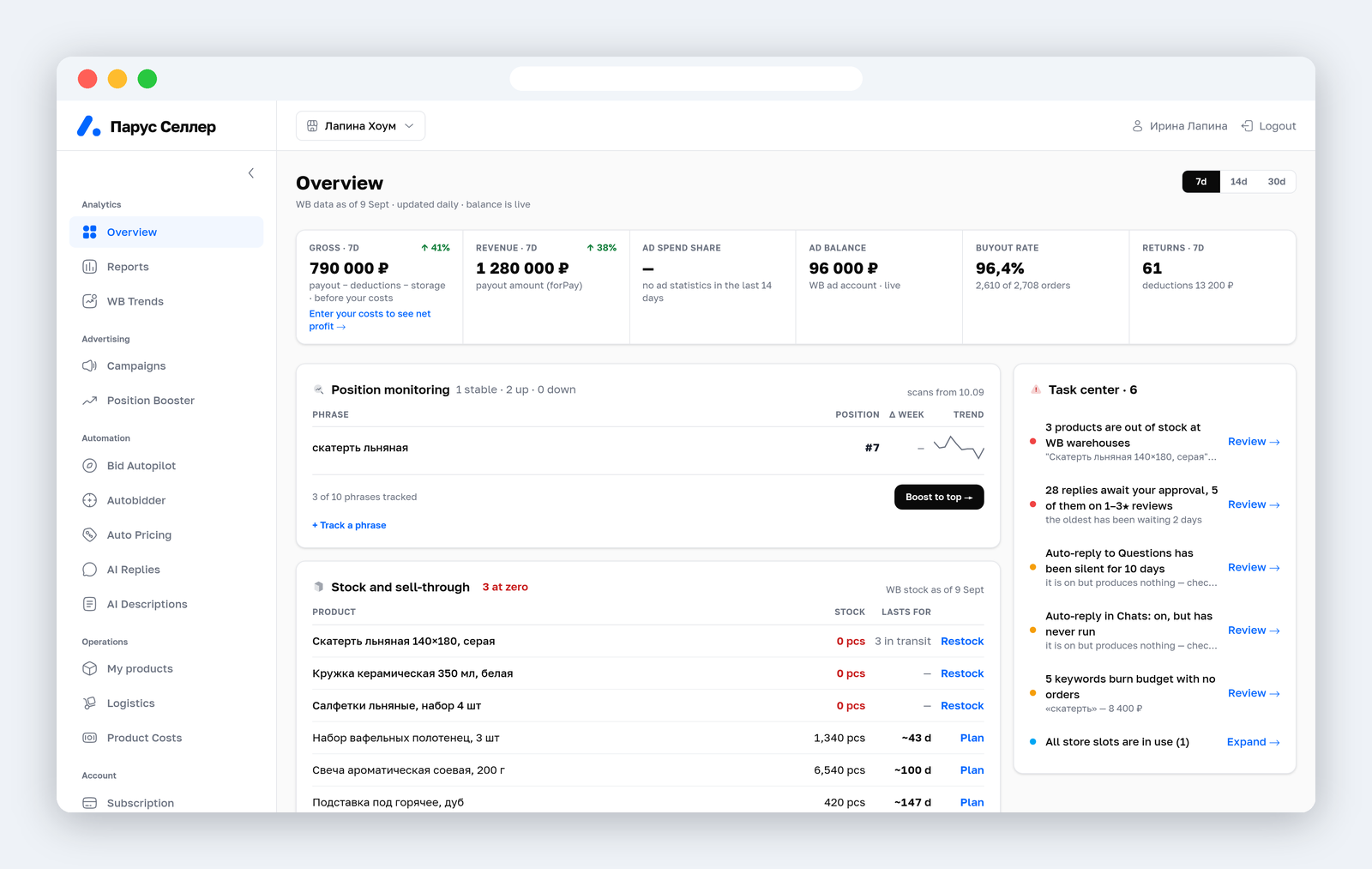
The first settlement report appears on Monday for the previous week in "Finance" → "Financial reports", and the sum becomes available for withdrawal a week later. How to read that report we took apart in the article on the weekly report. In Parus Seller a newcomer sees on one screen from day one what the WB portal assembles from four sections. That is the revenue and the payout amount for the week, the buyout rate, the products that ran out and the reviews with no reply. A store is connected by the API token you create yourself, and the service never asks for the portal login and password. Promo code PARUS60 makes the first two months free, registration here.
How to sell on Wildberries from scratch and not burn the first batch: what we would do
We would make the first batch small and take it through FBS, because 36% of sellers in the popular slice run a single card, and that is a normal entry point, not a mistake. We would call something else a mistake: carrying 500 units to the WB warehouse before the card has shown its first orders. Storage is counted by the day, a refused order is paid for with two trips, and on a trial batch that eats the margin faster than the commission does.
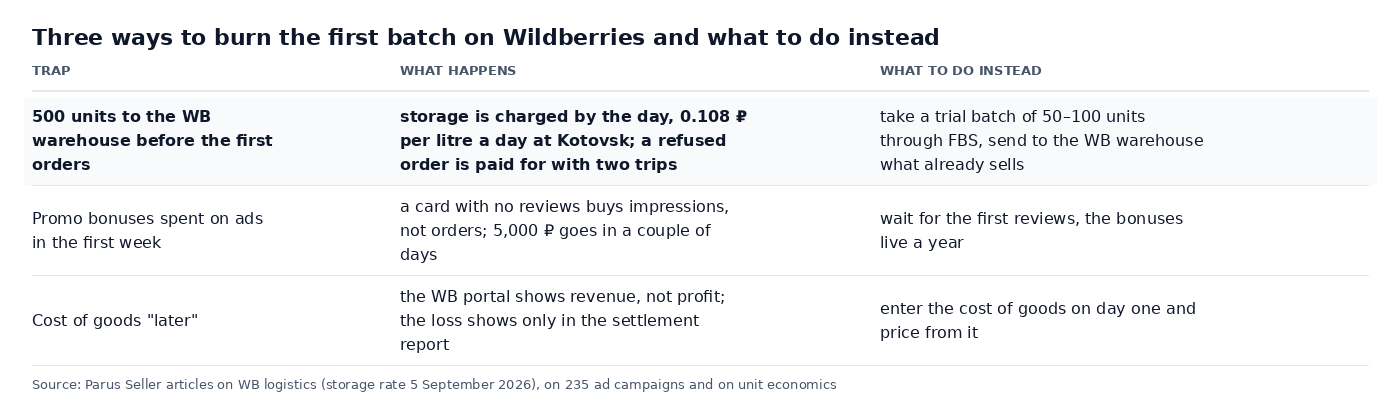
The promo bonuses from the licence fee are better not spent in the first week. Advertising on a card with no reviews buys impressions, not orders, and 5,000 ₽ goes in a couple of days. We took apart 235 campaigns and saw how it happens, in the article on Wildberries advertising. The bonuses live a year, and the first reviews on a card appear two or three weeks after sales start, which is when advertising begins to pay off.
The cost of goods is worth entering on the first day, not "later". Without it the WB portal shows revenue, not profit, and the seller learns about the loss from the first settlement report, when the batch is already sold. With our logistics-per-sale formula and the commission table this takes ten minutes, and we described the calculation in the article on unit economics. Everything else, from the offer agreement to the penalties, can be read as it happens.
FAQ about starting to sell on Wildberries
Can you sell on Wildberries as a private individual without a sole proprietorship? No. The WB instruction dated 1 September 2026 says plainly that private individuals cannot register on WB Partners. The fastest route for a private individual is self-employed status: registering in the My Tax app takes a day, and a self-employed seller pays the 5,000 ₽ from a personal card by QR code.
Is the 5,000 ₽ guarantee deposit refundable? Not in money. WB calls it a licence fee and credits the whole sum as promo bonuses to the advertising account for a year. If the account is closed the fee is not returned, and if it is not paid within 14 days of starting registration, the account is deleted.
How long does activation of a seller account take? Per the WB instruction the payment is usually credited within a day, in rare cases up to five business days. The guides at the top of search write about three or five days, but those figures are out of date. What drags on is not the activation but the wait for a new sole proprietor to appear in the state register.
Can you start selling on Wildberries with one product? There is no formal minimum, one card is a store too. Our data shows 36% of sellers in the popular slice run a single card, and the most reviews per card go to stores with 11–50 products. Starting with one product is fine, growing to a couple of dozen is necessary.
Which sales model should a beginner choose? For a trial batch "Marketplace" (FBS) fits: the goods sit with you, storage is free, and the commission is a few percent higher. Once a card shows steady orders, part of the stock is worth moving to "WB warehouse" for the geography and the delivery speed.
Author: Andrey Rybakov, Head of Analytics at Parus Seller. Based on data from 750,000 WB suppliers and 235 ad campaigns we analysed.