Wildberries inbound acceptance is what you pay to have a supply handled at the warehouse: unloading from the truck, moving it around the site and sorting it. The cost depends on the volume of the goods and on the warehouse coefficient for the day of drop-off. The spread here is the widest of all WB rates. The same supply of 20 boxes comes to 0 ₽ at a coefficient of ×0 and to 32,640 ₽ at ×10. We read three WB instructions dated 27 August, 2 and 4 September 2026, clause 11 of the current offer agreement and the penalty schedule. Everything that moves the price and the timing of acceptance is below.
In short: a box, a supersafe and a per-unit pallet cost 1.7 ₽ per litre, a mono-pallet 500 ₽ per pallet, and all of it is multiplied by the warehouse coefficient; the coefficient is visible under "Rates" and is not locked when you create a supply. Under the offer agreement WB accepts a supply by pallets on the day of unloading and by units within 10 working days, and you have 7 days to object to the report. Cancelling a supply later than 72 hours before it costs 5 ₽ per unit, and if WB refuses to accept your pallets through no fault of yours, it owes you 25,000 ₽.
What warehouse acceptance on Wildberries is and what its price is made of
Under the WB instruction dated 2 September 2026, acceptance is the handling of goods as a supply arrives: unloading from the truck, moving it inside the warehouse and sorting it for the storage warehouse or straight to the customer. The price runs on two base rates. For boxes, supersafes and per-unit pallets it is 1.7 ₽ for every litre of volume, multiplied by the warehouse acceptance coefficient. For mono-pallets it is 500 ₽ per pallet, again with the coefficient. On days when a warehouse has few shipments and free space, the coefficient is zero and acceptance is free.
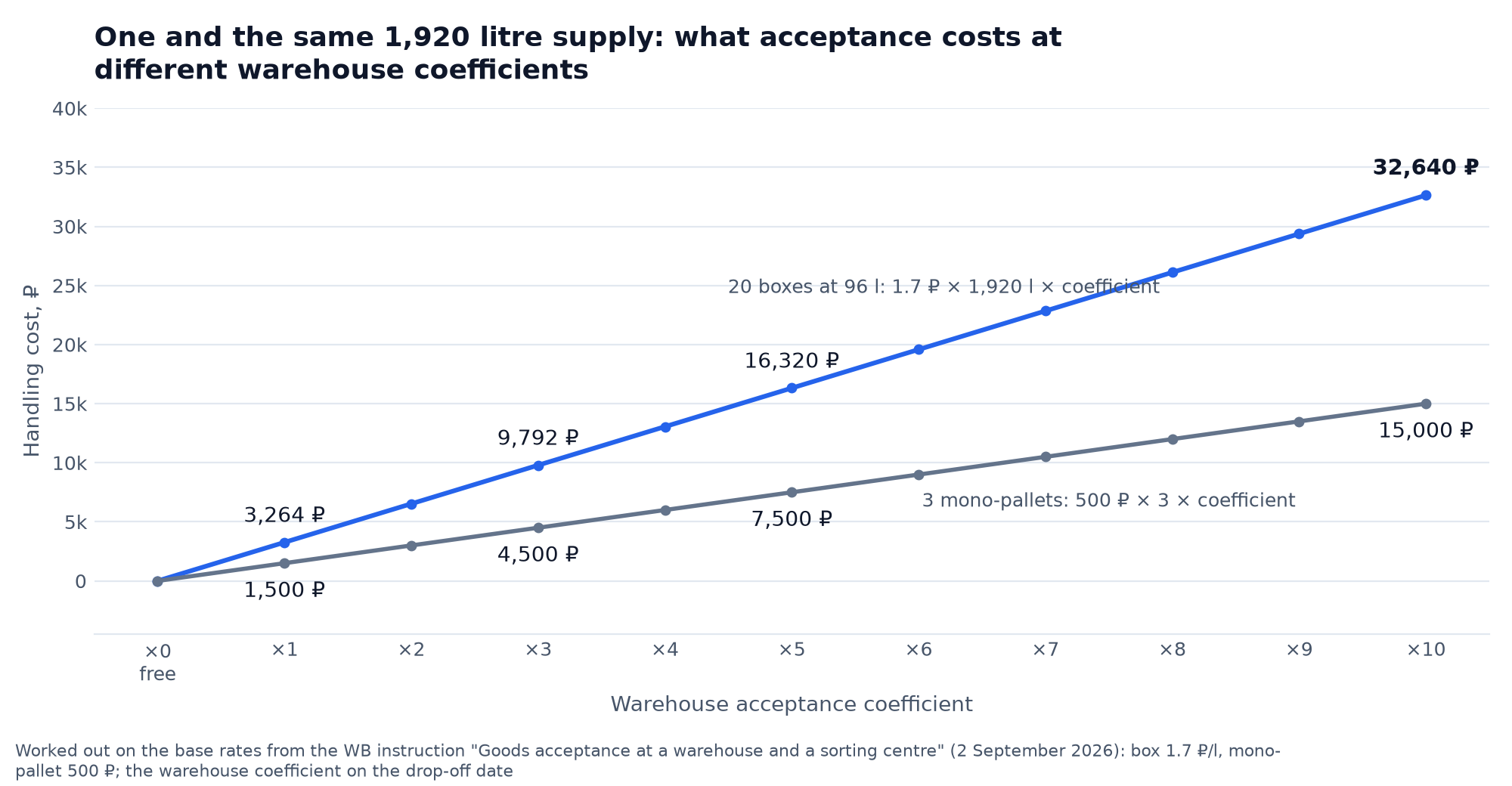
Take a supply of 20 boxes at 96 litres each, 1,920 litres in total. At ×1 the handling costs 3,264 ₽, at ×3 it is already 9,792 ₽, at ×5 it is 16,320 ₽, and at ×10 the same boxes come to 32,640 ₽. The same goods on three mono-pallets cost 1,500 ₽ at ×1 and 15,000 ₽ at ×10.
A mono-pallet is almost always cheaper on bulky goods, but it has its own limits: no more than three barcodes on a pallet and drop-off at a sorting centre only. WB works the exact amount out from the volume actually accepted, so if you bring more or less than you declared, the cost is recalculated.
The litres in the formula are the volume of the item in its individual packaging, the one you put in the product card. Understating the dimensions will not work: under clause 13.3.3 of the offer agreement the warehouse measures goods selectively, and cards where any dimension is more than 40% above the category average get measured more often. A discrepancy means a recalculation on the facts plus a penalty from the schedule, and a weight of 25 kg or more that is not stated in the card costs 3,500 ₽ per unit.
Where to see the acceptance coefficient and when acceptance is free
The warehouse coefficient is visible before you create a supply, at the moment you pick the date and after acceptance, and all of these are different screens in the seller portal. Before creating a supply, go to "Supplies and orders", "Rates", "Warehouse rates", the "Supply rates" tab. Pick the supply type, the date and the warehouse. Untick "Delivery" and "Storage" so that only acceptance is left. The "With free acceptance" tick leaves only warehouses with a zero coefficient in the list.
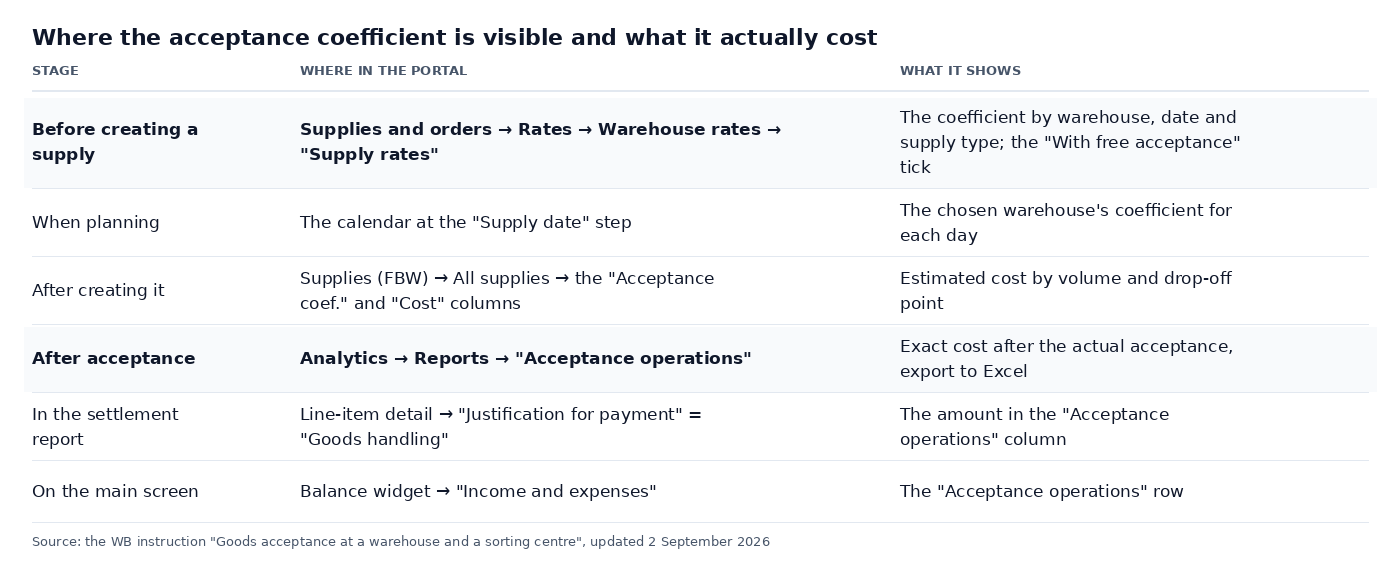
When you plan, the coefficient is shown by the calendar at the "Supply date" step. Once the supply is created, the estimated cost appears in the "All supplies" list, in the "Acceptance coef." and "Cost" columns.
The exact amount only arrives after the actual acceptance. It is shown by the "Acceptance operations" report under "Analytics", by the line-item detail of the weekly report with "Goods handling" in the justification, and by the balance widget on the main screen. How to read the line-item detail we covered in the article about the Wildberries weekly report.
Context you need to make sense of the September rules. From 15 August 2026 WB temporarily changed the way it works with warehouses in Russia: in rates, reports and analytics the data for Russian warehouses is folded into summary rows, "WB warehouse, Russia", and the API methods "Supply rates" and "Supply formation information" are switched off (the WB API digest for August 2026). By the same WB announcement of 15 August, the FBW logistics and storage coefficients for every Russian warehouse became a flat 170%, FBW supplies were allowed through pickup points at 5 ₽ per unit, and from 29 September a separate charge appears for moving goods from the drop-off point to the warehouse, 3 to 7 ₽ per litre (a retelling of the news on sellers.by, 2026). The acceptance coefficient stayed variable: it is tied to the drop-off point and the date.
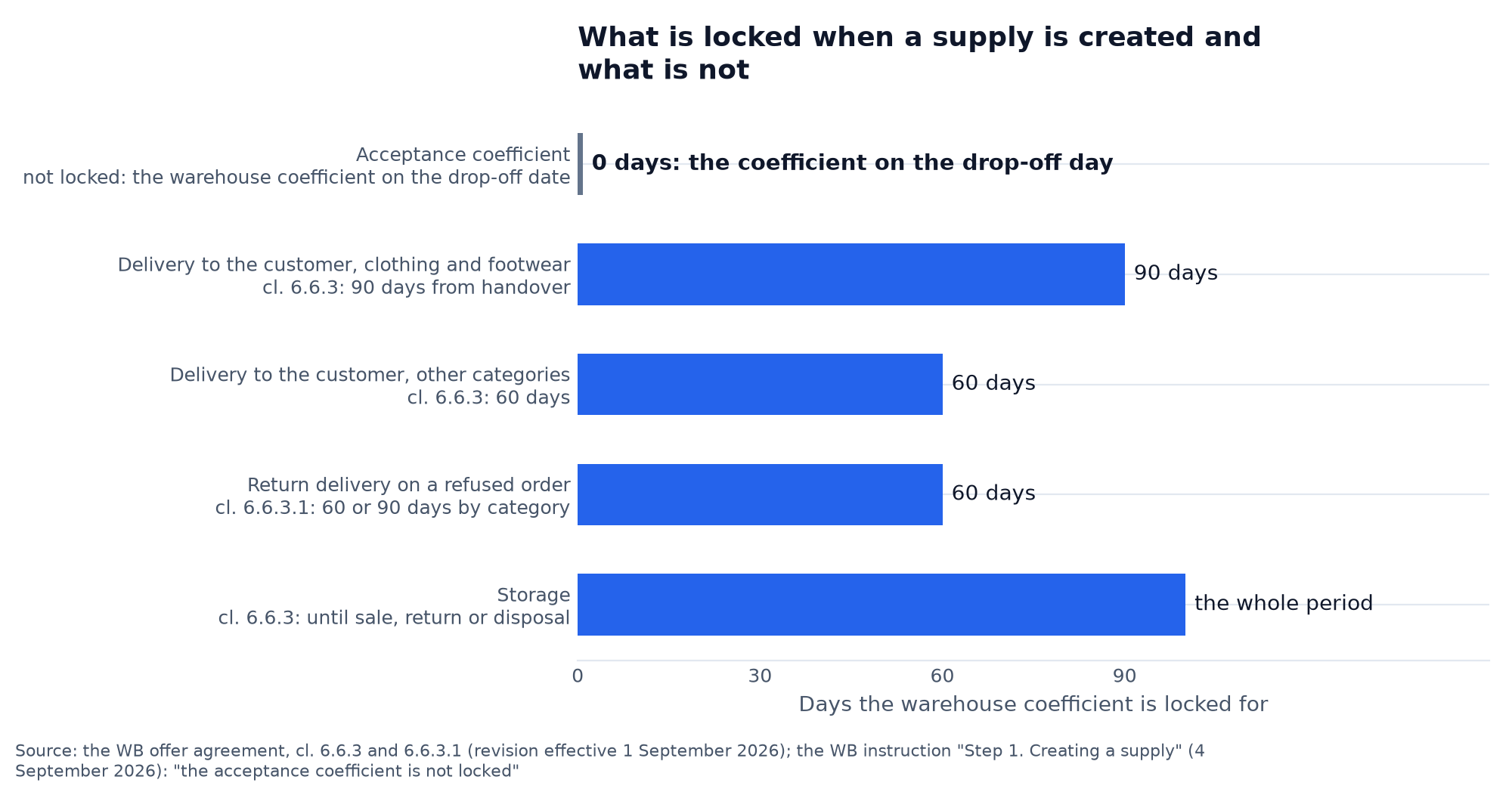
The main trap with the coefficient is that it locks differently from delivery and storage. The WB instruction dated 4 September puts it plainly: the delivery and storage coefficients are locked to the supply for 60 or 90 days, while the acceptance coefficient is locked only to the slot you picked, meaning the warehouse, the date and the coefficient at the moment of choice. Bring the goods to another warehouse, or on a date outside the ±24 hour window around the slot, and acceptance is charged at the coefficient in force on the day you arrive. A free slot you spotted in next week's calendar guarantees nothing until you have booked it.
How long acceptance takes under the offer agreement and when the report appears
Under clause 11 of the offer agreement acceptance runs in two steps. First the warehouse accepts the supply by number of places: it scans the barcode of each pallet as it is unloaded, and a waybill with the number of accepted cargo places appears in the portal. Then, within 10 working days of the acceptance by places, WB unilaterally accepts the goods by number of units and by assortment and publishes the acceptance report on the portal.
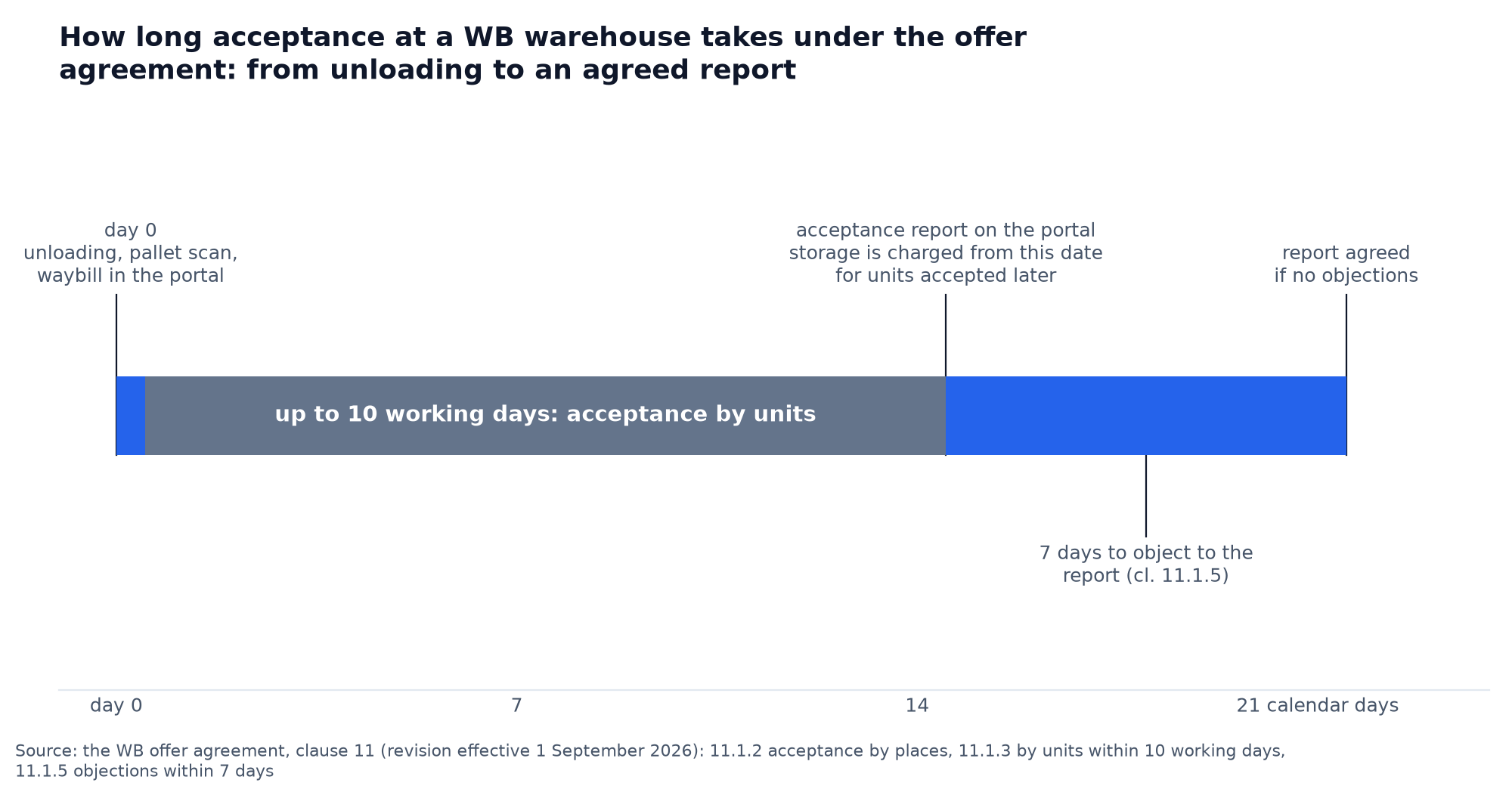
Two deadlines here are worth remembering. Seven days from the day the report is published are yours for a reasoned objection through the portal; without one the report counts as agreed by you, and disputing a shortage afterwards is next to impossible. And storage for units the warehouse took in later than 10 working days is paid from the acceptance date in the report, not from the unloading date. If the warehouse dragged its feet, no storage is charged for that time.
Clause 11 also holds a rule sellers do not know about. If WB refused acceptance by pallet count and you broke nothing, the platform has to pay you 25,000 ₽ by offsetting it against its own claims. This only works on a clean supply. Under clause 11.1.1, unloading in breach of the packaging and marking rules gives WB the right to refuse and to charge a penalty to you instead. Goods without correct marking go back to your pickup point under clause 11.1.4. After acceptance the supply card lets you download the acceptance report with an electronic signature, the barcode reconciliation report, a CSV for Chestny Znak, Russia's product marking system, and the waybill; the report is kept for 12 months.
Which penalties surround acceptance and what WB owes you
The penalties around acceptance sit in the penalty schedule to the offer agreement dated 14 August 2026, and almost all of them are charged per unit of goods, so on a large supply they pile up fast. The two most common ones. Cancelling or moving the supply date less than 72 hours before it costs 5 ₽ for every unit that was planned and not brought, capped at 25,000 ₽ per supply. For pallets it is 5,000 ₽ each. And short supply: you planned more than 100 units and failed to bring more than 30%, the same 5 ₽ per unit with the same cap.
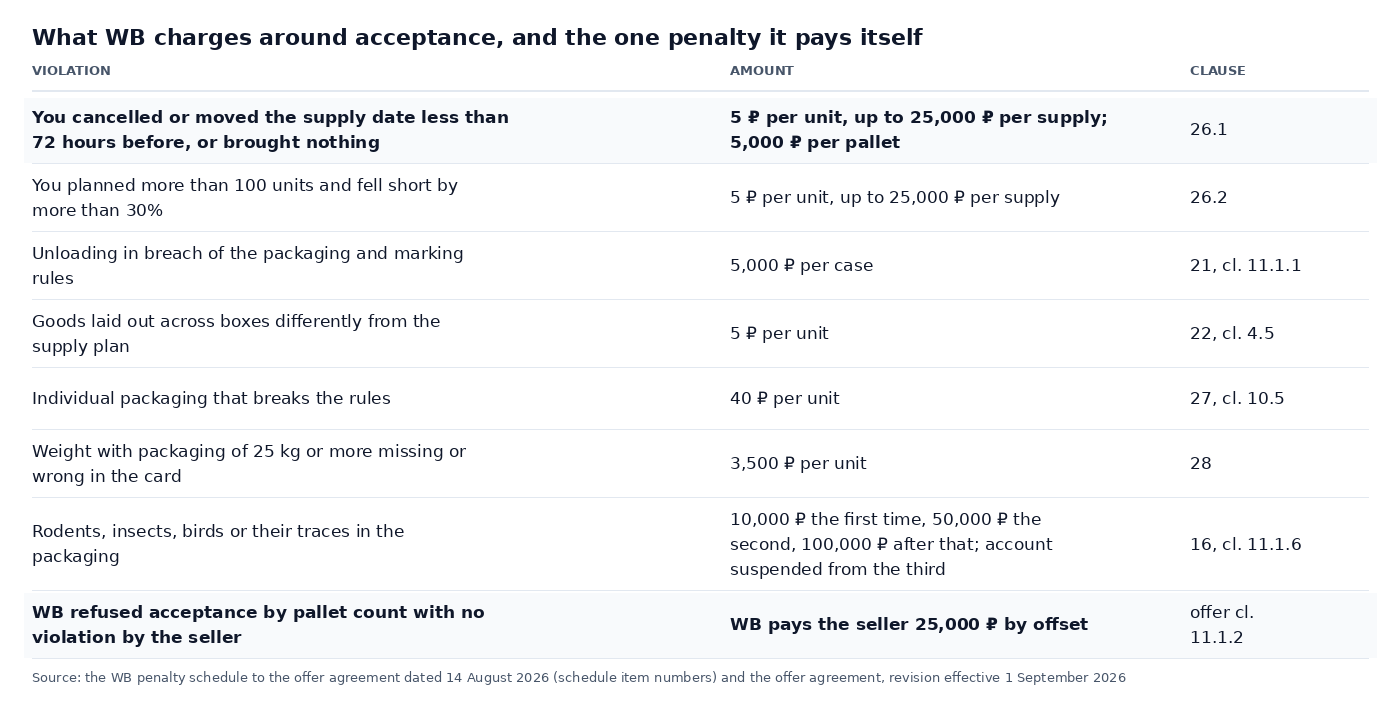
Then, in order of how often they hit. 5 ₽ per unit laid out across boxes differently from the supply plan. 40 ₽ per unit whose individual packaging breaks the rules. 5,000 ₽ for unloading in breach of the packaging and marking rules. 3,500 ₽ for every unit weighing 25 kg or more whose weight is not in the card.
Pests in the packaging stand on their own line. 10,000 ₽ the first time, 50,000 ₽ the second, 100,000 ₽ for the third and every one after. From the third case, clause 11.1.6 suspends the account as well. The overall turnover cap from clause 9.10.6 does cover penalties flagged "liability limited", and we went through it in detail in the article about Wildberries penalties for sellers.
The delay penalty people ask about most has nothing to do with warehouse acceptance: that one is an FBS order you failed to hand over within 24 hours. From 31 August 2026 it runs by the hour under clause 4.4 of the offer agreement, and we showed the formula and the hourly maths in the article about the Wildberries offer agreement 2026. The carrot for speed is there too: an order handed over within 13 hours cuts the commission on that sale by 5 percentage points.
Which supply type to choose and where it will be accepted
The supply type sets both the price of acceptance and the place it will be accepted. A box suits a wide assortment and small volumes: a 120 × 80 cm base, an item side up to 80 cm, the sum of three sides up to 160 cm, a barcode on every box. A mono-pallet is for bulky and heavy goods: a side up to 120 cm, a sum up to 200 cm, no more than three barcodes per pallet, drop-off at a sorting centre only. A per-unit pallet is boxes fixed with film on a pallet under a single barcode, again a sorting centre only. A supersafe is for jewellery and expensive goods only.
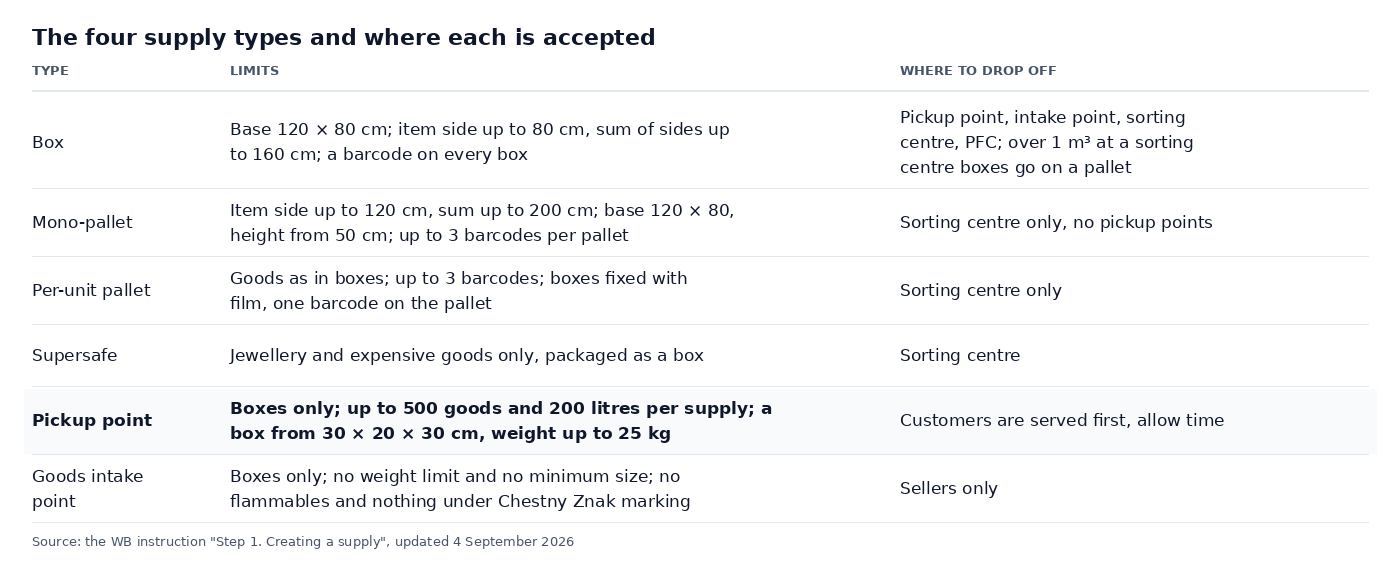
You choose the drop-off point, you do not choose the storage warehouse: after acceptance WB spreads the goods across warehouses itself, and takes the acceptance, delivery and storage coefficients that were in force at the drop-off point.
A pickup point takes boxes only, up to 500 goods and 200 litres per supply, a box from 30 × 20 × 30 cm and a total weight up to 25 kg, and customers are served first. Goods intake points work with sellers only: no weight limit and no minimum size, but for now no flammable goods and nothing carrying Chestny Znak marking. A sorting centre takes every type, and partner fulfilment centres with the "PFC" badge work like ordinary warehouses, with the option to insure the goods there.
How to catch free acceptance and not overpay
Free acceptance shows up at a specific warehouse on a specific date, does not last long and is not locked, so it gets caught rather than planned. The manual way is described above: the "With free acceptance" tick under "Rates" and the calendar at the date step. The problem is that windows open and close during the day, and whoever checks the calendar once a day sees only the booked ones.
At Parus Seller we solved this with the acceptance catcher. You tick the warehouses that suit you and a ceiling for the coefficient. The service checks slots through your store's API and books a suitable window itself, as long as your WB portal login is active. The journal shows which windows opened and what the catcher did with them. It works on your own token and inside WB's limits only, and scanning other people's stores is not possible.
An important caveat for September 2026. On 15 August WB temporarily switched off the "Supply rates" API method that returned acceptance coefficients, and "Supply formation information" along with it. There is no replacement, and Russian warehouses are folded into a single row in the API (the WB API release notes of 15 August 2026, with details in the news on the seller portal). We checked it on 7 September with a live call on a working token: a 404 with "This method is temporarily disabled". While the method is off, no service sees the coefficients through the API, and our catcher is on pause too. In this period the coefficients are only available in the seller portal, under "Rates" and in the supply calendar. As soon as WB brings the method back, the catcher carries on without you.
Both the price of acceptance and the price of waiting are worth counting. A 1,920 litre supply at ×3 costs 9,792 ₽, and if you wait a week for ×0, the goods do not sell during that week. At a margin of 500 ₽ a unit and 40 sales a day, a week of standing still is 140,000 ₽ of profit you did not make against 9,792 ₽ for acceptance now.
Expensive coefficients are worth sitting out on goods with slow sell-through and large stock, while the fast movers should go in the nearest window even if it is paid. And keep short supply in mind. Build the supply plan from the goods you have actually gathered, otherwise moving it later than 72 hours turns into 5 ₽ per unit and 25,000 ₽ for pallets.
FAQ
What is MP acceptance on Wildberries? It is the handling of goods for the "Marketplace" model (FBS): when you hand an order over to a pickup point, a sorting centre or a warehouse, WB charges for handling it. The cost is visible in the assembly task in the "Handling cost" field and on the warehouse map, in the "Marketplace" tab, by drop-off date.
What time is acceptance on Wildberries and how long does it take? By pallets the supply is accepted at the moment of unloading, in the time slot you booked with the pass. By units the warehouse takes up to 10 working days, after which it publishes the report. Objections to the report are accepted for 7 days.
What is the acceptance coefficient and what does it depend on? It is a multiplier on the base rate of 1.7 ₽ per litre or 500 ₽ per pallet. It is set by how busy the warehouse is on a given date: the fewer shipments and the more free space, the lower the coefficient, down to zero. It is visible under "Rates" and in the calendar when you pick a date.
Pickup point acceptance rules: what cannot be brought? A pickup point takes boxes only, up to 80 cm on a side and 160 cm on the sum of sides, up to 500 goods and 200 litres per supply, weighing up to 25 kg. It will not take pallets, supersafes, oversized and extra-oversized goods, jewellery, perishables, aerosols, paints, oils, furniture, building materials, fertilisers and soils. A box that is turned away you take back with you.
What is the penalty for being late on Wildberries? If you mean a supply to a warehouse, cancelling or moving it later than 72 hours before costs 5 ₽ per unit, capped at 25,000 ₽ per supply. If you mean an FBS order, the penalty runs by the hour from hour 24 under clause 4.4 of the offer agreement: on an item at 3,000 ₽ that is 54 ₽ after 30 hours and up to 1,296 ₽ after 120.
Wildberries acceptance report: where to download it and how long is it kept? In the card of the accepted supply, the "Download documents" button: the acceptance report comes as a ZIP archive with an Excel file and an electronic signature file, and stays available for 12 months. Next to it are the barcode reconciliation report, a CSV for Chestny Znak and the waybill on the "Pass" tab.