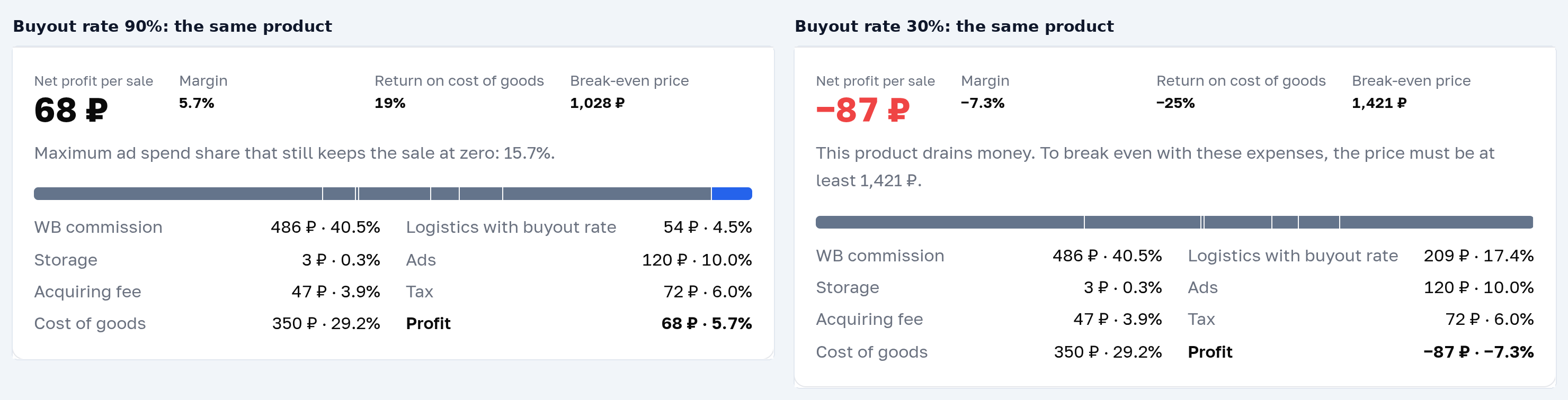
Sellers usually think about the buyout rate twice: when they pick a niche, and when profit suddenly melts away. In between, the metric sits somewhere in the seller portal and looks harmless. It is not. The buyout rate works as a multiplier on logistics, and the difference between 90% and 30% turns 72 roubles of cost per sale into 317.
In short: buyout rate = orders bought out / all orders, items still in transit do not count. Where to find it: WB seller portal → Analytics → Product rating → Key metrics. At a buyout rate of 30% logistics per sale grows more than fourfold, and for clothing 30-60% is the norm, so returns are priced in from the start.
What the buyout rate is and how it is counted
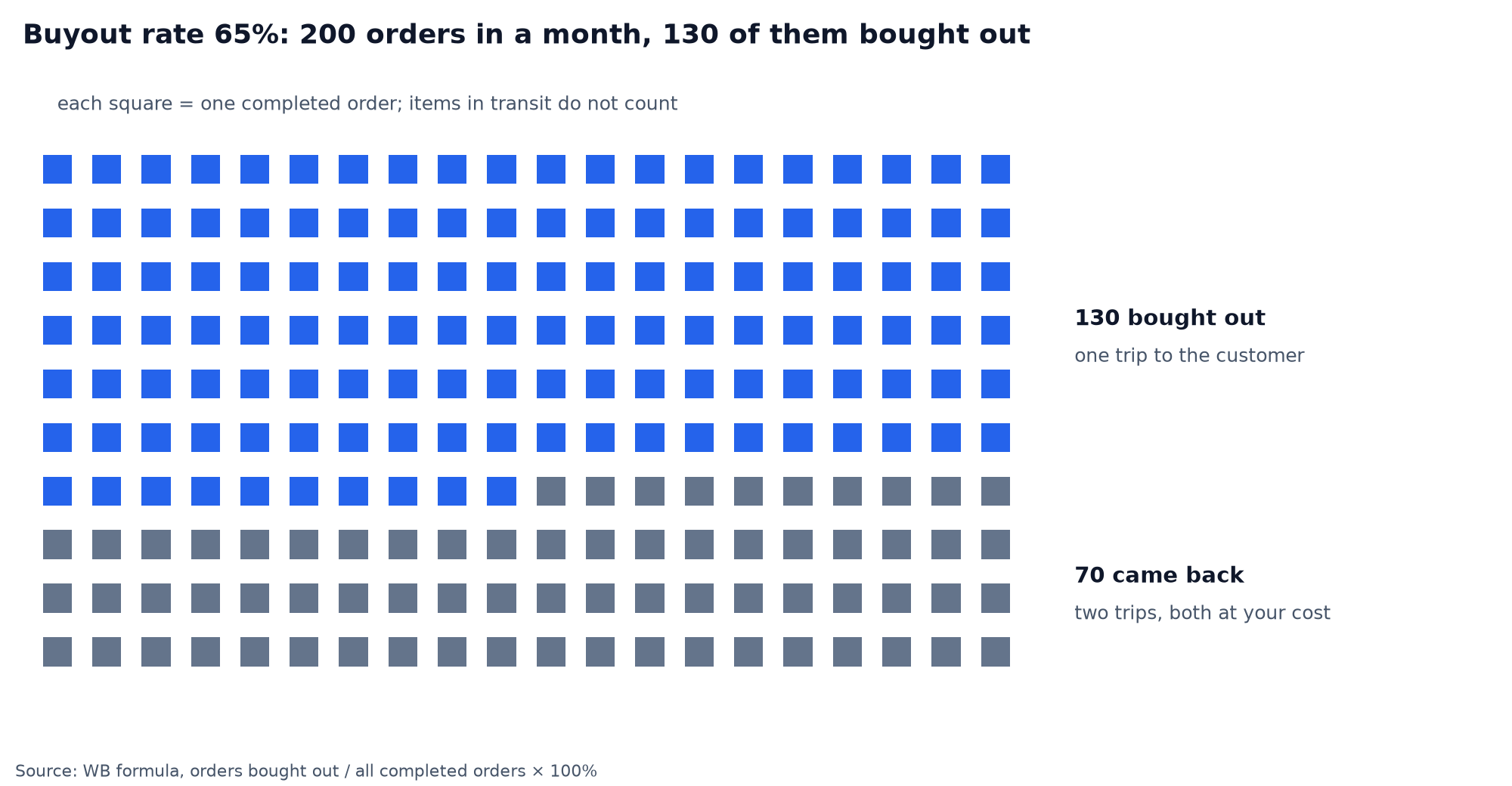
The buyout rate on Wildberries is the share of orders customers actually collected, out of all orders for the period. Items still on their way to the customer stay out of the calculation: that is how the marketplace itself defines it (WB Insight, 2026).
Buyout rate = orders bought out / all completed orders × 100%
An example: over a month the product was ordered 200 times and collected from pickup points 130 times. The buyout rate is 65%. The other 70 units travelled to the customer and came back to the warehouse, and you paid for every trip back.
Where a seller finds the buyout rate
In the seller portal the path runs: "Analytics" → "Product rating" → "Key metrics". The buyout rate is shown there both for the store and for each product. Nothing needs counting by hand, the marketplace does it for you.
Two points that trip people up:
- Customers have a buyout rate of their own in the app. It drives the customer's discount and has nothing to do with your seller analytics.
- The store average lies. Look at products. A single vendor code with a buyout rate of 25% can quietly eat the profit of a whole category.
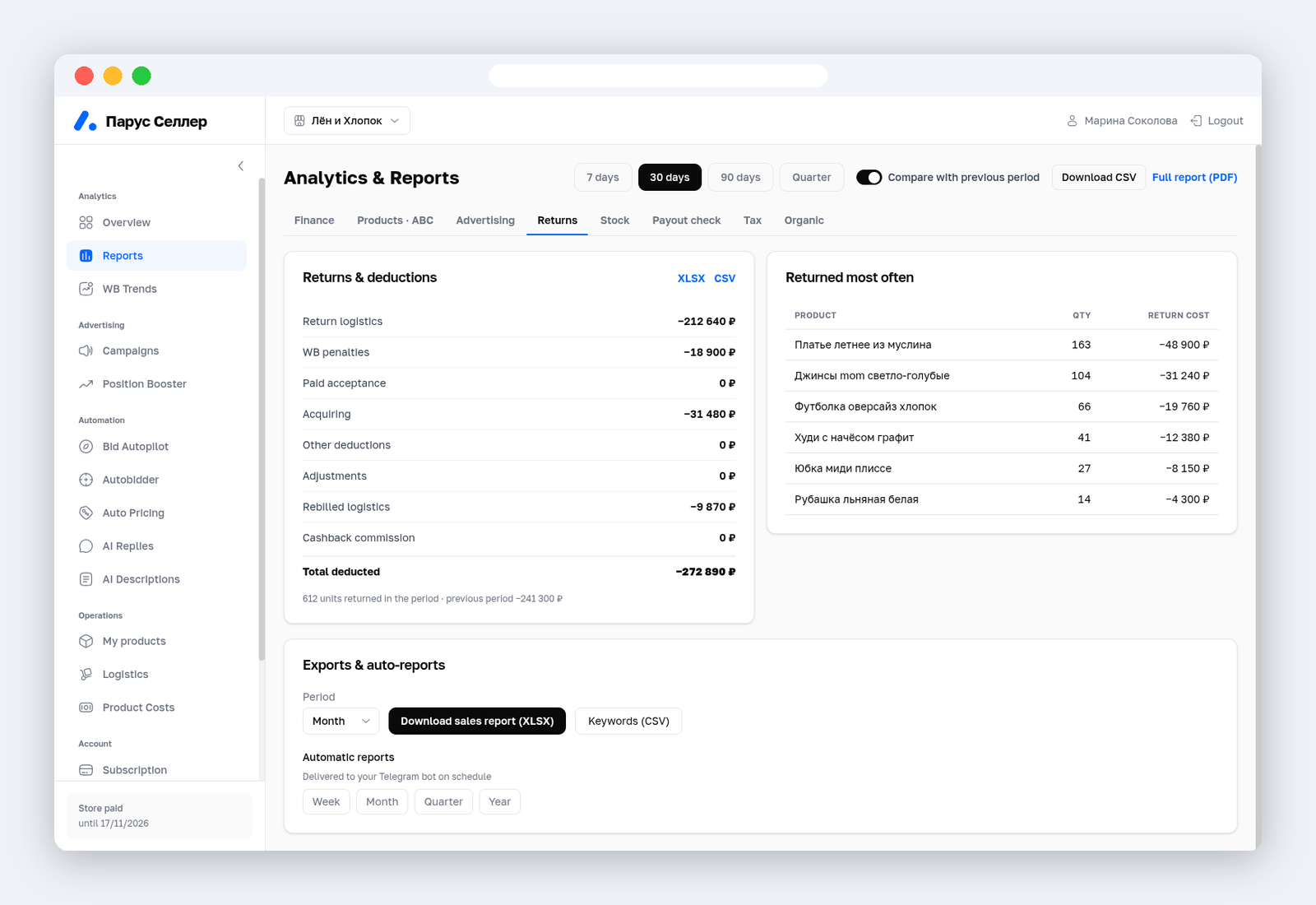
How much returns cost you is visible in Parus Seller on the "Returns" tab: every deduction in one table (return logistics, penalties, the acquiring fee) and the products that come back most often, with the price of their returns.
What a low buyout rate costs in roubles
Every refused order means two trips you paid for: delivery to the customer and the return to the warehouse. So honest logistics is counted not per shipment, but per sale that actually happened:
Logistics per sale = delivery + (delivery + return) × (1 − buyout rate) / buyout rate
Take a product with delivery at 60 ₽ and a return at 50 ₽:
- buyout rate 90%: 72 ₽ per sale
- buyout rate 70%: 107 ₽
- buyout rate 50%: 170 ₽
- buyout rate 30%: 317 ₽, more than four times as much
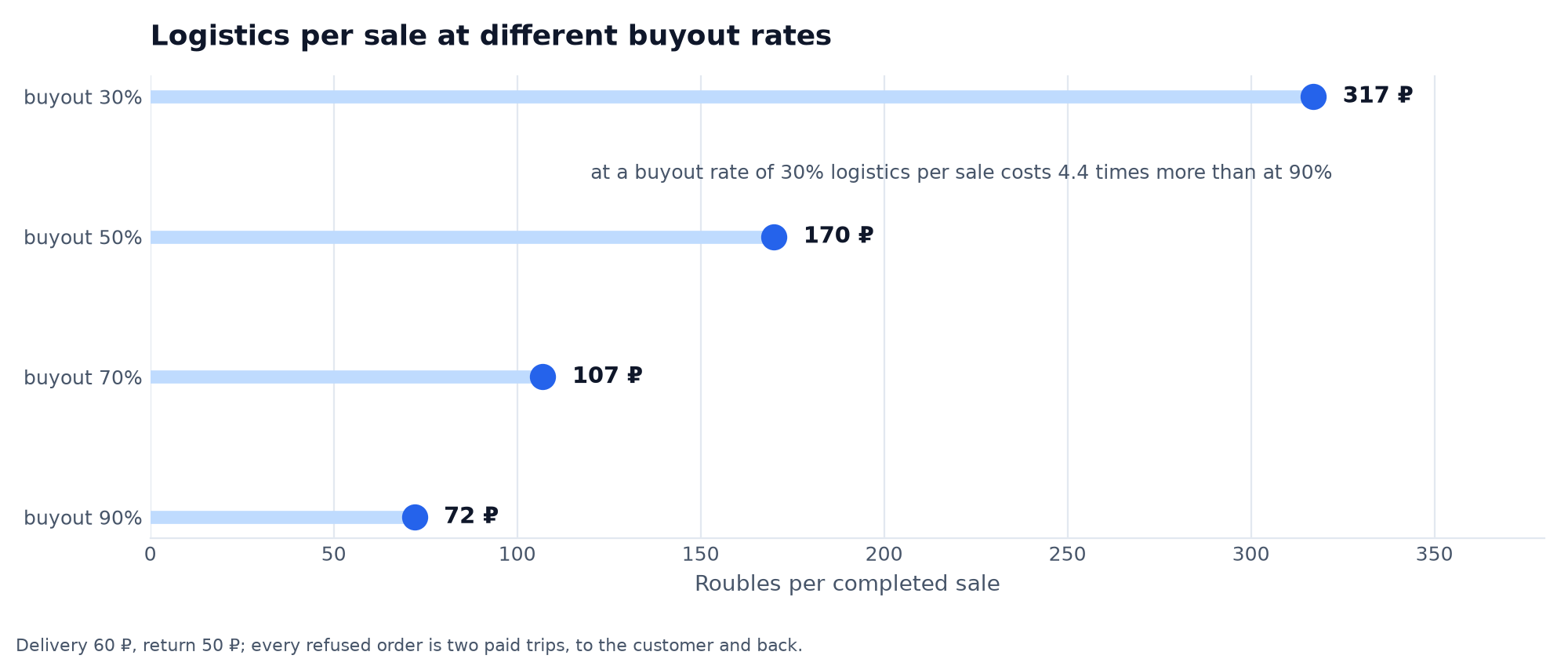
At 100 sales a month the difference between a buyout rate of 90% and one of 30% comes to 24,500 ₽ of pure overpayment for refused orders. That money is a separate line in no report at all, it is smeared across the "Logistics cost" column of the weekly report. To work out what a low buyout rate does to the profit of one particular product, use our unit economics formula with a free sheet, or go straight to the online Wildberries profit calculator, where the buyout rate is a field of its own.
What counts as a normal buyout rate
A normal buyout rate depends on the category, not on how hard the seller tries. The benchmarks worth keeping in mind:
- clothes and shoes: 30-60%, customers order several sizes to try on
- goods that need no fitting (home, cosmetics, electronics): 85-95%
- jewellery and accessories: 70-85%
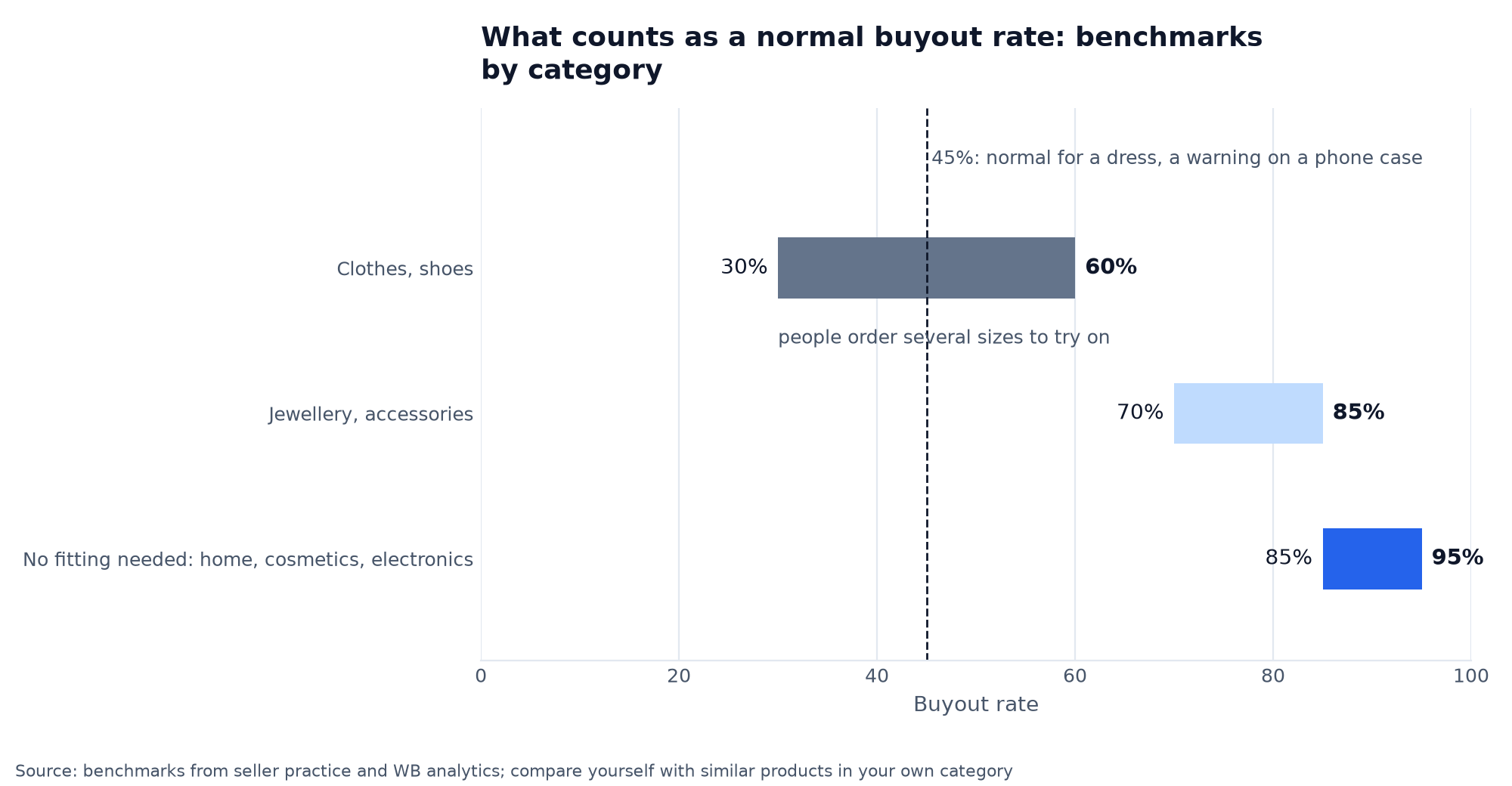
So a "bad" buyout rate of 45% on a dress is still the norm, and it gets priced in. The same 45% on a phone case is already a signal: something is wrong with the card or with the product. Compare your own category against similar products, not against the average across the site.
Why the buyout rate falls
Four causes cover almost every case:
- The card promises something the parcel does not deliver. The colour in the photo is brighter, the size chart lies, the composition in the description is off. The customer compared and walked away.
- Seasonal fitting. During sales and gift seasons people order more "just to look", and the buyout rate sags across the whole category at once.
- Quality and packaging. A crumpled box at the pickup point kills the buyout rate as surely as a defect does.
- Slow delivery. While the parcel spent ten days on the road, the customer found the same thing at the pickup point next door.
A sharp drop with no changes to the card? Check whether the dispatch warehouse changed and whether a defective batch came in.
How to raise the buyout rate
What works is not "secret tricks" but closing off the reasons for refusal. In order of effect:
- An honest size chart with measurements in centimetres. For clothing this is the main lever: fewer "I will order three sizes and send two back".
- Photos that match the product. Real colours, fabric close up, video. A beautiful render that feels like a different item raises orders and sinks the buyout rate.
- Answers to customer questions. A refused order often starts with an unanswered question about composition or compatibility. Answering everything fast is exhausting, so we hand that work to AI.
- Packaging that survives logistics. Bubble wrap is cheaper than a return.
- A warehouse closer to the customer. Fast delivery leaves no time to change your mind.
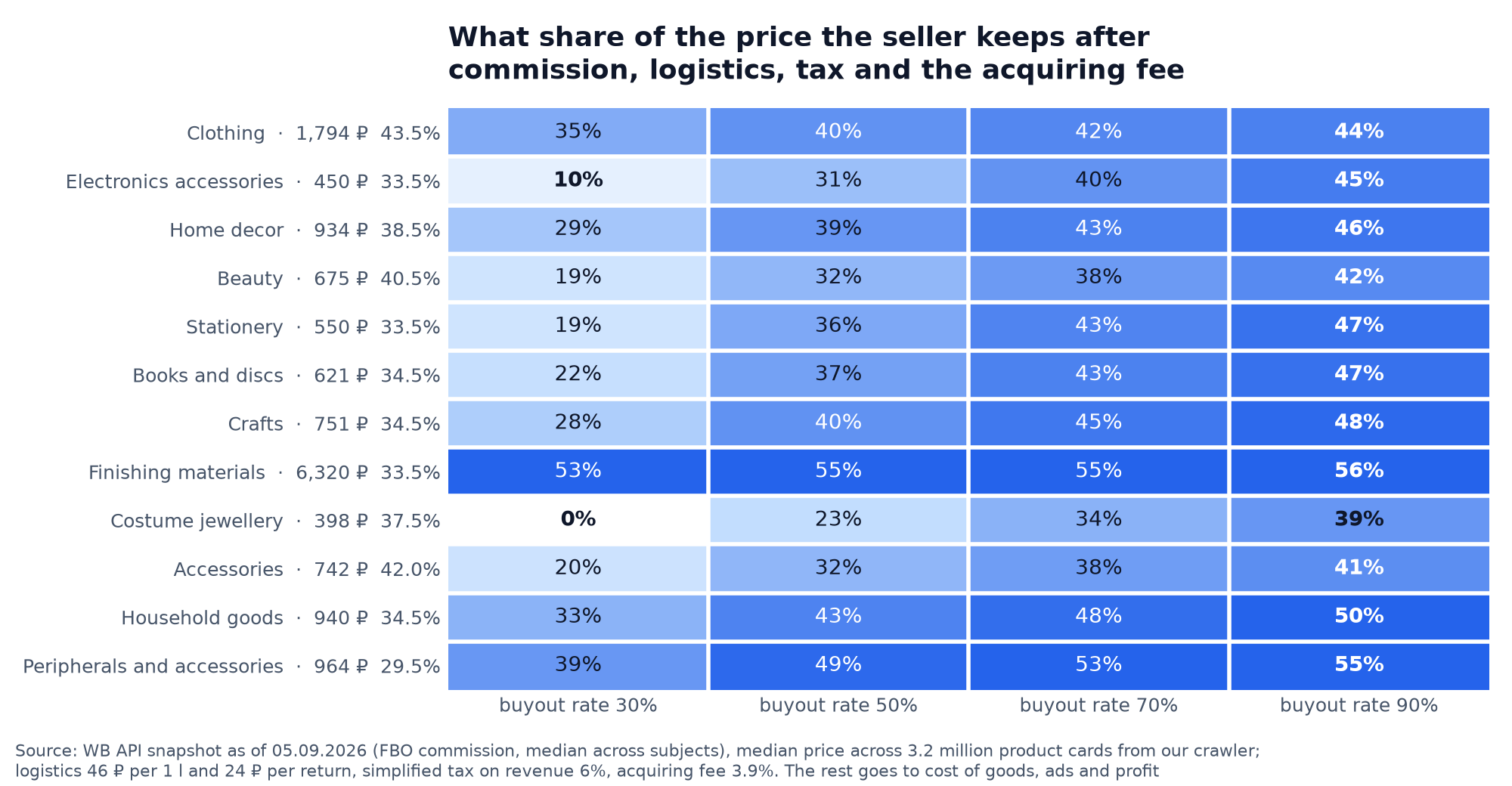
Check the effect by product two or three weeks after the change: the buyout rate is slow, it needs a volume of orders. What each point of buyout rate is worth in money shows across the 12 largest categories: on cheap products the share of the price left to the seller after commission and logistics grows several times over.
How the buyout rate gets into your profit automatically
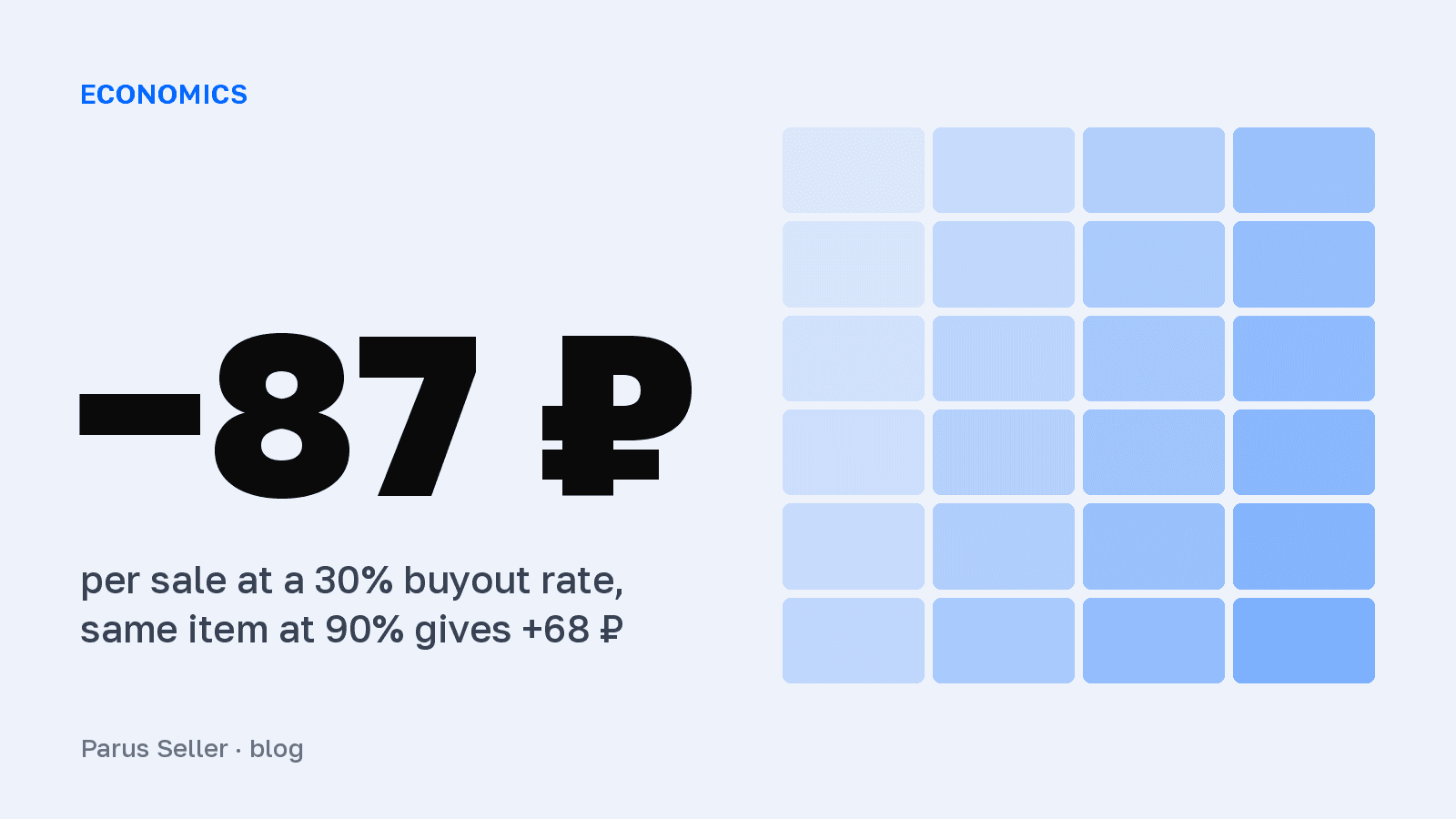
Counting "logistics adjusted for the buyout rate" by hand for every product costs you an evening, and a month later the calculation is out of date. Parus Seller does it itself: it takes the actual buyout rate of each product from WB reports, recalculates honest logistics and shows net profit with it included. The same screen shows which products ship losses because of returns, before that becomes visible in the bank account. The same effect on a single product is in the online Wildberries profit calculator: at a buyout rate of 90% a sale brings 68 ₽, at 30% it goes to −87 ₽.
First two months free with promo code PARUS60, no card required: sign up and connect your seller portal. Connecting by API key from the WB seller portal takes a couple of minutes, the key is created by the owner and revoked in one click.
And if you want to see where the rest of the price goes, we have breakdowns of unit economics with the formula for every deduction and 235 ad campaigns with their typical budget leaks.
FAQ
What happens if the buyout rate is low? Wildberries imposes no direct sanctions, but the economics suffer: you pay for every return trip, and between trips the item is frozen and not selling. Below the break-even buyout rate the product ships losses with every sale.
Why did the buyout rate drop for no visible reason? Usually the season (sales and holidays add "fitting room" orders), a new batch that differs from the card, or a change of warehouse with slower delivery. Look at the trend by product, not by store.
What buyout rate should you have on Wildberries? There is no universal number: 30-60% for clothes and shoes, 85-95% for goods that need no fitting, 70-85% for accessories. Compare yourself with similar products in your own category.
How does the buyout rate affect a card's promotion? WB does not publish it as part of the ranking formula, but the link is there indirectly: refused orders bring negative reviews and a drop in conversion, and those do move positions.
Is an item in transit counted in the buyout rate? No. While the order is on its way to the customer it takes no part in the calculation: the metric counts only completed orders.