What you get for lost goods: not the retail price but a calculated value under clause 11.3.5 of the offer agreement. VAT, WB's category commission and the category markup from the platform's own reference are taken out of the potential price. On a t-shirt with a potential price of 3,000 ₽ that leaves 965 ₽, on a smartphone of the same price 1,349 ₽. Goods count as lost 60 days after you demand them back, or on the day WB itself reports the loss. The money arrives within 30 working days plus 5 working days after you press Withdraw.
The query "сгорел товар на складе вб" is typed 578 times a month, "компенсация вб продавцу" another 126, and almost every article in the results was written after the fires of 2024 and 2025. They retell the news and promise compensation at the selling price. We opened the current version of the offer agreement dated 1 September 2026 and worked the formula out on real WB commissions and markups. The conclusions came out different.
In short: compensation is based on a calculated value, not on your selling price; about a third of the price comes back in clothing and footwear and up to 45% in electronics; lost profit is not covered; a fire from a drone, shelling or an explosion is explicitly listed as force majeure, and then WB pays nothing under this section; if the goods turn up after the payment, the compensation is deducted back.
When goods count as lost
The moment of loss does not arrive by itself, two rules define it. First: you demanded the goods back from the warehouse, and 60 days after the demand they did not reach the chosen pickup point. Then the goods count as lost from the end of that term. If WB reported a stock count before those 60 days ran out, the term extends: you count 90 days from the stock count notice.
The second rule works faster. WB may report the loss itself, and then the goods count as lost from the moment of the notice. Publishing the details in the portal counts as a notice too: the list, quantity and value of lost goods may arrive right inside the settlement report or a daily report. So rows with unclear write-offs are worth reading rather than scrolling past.
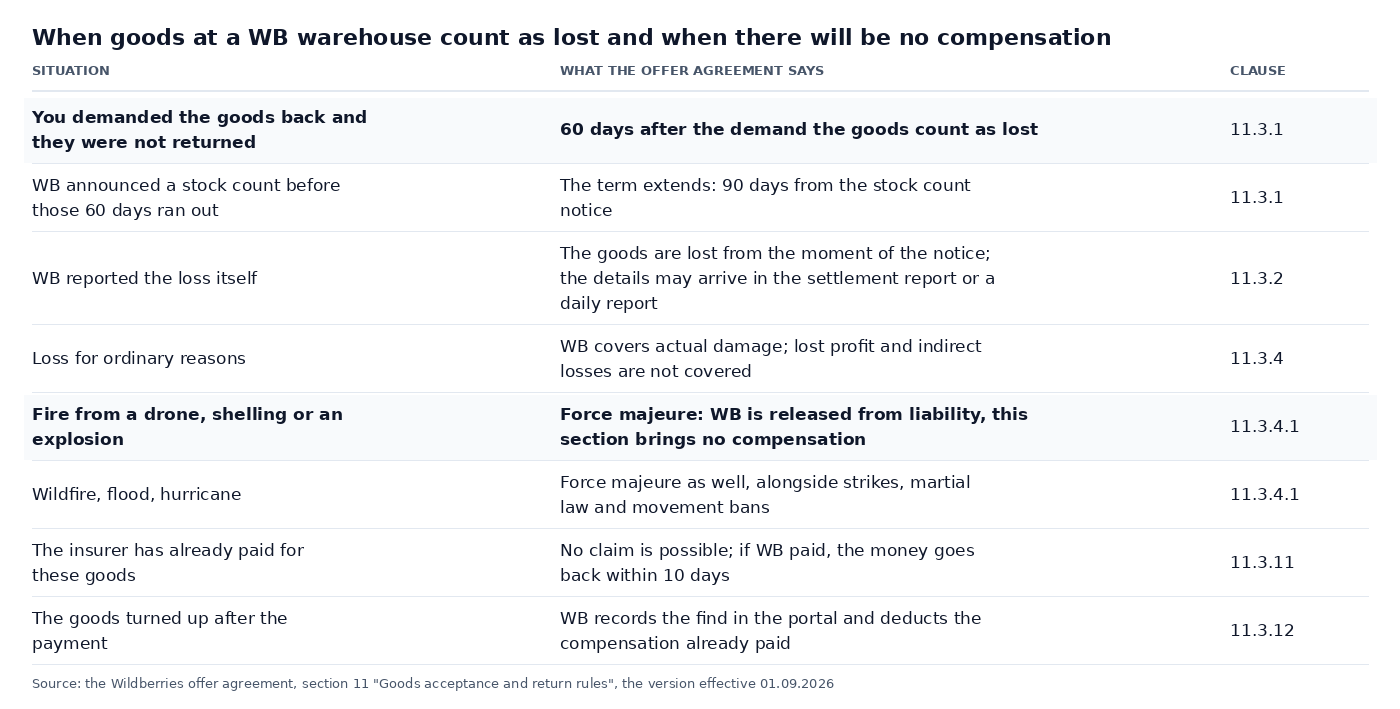
The offer agreement separately states that only actual damage is covered. Lost profit, including the difference between your retail price and the compensation, and any indirect losses, are not covered. In other words, the earnings you missed because the goods vanished before the season do not count.
How much is paid for burnt or lost goods: the formula
Clause 11.3.5 sets the formula for the calculated value: Sv = P − VAT − C − (P − VAT − C) × Markup%. Here P is the potential price, C is WB's commission for the item's category, VAT is the tax rate if you pay it, and Markup is the percentage from a separate reference of the platform. Put simply, the platform's share is taken out of the price first, and then your own markup as well, because it counts as income rather than cost.
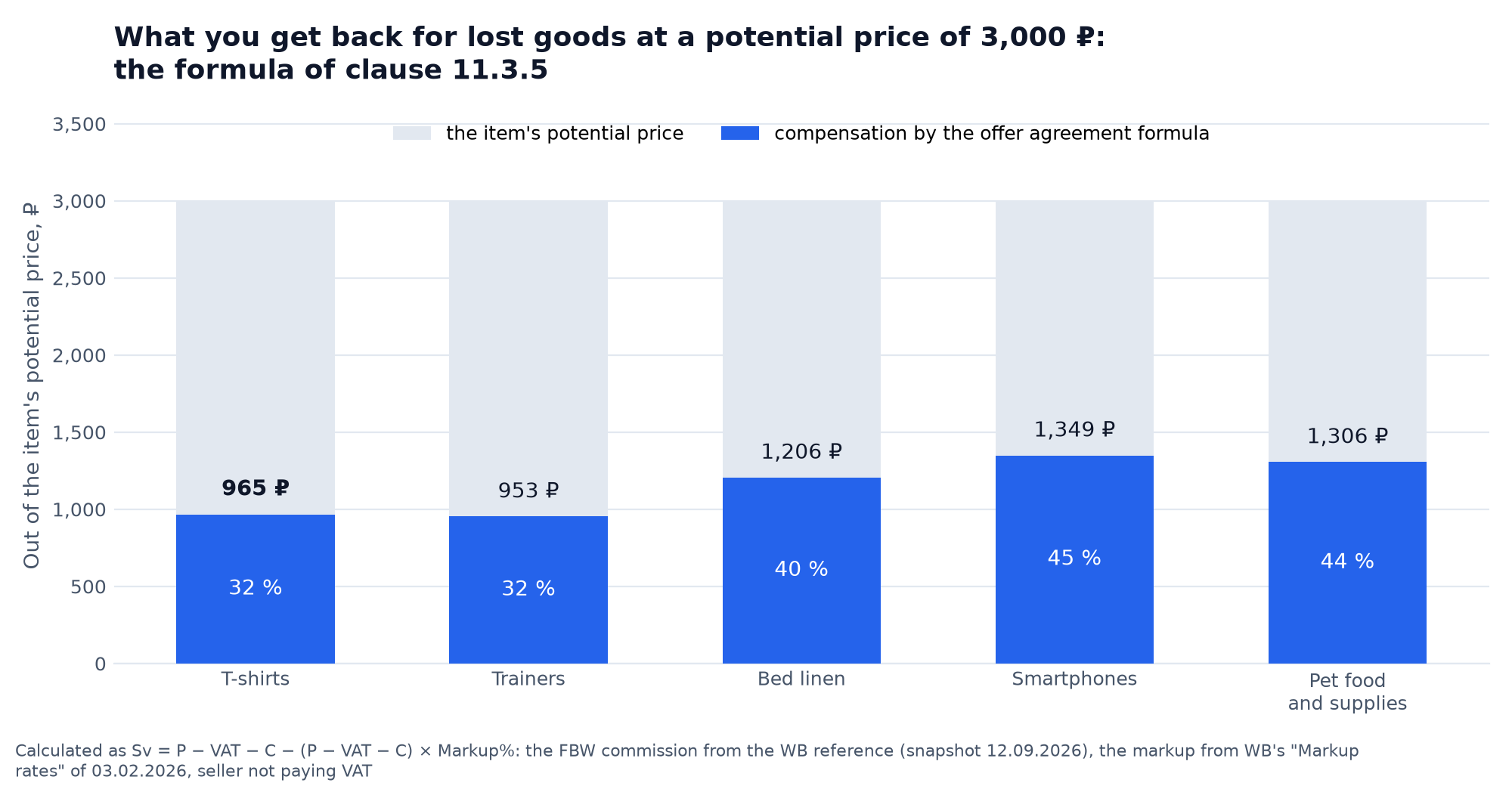
The figures on the chart are worked out on the current FBW commissions from WB's reference and the markups from the "Markup rates" document of 3 February 2026, for a seller not paying VAT. In clothing and footwear about a third of the potential price comes back, in bed linen 40%, in electronics and pet supplies 44% and 45%. If you do pay VAT, the compensation is smaller still, because the tax comes out of the price before everything else.
The potential price is not arbitrary either. If the item sold at least 10 times, it is your average retail price across every sale over the 365 days before the last sale. If there were fewer than ten sales, WB takes the average price of your own items of the same subject over the same period. And there is a ceiling: if the resulting price is above the maximum retail price for that subject across all sellers on the platform, that maximum is used instead.
There is a second route, through cost. WB may request purchase documents, and you may state your disagreement with the calculation, and then you have 10 days to put together the pack: contracts, delivery notes, handover acts, UPDs, invoices and payment documents. If the platform agrees with the confirmed cost, the compensation equals it. For an item with a high purchase price and a low markup this route pays better than the formula.
When WB pays nothing at all
The key paragraph missing from the popular articles is clause 11.3.4.1. It lists the force majeure circumstances that release the platform from liability. The list holds earthquakes, floods, wildfires and hurricanes, leaks of polluting substances, strikes and civil unrest, martial law and states of emergency, bans on movement.
And the final item there is the wording worth opening the agreement for: any consequences of the use, fall, launch or activation of weapons, military equipment, aircraft including drones, munitions and their parts, shelling and explosions. It is spelled out that this also covers objects considered neutralised, even when there are certificates confirming no explosive items are present.
The practical conclusion is simple. If the warehouse burnt down in a drone attack, compensation under section 11.3 is not due, and pressing support for it is pointless. What remains is goods insurance and the platform's own voluntary programmes, as happened with the Shushary fire of January 2024: WB published a compensation report in a separate portal section, and the seller accepted it with an "Agree with the report" button, which meant waiving other claims over that event.
Two more cases leave you with nothing. If the insurer has already covered the damage, the same claim cannot go to WB, and if the platform did pay, the money must go back within 10 days. And if the goods paid for later turn up at the warehouse, WB records the find in the portal and deducts what it paid from your balance.
Timings: when the money arrives
The count starts from the recognition of the loss. After it the platform has 30 working days to pay, and if cost documents were requested, the term runs from the moment you provide them. Then the amount appears in the portal as available to claim, and from that moment WB's obligation counts as fulfilled.
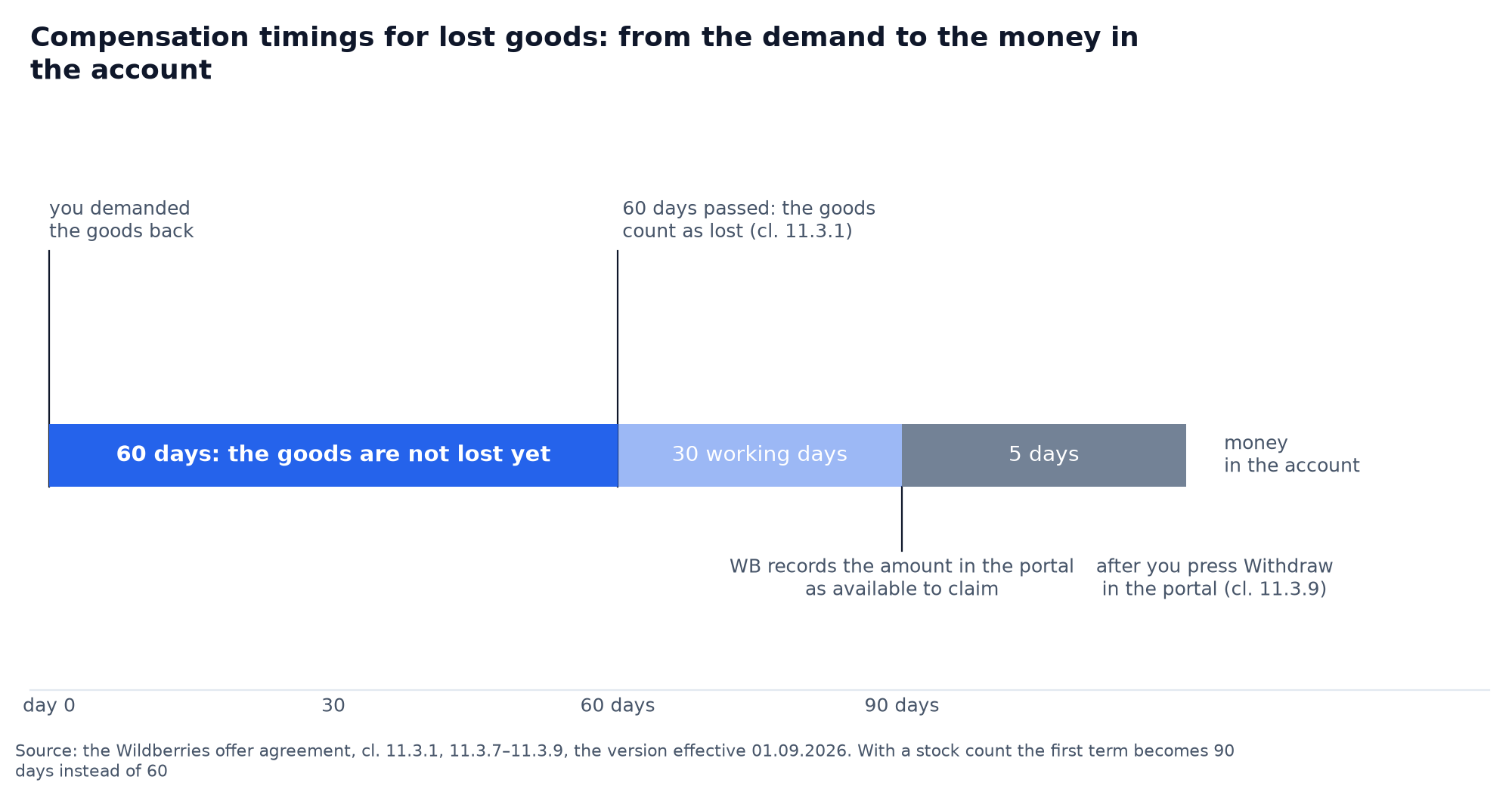
The last step is the seller's. The money does not leave on its own: you press Withdraw in the portal, and after that the platform has 5 working days to transfer it. The amount available to claim includes both the compensation and ordinary revenue minus every claim WB has against you, so seeing exactly the figure from the calculation will not happen.
What the seller should do, step by step
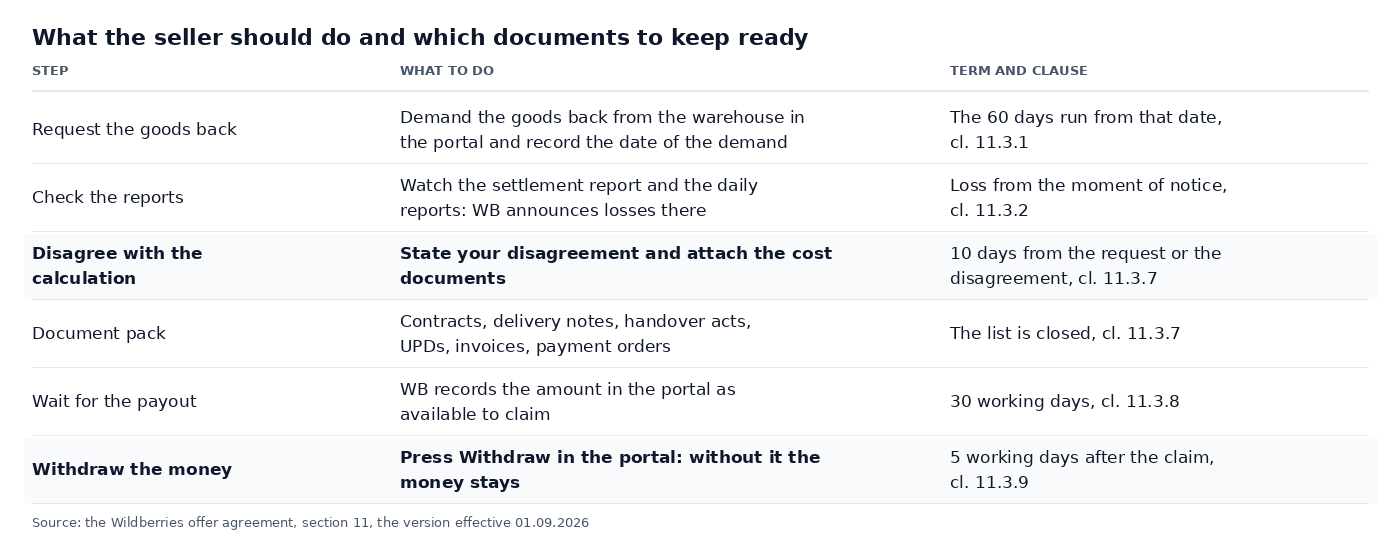
One habit is worth adding to this list. Record the date of your demand yourself: the 60 days run from it, and in correspondence with support that date will be the main argument. And keep purchase documents ready for your fast movers, because 10 days to gather the pack go quickly, especially with a supplier abroad.
Watching which amounts actually arrive in the reports is easier outside a spreadsheet: in Parus Seller the weekly reports, the line-item detail and the payout reconciliation sit side by side, and a discrepancy shows at once. How to sort out unclear write-offs in the report we covered in the article on WB deductions, and the acceptance and the report that start the warehouse's liability in the article on inbound acceptance at WB warehouses.
Frequently asked questions
Goods burnt at a WB warehouse, what comes first? Record what exactly was at the warehouse: stock by barcode on the date of the event, the reports and the value. Then watch whether WB recognises the loss itself, and in parallel check your policy if the goods were insured. If the cause was a drone attack or shelling, compensation under section 11.3 is not due.
Which WB warehouses burnt down? The large fires of recent years are Shushary in January 2024 and the warehouses hit by attacks in 2025 and 2026. For Shushary WB ran a separate compensation programme with a report in the portal and an acceptance button. For the attacks the platform carries no such obligation.
How long does compensation take? 60 days until the loss is recognised (90 if a stock count is announced), then 30 working days to pay and 5 working days after you press Withdraw. Two to four months in total.
Can compensation match the selling price? No. The agreement explicitly excludes lost profit, including the difference between your price and the calculated value. The most you can get beyond the formula is a documented cost, if WB agrees with it.
What if you disagree with the amount? State your disagreement and send the cost documents within 10 days. If the answer does not satisfy you, the next step is a pre-trial claim under clause 8.9 of the agreement with the numbers of all earlier requests.
Does insurance help? It replaces the compensation rather than adding to it: you cannot collect both an insurance payout and a WB payment for the same goods. On the other hand it works in the force majeure cases where the agreement releases the platform, and WB offers separate insurance for goods at partner fulfilment centres.