In Russian, the query for "self-employed on WB" is typed 1,100 times a month, and four out of ten of those people are looking for courier shifts or warehouse work. This article is for the other half, the people who want to sell what they make on Wildberries without registering a business. Self-employed here means registered under the professional income tax (NPD), the Russian regime for individuals with no company and no staff. Four guides at the top of search already disagree on the rate: MPStats and Sravni say 6%, because the money arrives from a company, while PromoPult and vc.ru say 4%. We read Federal Law 422-FZ, we read two Wildberries instructions and the clarifications from the Ministry of Finance (Minfin) and the Federal Tax Service (FNS), then we looked at sellers with no state registration number in the Wildberries catalogue and checked their tax IDs (INN) through the tax service lookup.
In short: a self-employed seller on Wildberries may sell only goods of their own making, with no Chestny Znak marking and no employees, as long as income for the year stays under the cap of 2.4 million ₽. The 4% tax on sales to individuals is calculated on the full customer price from the weekly settlement report, not on the payout. Receipts are issued in the My Tax app by the 9th of the following month, and the tax is paid by the 28th. Registration works the same as for a sole proprietor, except you can pay the 5,000 ₽ fee from a personal card.
Can a self-employed person sell on Wildberries, and what the law allows
Yes. The WB instruction "New seller registration", in the original «Регистрация нового продавца», dated 1 September 2026, names three legal forms that get a seller account: a company, a sole proprietor (IP) and a self-employed person. The restrictions come from the tax regime, not from the marketplace. Article 4 of Federal Law 422-FZ, as amended on 4 August 2026, lists who cannot use the professional income tax, and three items on that list hit marketplace sellers directly.
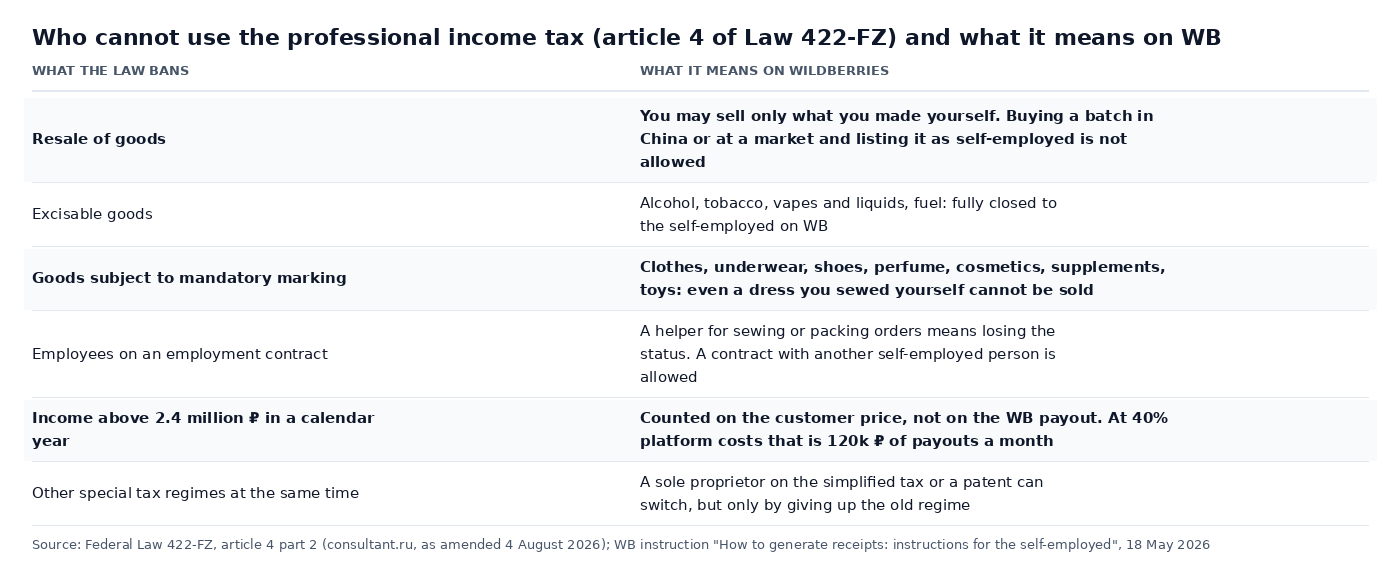
The first item is resale. You sell only what you made yourself: candles, ceramics, posters, soap, wooden stands, knitted clothes. A batch of phone cases bought in China and sold under your own brand is resale, and the regime does not cover it.
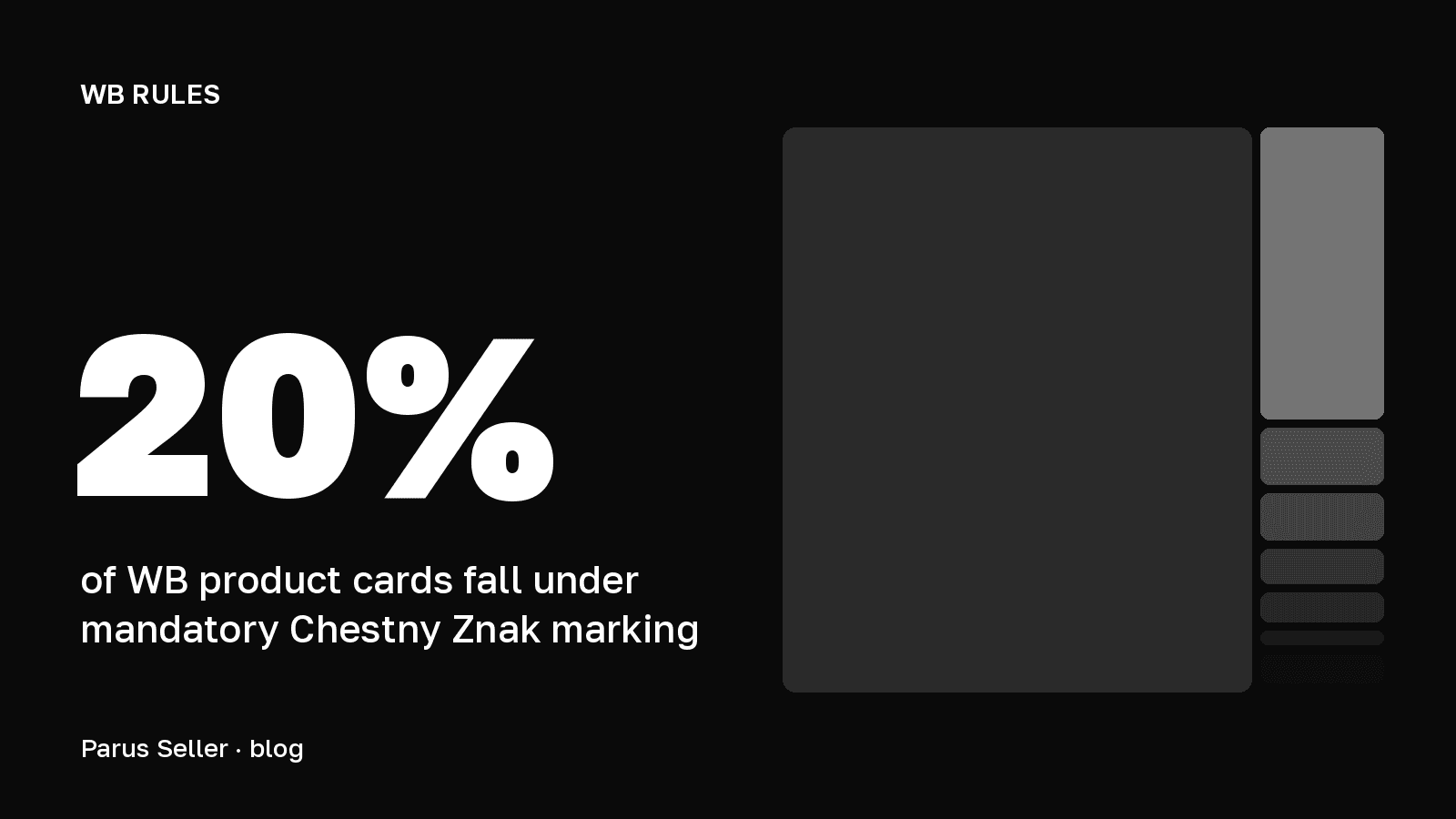
The second item rules out goods subject to mandatory marking, and this is where people go wrong most often. Clothes, underwear, shoes, perfume, cosmetics, supplements and toys carry Chestny Znak codes, Russia's product marking system, and a self-employed person cannot be a participant in the circulation of marked goods. A dress you sewed yourself cannot be sold on Wildberries as self-employed, which we covered in our article on Chestny Znak. The third item is the cap of 2.4 million ₽ a year, and it counts the customer price, not the sum Wildberries transfers to your card.
There is a flip side. A sole proprietor can pay the professional income tax too: you keep the entrepreneur status but pay 4% instead of the simplified tax and skip the fixed insurance contributions. Our supplier registry, built on Federal Tax Service data, shows that roughly 6% of sole proprietors with a known tax regime are on this one. To the marketplace they are ordinary sole proprietors with a business bank account, to the tax service they are self-employed.
How to register as self-employed on Wildberries: 5,000 ₽ from a personal card
Registration follows the same path as for a sole proprietor, and we walked through all 12 steps in our guide to starting on WB. Two things differ. On the step where you pick your legal form, tick "self-employed", and by that point you must already hold the status, because WB checks your tax ID against the Federal Tax Service registers. Getting the status takes ten minutes in the My Tax app with your passport, or through the taxpayer portal. WB also runs its own entry point at npd.wildberries.ru: registration starts in the WB Partners app and finishes in My Tax.
The second difference is how you pay the licence fee. Companies and sole proprietors pay the 5,000 ₽ only from a business bank account tied to their own tax ID. As a self-employed seller you need no business account, and the instruction lets you pay from a personal bank card by QR code. One condition: the payer's tax ID must match the one used at registration, so a card belonging to a friend or a relative will not do.
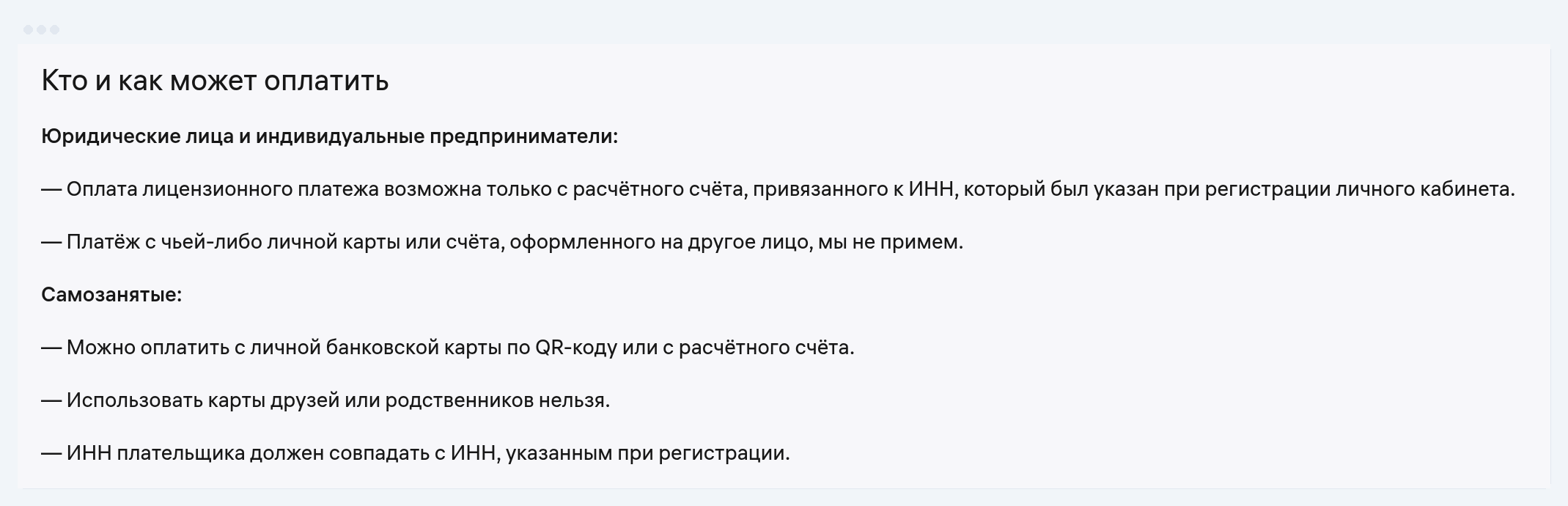
The amount and the rules are the same as for everyone else: 5,000 ₽ in a single transfer, VAT included, refunded as promo bonuses in the ad account rather than back to your card. Miss the 14-day window and the account is deleted. Wildberries sends sales payouts to the details you enter under Settings, and a personal card works there too.
What tax the self-employed pay on Wildberries: 4% of the customer price, not the payout
The rate depends on who the customer is, not on who sends the money. The rates on npd.nalog.ru are simple: 4% on income from individuals, 6% from companies and sole proprietors. The guides that say "6%, because WB is a company" are confusing the agent with the customer. In letter no. 03-11-11/74629 the Ministry of Finance explained that for marketplace sales the 4% rate applies to sales to individuals, even when the money arrives from the platform. The WB instruction "How to generate receipts: instructions for the self-employed", in the original «Как сформировать чеки: инструкция для самозанятых», updated on 18 May 2026, puts it even more precisely.
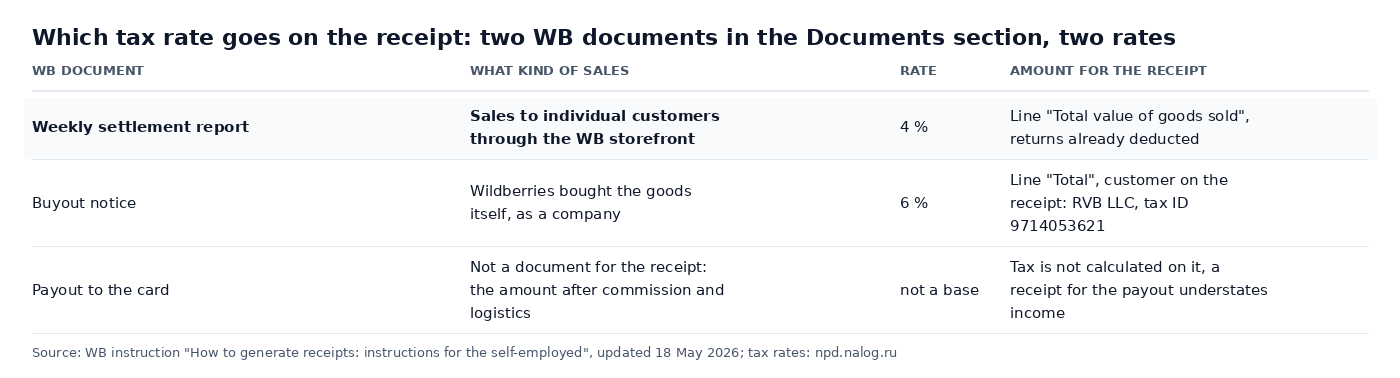
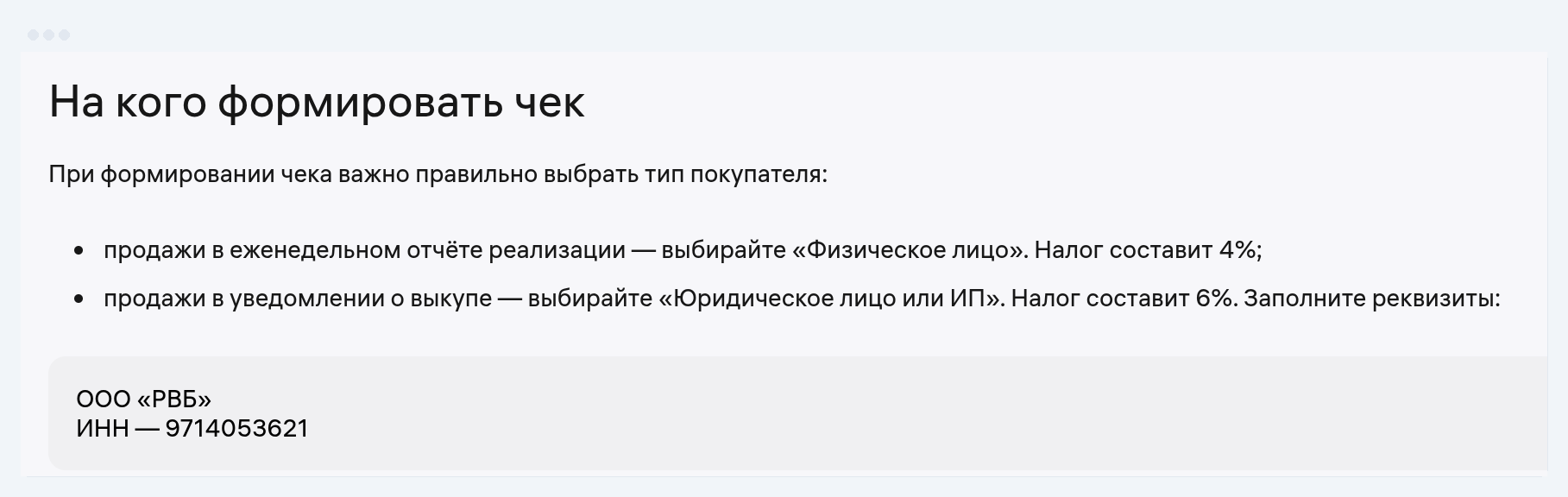
Sales in the weekly settlement report, «еженедельный отчёт реализации», are sales to individuals, so the rate is 4%. The amount for the receipt comes from the line "Total value of goods sold", «Всего стоимость реализованного товара», with returns already deducted. Sales in the "Buyout notice", «Уведомление о выкупе», are the cases where Wildberries bought the goods itself, so that name is about WB as the buyer and has nothing to do with your buyout rate. There the tax is 6%, and the customer named on the receipt is RVB LLC with tax ID 9714053621. We explained what these report lines are and how to read them in our article on the WB weekly report.
The big mistake is not the rate, it is the base. The WB instruction explicitly forbids deducting WB's commission or any other cost from the taxable amount. Take a single sale: the customer paid 1,200 ₽, the commission was 25%, logistics 80 ₽, the acquiring fee 4%, and 772 ₽ landed on the card. The 4% is calculated on the 1,200 ₽ and comes to 48 ₽, not 31 ₽ on the payout.
At a turnover of 150,000 ₽ a month, the "convenient" calculation from the payout understates the tax by roughly 2,000 ₽ a month. Under audit that saving turns into back taxes, interest and a penalty of 20% of the undeclared income under article 129.13 of the Russian Tax Code. We broke down what the payout is made of in our article on how much Wildberries takes from a seller.
The first months cost less. On registration you get the 10,000 ₽ tax credit: until it runs out, the 4% rate works like 3% and the 6% like 4%. The app applies it for you. At 100,000 ₽ a month the credit lasts about ten months.
How to pay the tax as a self-employed seller: receipts by the 9th, tax by the 28th
A self-employed seller on a marketplace does not issue receipts to customers, because part 2 of article 14 of Federal Law 422-FZ removes that duty when the sale goes through an intermediary. The income still has to be recorded, and you do that with a receipt issued to yourself in the My Tax app. You can issue one per sale, or a single sum per weekly report. The second is simpler, the first is handier with returns, because a receipt for a returned item is cancelled with the reason "goods returned by the customer".
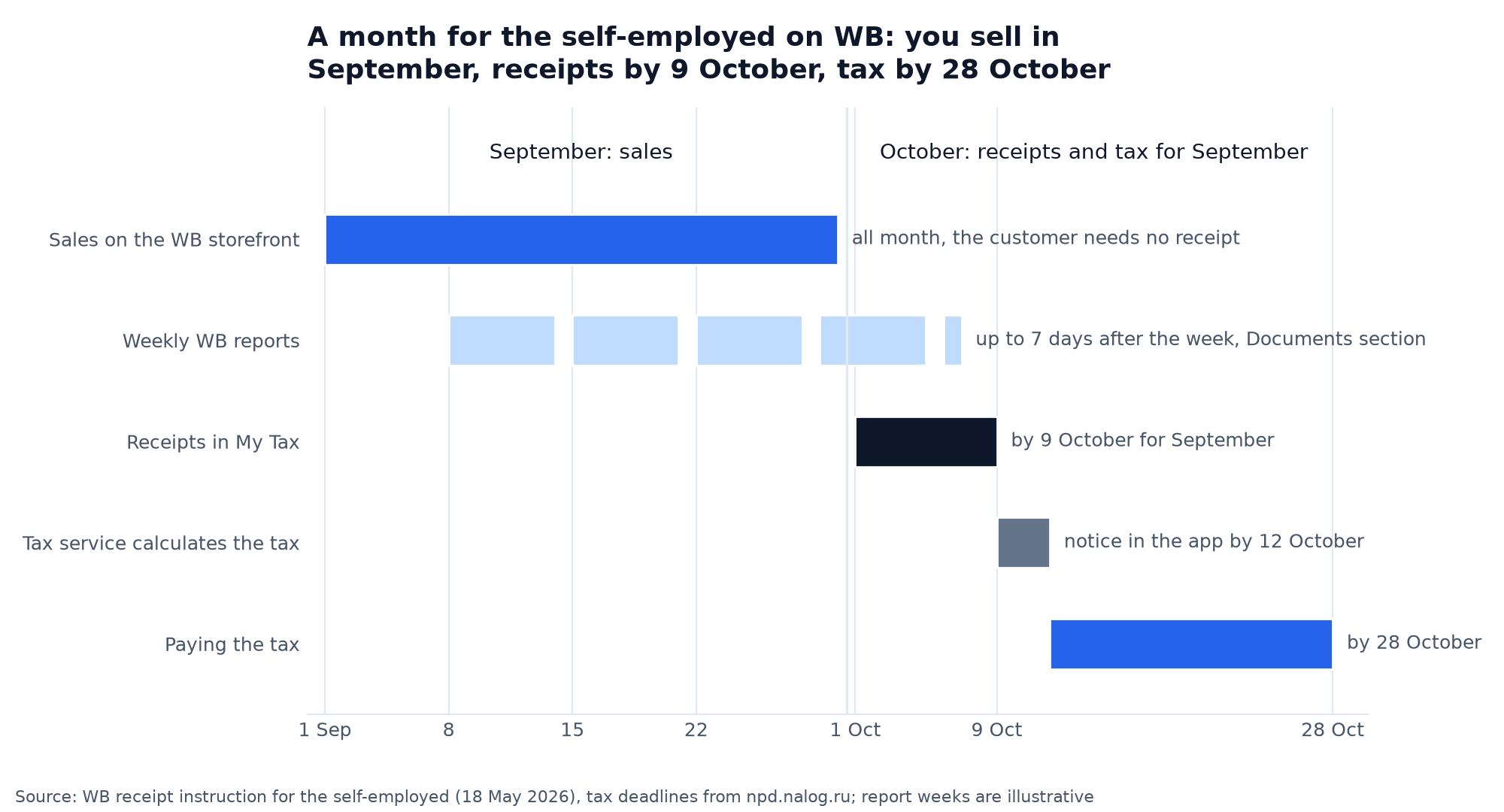
The deadlines in the WB instruction and the tax rules run like this. WB delivers printable reports to the Documents section within 7 calendar days of the reporting week. The receipt covering a month of sales must be issued no later than the 9th of the following month. By the 12th the Federal Tax Service pushes the tax amount into the app, and by the 28th you pay it. No return, no contributions, no accountant.
There is another path: fiscalisation, meaning you let WB issue your receipts. The platform then files them with the tax service and leaves you only the payment. The instruction warns about the trap: if both WB and you issue receipts, income and tax are counted twice. There must be one source of receipts.
Self-employed or sole proprietor on Wildberries: where the 2.4 million ₽ line runs
While sales fit under the cap, self-employment is almost always cheaper. We ran three options for a seller with no employees on 2026 figures: the 4% professional income tax, a sole proprietor on the simplified tax on revenue (6%), and a sole proprietor on the simplified tax on revenue minus costs (15%). A sole proprietor also pays fixed insurance contributions of 57,390 ₽ for 2026 plus 1% on income above 300,000 ₽ under article 430 of the Russian Tax Code. On the 6% regime the tax is also calculated on the full customer price, WB's commission does not reduce it, but the contributions are deducted from the tax in full.
Self-employed or sole proprietor: how much goes to the state in a year
Sales are counted at the customer price, the same way as in the WB settlement report. Fixed contributions of a sole proprietor for 2026: 57,390 ₽ plus 1% above 300,000 ₽. Every field is editable.
On 1,800,000 ₽ of sales per year, 450,000 ₽ is left after the platform and the cost of goods. Of that, to the state:
Self-employed, professional income tax (NPD) 4%
72,000 ₽
- Tax
- 72,000 ₽
- Contributions
- none
- In hand
- 378,000 ₽
No contributions and no pension record. The 10,000 ₽ tax credit at registration covers your first tax payments
Sole proprietor (IP), simplified tax on revenue (6%)
108,000 ₽
- Tax
- 35,610 ₽
- Contributions
- 72,390 ₽
- In hand
- 342,000 ₽
6% of the full customer price, reduced by mandatory contributions. In some regions the rate is 1–5%
Sole proprietor (IP), simplified tax on revenue minus costs (15%)
117,069 ₽
- Tax
- 58,753 ₽
- Contributions
- 58,316 ₽
- In hand
- 332,931 ₽
Commission, logistics and cost of goods count as expenses. The minimum tax is 1% of revenue
At 1.2 million ₽ of sales a year the self-employed seller pays 48,000 ₽, the sole proprietor on 6% pays 72,000 ₽, and the one on 15% about 94,000 ₽. At the edge of the cap, 2.4 million ₽, the gap doubles: 96,000 ₽ against 144,000 ₽. But self-employment builds no pension record, and if you want one, you pay the contributions voluntarily.
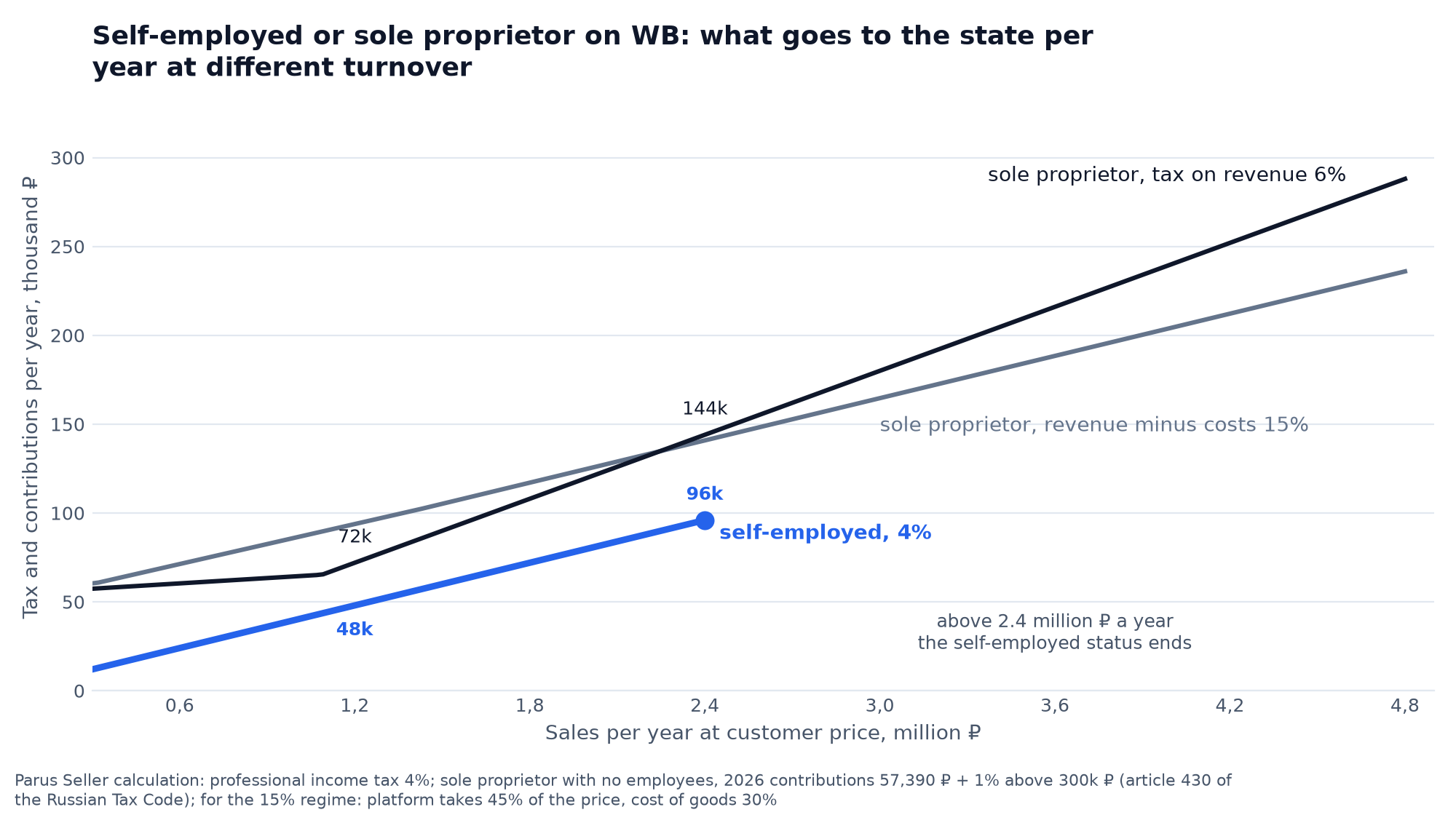
The 2.4 million ₽ cap runs cumulatively from 1 January and counts the customer price. With 45% of that going to the platform, it amounts to only 110,000 ₽ of payouts a month, which is one product selling well. Once you pass it, the WB instruction gives you 20 calendar days to register as a sole proprietor and pick a tax regime. If you already are one, the right to the professional income tax ends at the receipt that pushed income past 2.4 million. None of this needs a new WB Partners account: you change the legal form under Settings, in the seller's payment details.
How many self-employed sellers really trade on Wildberries, and what they sell
Wildberries does not publish the number of self-employed sellers, but you can spot them on the seller profile: a sole proprietor shows an OGRNIP, a company an OGRN, and a self-employed person only a name and a tax ID. We took the sellers whose product cards reached the popular-query slice of the catalogue in the 14 days before 11 September 2026 and split them on that signal. Sellers with no state registration number and no «ИП» in the store name came to 2,961 out of 93,000, a little over 3%. They hold 15,118 product cards, which is 1.8% of the catalogue in this snapshot.
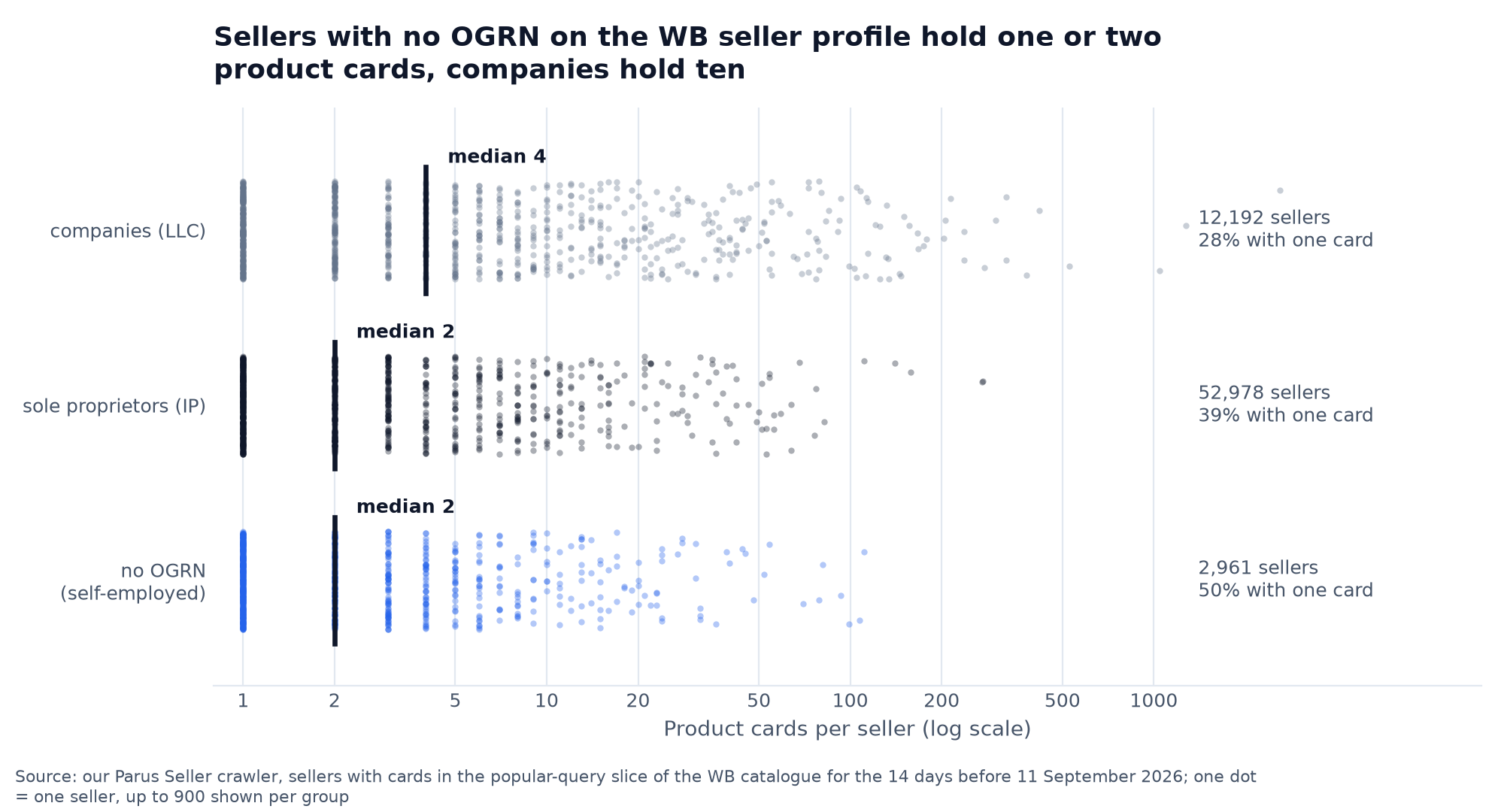
Half the sellers with no state registration number hold a single product card, and the median is two. Sole proprietors also sit at a median of two, but 39% of them trade with one card. Companies have a median of four, and 28% hold one. A self-employed seller on WB is almost always a store with one or two items, which makes sense for goods you make yourself.
Then we checked the tax IDs from that group against the open Federal Tax Service lookup, which answers whether a person pays NPD on a given date. Of 250 tax IDs checked, 123 were paying it on 11 September, about half. The rest either became sole proprietors while the WB seller profile kept the old details, or lost the status.
For comparison we also checked 80 sellers with no state registration number but with «ИП» in the store name: 6 of them pay NPD, so they are sole proprietors on that regime. That puts the real number of self-employed sellers in the popular-query slice at around fifteen hundred, which answers the question about competition. The handmade niche on WB is close to empty.
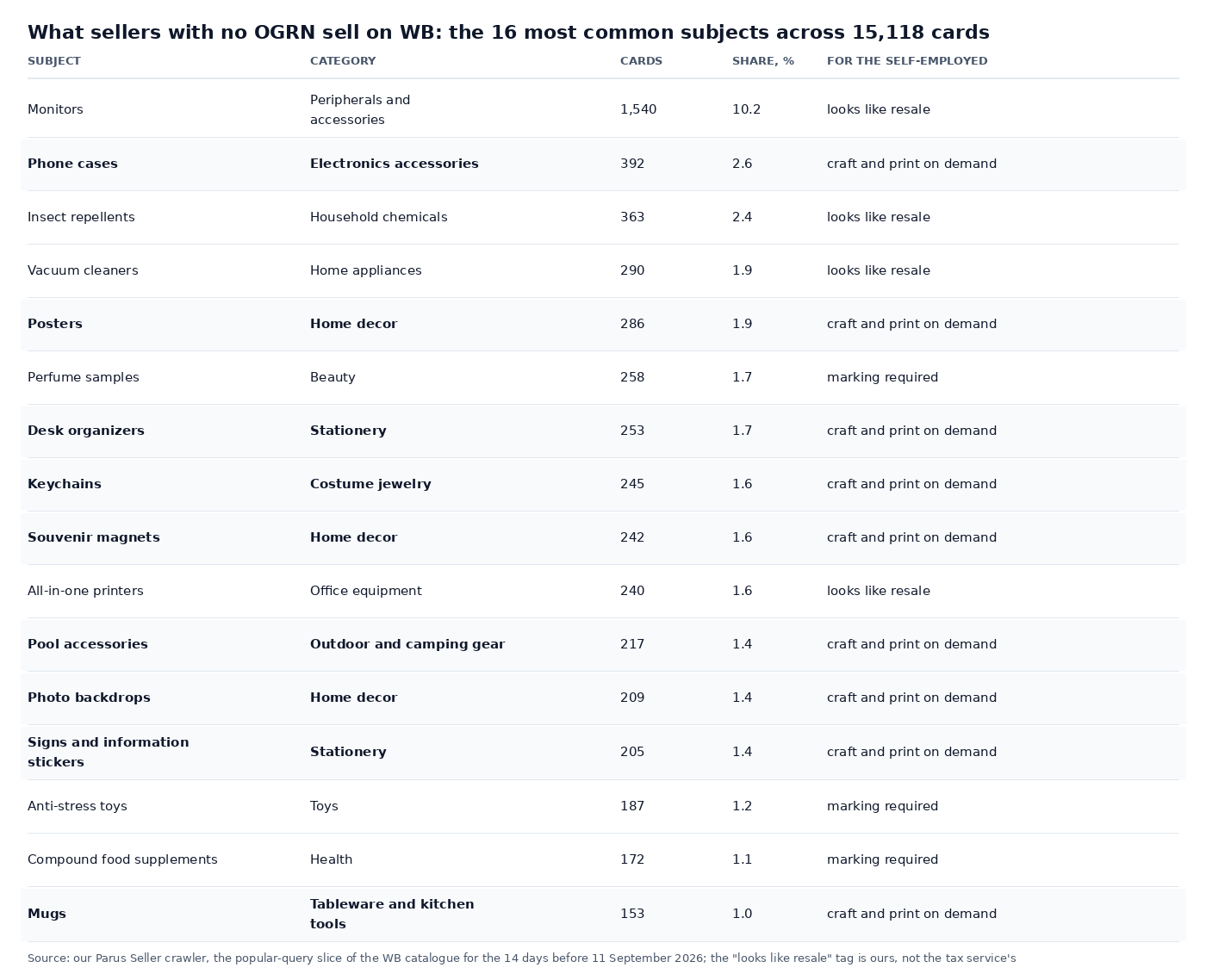
What this group sells tells two stories. The first is the expected one: printed phone cases, posters and paintings, photo backdrops, souvenir magnets, keyrings, postcards, printed mugs, desk organisers. That is print on demand and craft, none of it marked.
The second story is less pleasant. The same group holds monitors, vacuum cleaners and printers running to hundreds of cards, plus perfume samples and supplements. Reselling electronics is closed to the self-employed by law, and perfume and supplements are subject to mandatory marking. We checked the 25 largest sellers in the group by card count: only 6 pay NPD, and not a single seller of monitors, printers, vacuum cleaners or cables is self-employed. They are sole proprietors whose WB seller profile simply carries no OGRNIP. There are few craftspeople among the large sellers, and that is part of the answer too: a self-employed seller on WB rarely grows past a dozen cards.
Four traps for the self-employed on Wildberries
Three of the four traps are about the tax rather than the platform, and WB warns about them in its instruction. The fourth is about the cap, and nobody in the top of search writes about it: sellers count the 2.4 million from payouts, while the law counts the customer price.
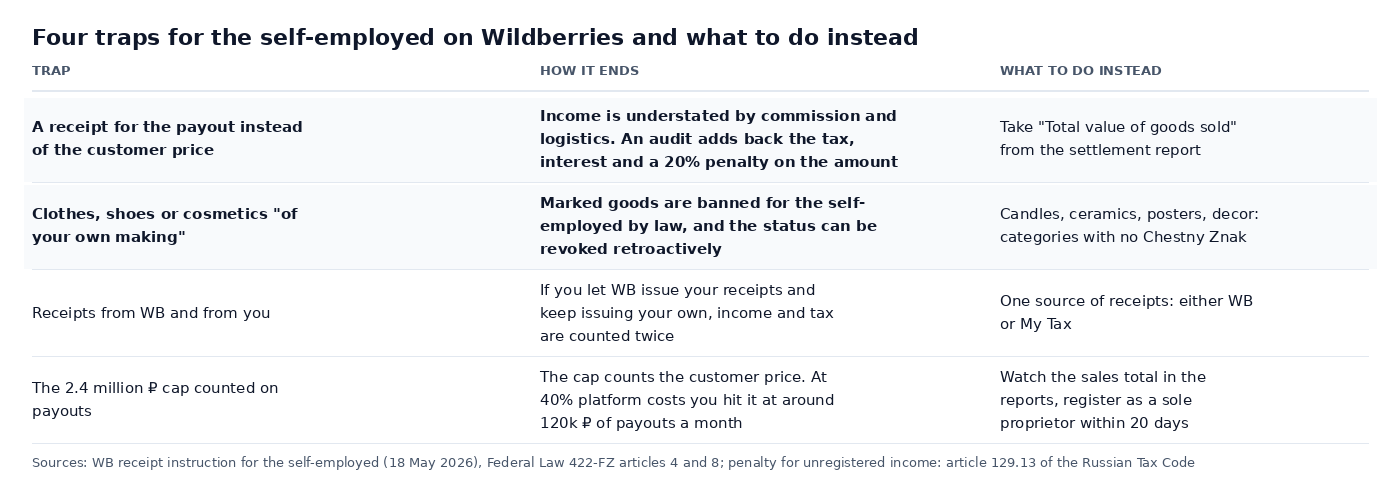
If sales are growing and the cap is close, register as a sole proprietor early rather than in the last 20 days. Work out your cost of goods, commission and logistics with our WB calculator and pick between the 6% and the 15% regime by your own cost structure. We went through the terms in our article on the WB 2026 offer agreement, which is one document for sole proprietors and the self-employed alike.
FAQ about self-employed sellers on Wildberries
Can a self-employed person sell clothes on Wildberries? No. Clothes, underwear and shoes are subject to mandatory Chestny Znak marking, and article 4 of Federal Law 422-FZ bars anyone on the professional income tax from trading marked goods. That covers garments you sewed yourself. Clothing needs a sole proprietor registration.
Does a self-employed seller need a business bank account for WB? No. Under the WB instruction dated 1 September 2026 you pay the licence fee from a personal card by QR code, and payouts arrive on a card as well. The one thing that matters is that the payer's tax ID matches the one used at registration.
What amount does a self-employed seller pay tax on? The line "Total value of goods sold" in the weekly settlement report, which is the price the customer paid. WB's commission, logistics and advertising are not deducted from the base, as stated both in the WB receipt instruction for the self-employed and in the Federal Tax Service knowledge base.
How does a self-employed seller handle tax on returns? The report line already accounts for returns, so a single weekly receipt needs no adjustment. If you issued receipts per sale, the receipt for the returned item is cancelled in My Tax with the reason "goods returned by the customer".
What happens if a self-employed seller passes 2.4 million ₽ on WB? The right to the professional income tax ends with the sale that crossed the cap. You then have 20 calendar days to register as a sole proprietor and choose a tax regime. The WB account stays the same, only the seller's payment details in the settings change.
Author: Andrey Rybakov, Head of Analytics at Parus Seller. Based on data from 770,000 WB suppliers and 235 ad campaigns we analysed.