How to create a supply on Wildberries: under FBW (WB calls the model "WB warehouse", the market still says FBO) a supply is created in the Supplies and orders section in four steps: products, packaging type, drop-off point, date. Under FBS a supply is assembled from customer orders, the seller has 192 hours to ship, and the commission discount goes only to those who make it in 13. A pickup point accepts only a box up to 80 cm per side, up to 500 items and 200 litres; pallets go to a sorting centre. Handling an FBS order at a pickup point costs 10 ₽ per item up to 500 a day and 50 ₽ for every item after that.
The query "поставка вб" is typed 10,900 times a month, plus another 4,100 with the spelling "вайлдберриз". The guides at the top of the results were written before September 2026 and miss three things. WB introduced goods intake points (PPT) with no queue of customers, added the "per-unit pallet" supply type and opened partner fulfilment centres. We took four guides from the seller portal, updated between 31 August and 18 September, and assembled a single route out of them: what to click, what to stick on, where to drive and what it costs.
In short: FBW is four steps in the portal and three packaging types, FBS is an assembly task with a 192-hour timer; pickup points take boxes only, pallets only sorting centres; shipping an FBS order within 13 hours cuts the commission by 5 points, shipping after 48 hours means a penalty; at a pickup point handling costs 10 ₽ per item up to 500 a day, then 50 ₽.
Which Wildberries supply routes exist: FBW, FBS to a sorting centre and FBS via a pickup point
A seller has three routes, and they differ in who stores the goods and who picks the order. Under FBW you deliver a batch to a Wildberries warehouse in advance, and the platform stores, picks and delivers on its own. Under FBS the goods stay with you, and every customer order becomes an assembly task that you pack and take either to a sorting centre or to a pickup point. The name "FBO" has not appeared on the WB portal for a long time; the model is called "WB warehouse" with the FBW tag. We keep both spellings in this article because people search both ways.
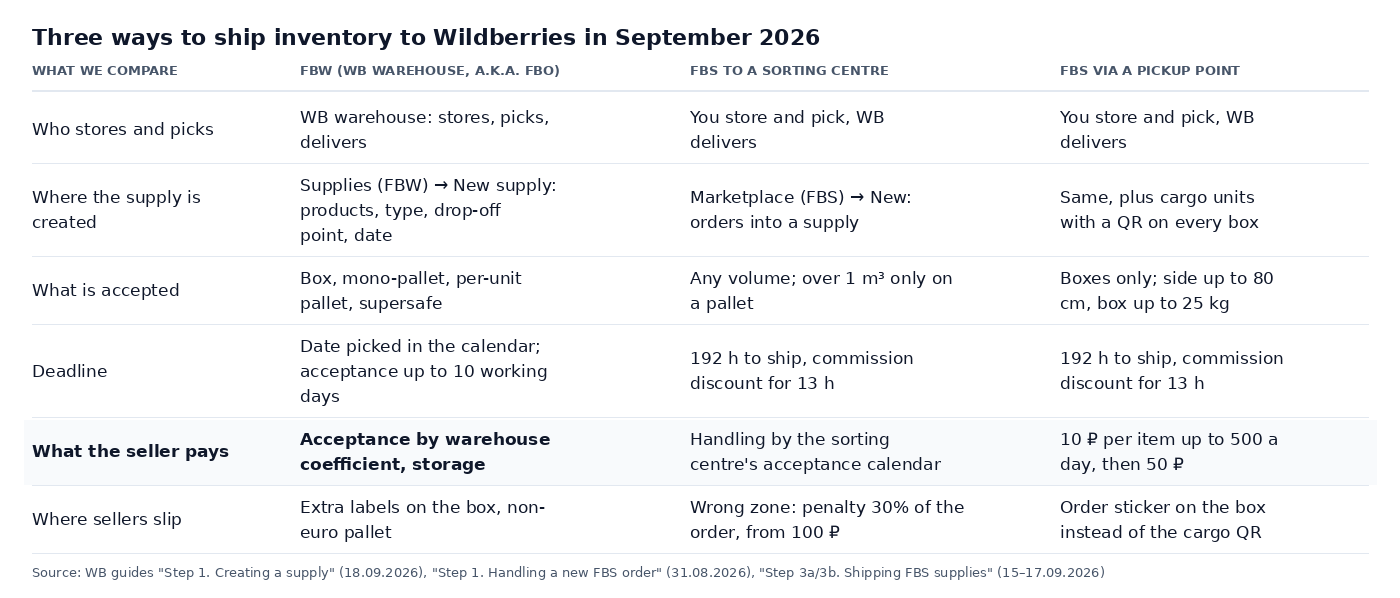
The choice between them is not a matter of taste. If the product sells evenly and space at a WB warehouse costs less than your rent, FBW wins: the customer gets the order faster and you pay no handling fee per unit. If the range is wide and demand is jumpy, FBS keeps stock under your control and does not require catching acceptance windows, but every order has to be packed within hours, not days. Many sellers trade both ways at once: fast movers at a WB warehouse, the long tail from their own.
How to create a Wildberries supply under FBO (FBW) step by step
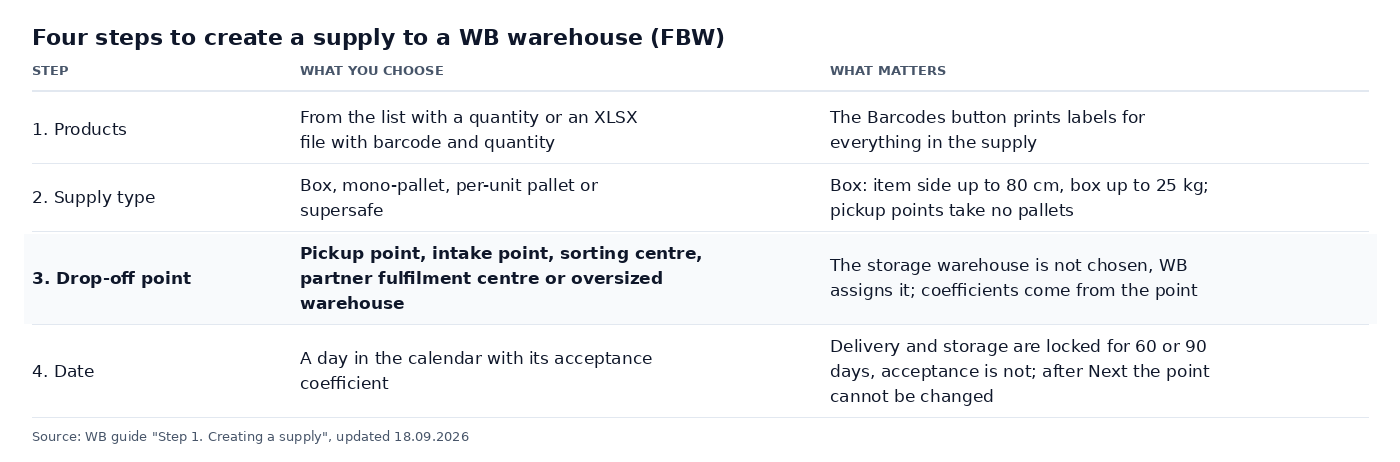
The WB guide "Step 1. Creating a supply" was updated on 18 September 2026, and this is the path. In the Supplies and orders section open Supplies (FBW) and click New supply. Products are added by hand from the list with a quantity, or with an XLSX template with a barcode and quantity on each row. The Barcodes button here prints labels for everything in the supply.
The second step is the supply type. A box suits a wide range and small batches. The shipping box base is up to 120 × 80 cm, an item side in individual packaging up to 80 cm, the sum of three sides up to 160 cm, a box with goods up to 25 kg, and every box carries its own barcode. A mono-pallet is for bulky and heavy goods: an item side up to 120 cm, the sum up to 200 cm, no more than three barcodes per pallet separated by cardboard, and the load together with the pallet at least 50 cm high.
The per-unit pallet is the new type, and it combines both. Goods as in a box, boxes standing on a pallet under stretch film, only the pallet gets a label, and at the warehouse such a supply is accepted item by item. The supersafe is reserved for jewellery and expensive goods.
The third step is the drop-off point, and here is the main change of recent months: you cannot choose the storage warehouse. You pick only the point where you bring the goods, and after acceptance WB spreads them across its own warehouses. The acceptance, delivery and storage coefficients are taken from the drop-off point. The fourth step is the date. Delivery and storage coefficients are locked for 60 or 90 days, the acceptance coefficient is not locked and is taken on the shipping day. After the Next button at the date step the drop-off point can no longer be changed.
Then comes packing under the guide "Step 3. Preparing the supply for shipment" of 4 September. The rule that costs most to break: only the box barcode goes on the box. If an item barcode, an IMEI or a stray label ends up on it, the warehouse may accept a box with twenty units as one unit, and that becomes a shortfall. The second rule is about pallets. Sorting centres take only wooden euro pallets of 120 × 80 × 14.5 cm, a load up to 1.8 m high and 500 kg, film no thinner than 0.15 mm. Inside the truck a 10 cm gap must remain between the pallets and the edge for the loading bridge. Third: if one truck carries four or more box supplies, only one may be handed over loose, the rest go on a pallet with a packing list.
Print item barcodes in advance and check three places: the card, the label, the supply. If the card has two barcodes and the item carries the one not entered in the supply, the item will not be accepted. For WB labels of the right format we have a free barcode generator. It draws 58 × 40 and 58 × 30 labels in the browser without sending anything anywhere, and in Parus Warehouse the same labels print for every item of a supply at once.
Where to ship: pickup point, intake point, sorting centre or WB warehouse
The phrase "вб поставка на пвз" is searched 985 times a month, and WB's answer to it got longer in September. A pickup point accepts only the Box type in a shipping box: a side up to 80 cm, the sum of sides up to 160 cm, up to 500 items and 200 litres per supply. A regular pickup point also has a minimum box size of 30 × 20 × 30 cm and a total supply weight of up to 25 kg. The list of what a pickup point will not take is long: large and oversized goods, jewellery, perishables, aerosols, paints, oils, furniture, building materials, fertilisers and soils. A refused box has to go back with you; it cannot be left at the point.
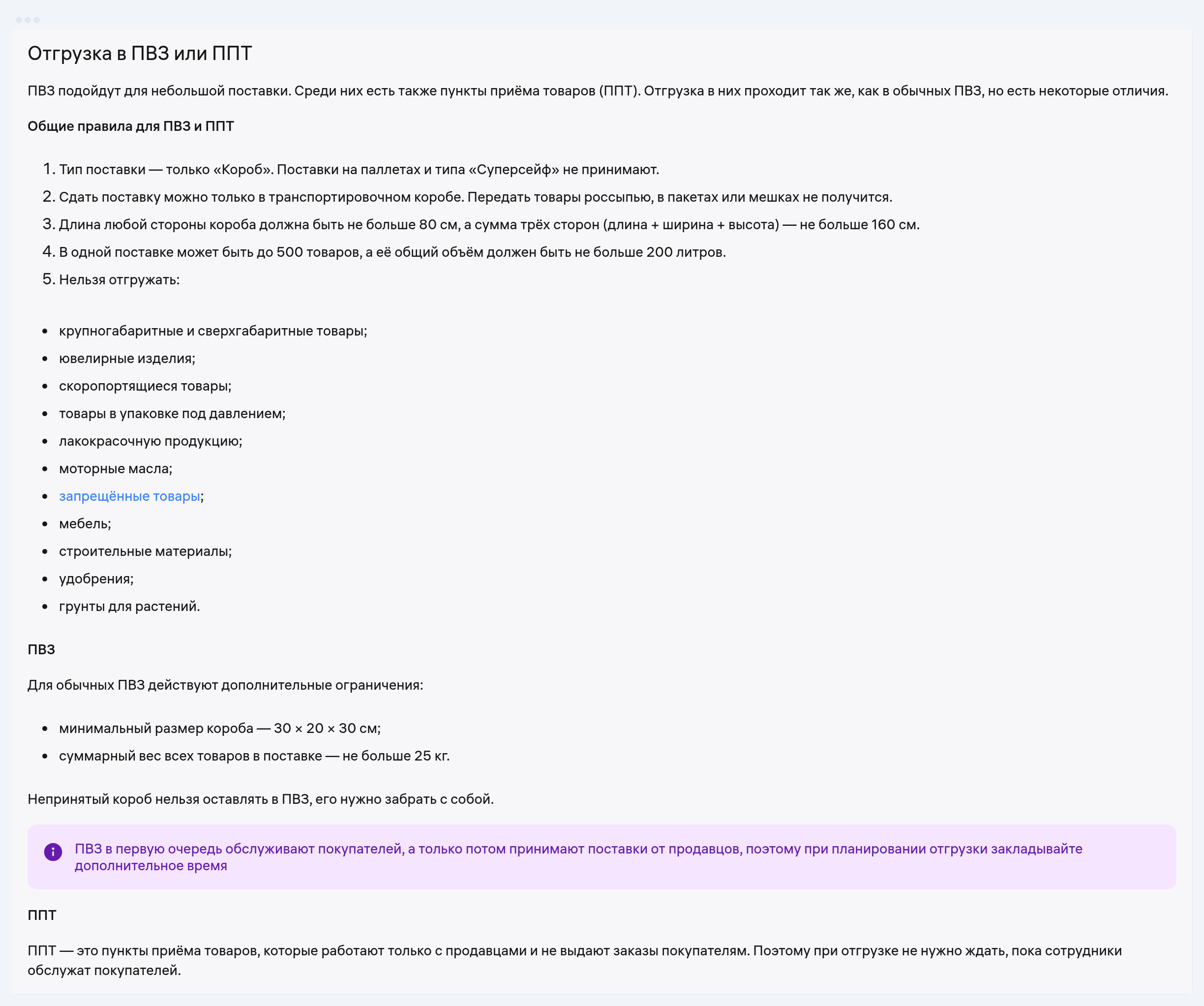
Intake points (PPT) work with sellers only. There is no queue of customers, no minimum box size and no supply weight cap, but for now they take no flammable goods and nothing with Chestny Znak marking codes. There may be no Wildberries sign at the intake point's address; the only landmark is the address on the portal. A sorting centre accepts supplies of any type and spreads them across warehouses. The oversized warehouse is a separate route for large goods. And one more new line in the list of points: points tagged "PFC", partner fulfilment centres, where the goods are also stored after acceptance, and after a refusal may travel to the nearest WB warehouse.
In September 2026 the acceptance coefficient is visible only in the portal, in the Rates section and in the calendar when picking a date. The API method that gave coefficients to services was switched off by WB on 15 August, and our window catcher is paused along with everyone else's. How acceptance itself is calculated and what to do with a ×10 coefficient we covered in the article on inbound acceptance at WB warehouses. Here we only recall: the coefficient multiplies 1.7 ₽ per litre for boxes and 500 ₽ per mono-pallet. One and the same 1,920 litre supply costs from 0 to 32,640 ₽ depending on the day.
How to create a Wildberries supply under FBS and ship it via a pickup point
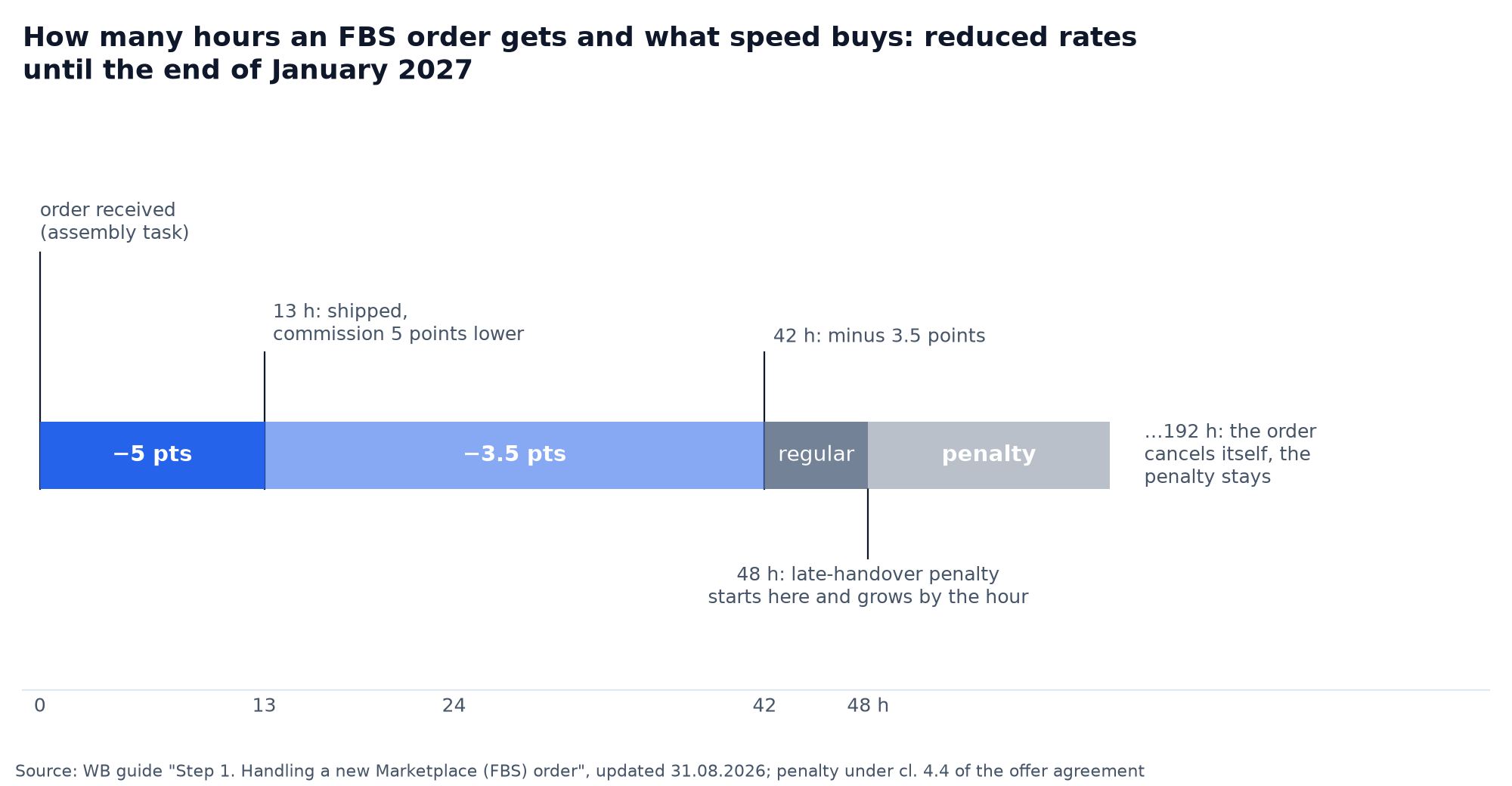
An FBS supply is not planned, it is born from orders. The guide "Step 1. Handling a new order" of 31 August gives the timer: an assembly task must be shipped to a warehouse, a sorting centre or a pickup point within 192 hours, otherwise the order cancels itself and WB charges a penalty. Inside those eight days there is a ladder that runs until the end of January 2027. Ship within 13 hours, and the commission coefficient for sales from your own warehouse (kS) drops by 5 percentage points. Make it in 42 hours, minus 3.5 points. Between 42 and 48 hours the commission is the base one. After 48 hours a late-handover penalty under clause 4.4 of the offer agreement is charged, whether the customer buys the item or not.
Assembly goes through Supplies and orders → Own warehouse → Marketplace (FBS) → New. You tick the orders, click New supply, and here are two limits that trip up newcomers: one supply takes orders from one seller warehouse only, and individuals and legal entities do not mix. The button "Collect all small-item orders" puts every new small-item order into the supply in one click, except legal entities, large and oversized goods. The picking list opens in the browser, in XLSX or in PDF, and in the browser version several employees can mark items as picked at the same time. A supply can be edited, renamed and orders moved between supplies only until the Hand over for delivery button.
Shipping to a sorting centre is described in "Step 3a" of 17 September, and there the zone rule applies. You may drive only to a sorting centre in your own zone, otherwise the penalty is 30% of the value of every order, but no less than 100 ₽ under clause 9.10.1 of the offer agreement. Without the supply QR code the load is not accepted, a supply travels in one vehicle, a pass is valid three days for one entry, and a volume over one cubic metre is accepted only on pallets. If the supply was turned away, the reason is visible in the status "Not accepted at the warehouse", and you get 120 hours from the order's creation to fix it. Is a carrier bringing the load? Then an electronic waybill via EDI is required, but until 1 March 2027 a paper waybill passes without a penalty.
The pickup point route under "Step 3b" of 15 September is built on cargo units. One box is one cargo unit with its own QR code, and the system allows no more cargo units than half the orders in the supply. Every item gets an order sticker, every box a cargo QR, and they must not be mixed up: an order sticker on the box means the whole box goes to one customer. Acceptance happens only with the seller present. The employee scans the box QR, opens it and scans every sticker, so bring tape with you. At least two hours must pass between two shipments to the same pickup point.
What a Wildberries supply costs: acceptance, pickup point handling and penalties
Under FBW you pay acceptance by the warehouse coefficient and storage, under FBS the handling of every unit. The guide "Step 3b" is the first to put a number on pickup point handling: the first 500 items a day at 10 ₽ each, every item after that at 50 ₽. The cap is counted separately for each zone of your warehouses. A seller with 300 orders a day pays 3,000 ₽, with 500 orders 5,000 ₽, and with 800 already 20,000 ₽. The 300 items above the cap cost 50 ₽ each, and that is three quarters of the whole bill.
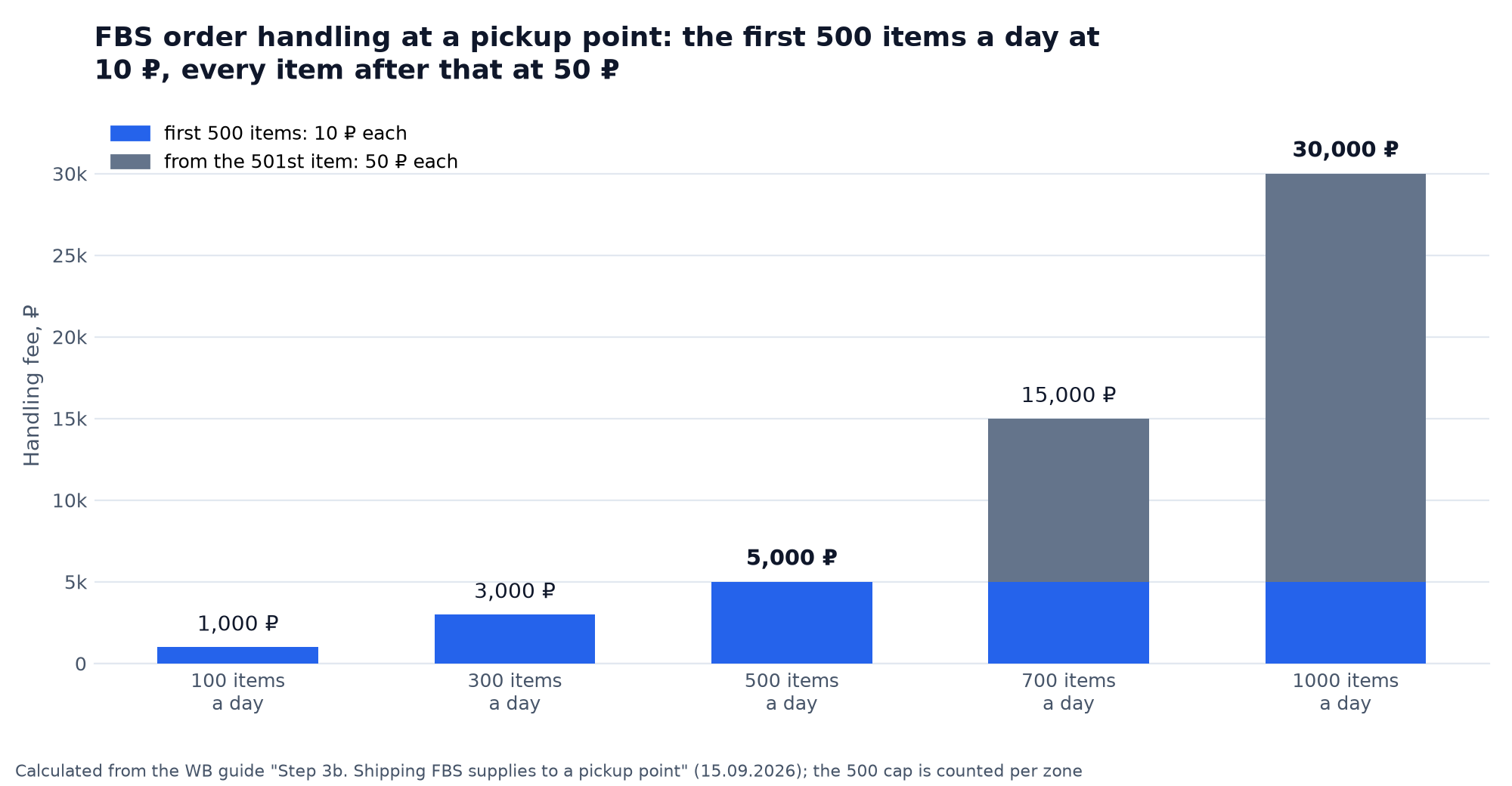
Hence a simple rule for those who grow. As soon as the daily flow in one zone approaches 500, it is cheaper to split shipments between zones, if your warehouses sit in different ones, or to take part of it to a sorting centre. There handling is priced by the acceptance calendar, and WB shows it in the assembly task in the "Handling cost" field for the supply's warehouse and for the last two points you shipped to.
Penalties around a supply come from three sources. Cancelling or moving an FBW supply later than 72 hours before the date costs 5 ₽ per unit, up to 25,000 ₽. For an overdue FBS order the penalty under clause 4.4 is counted by the hour. On a 3,000 ₽ item it grows from 54 ₽ at 30 hours to 1,296 ₽ at 120, we worked it out in the offer agreement navigator. Shipping to a foreign zone costs 30% of the order, cancelling a task through your own fault a penalty under item 14 of the schedule. There is a flip side too. If the FBS delivery rating drops below 70% (80% for oversized goods), supplies are blocked for five days, and no commission discount will help any more.
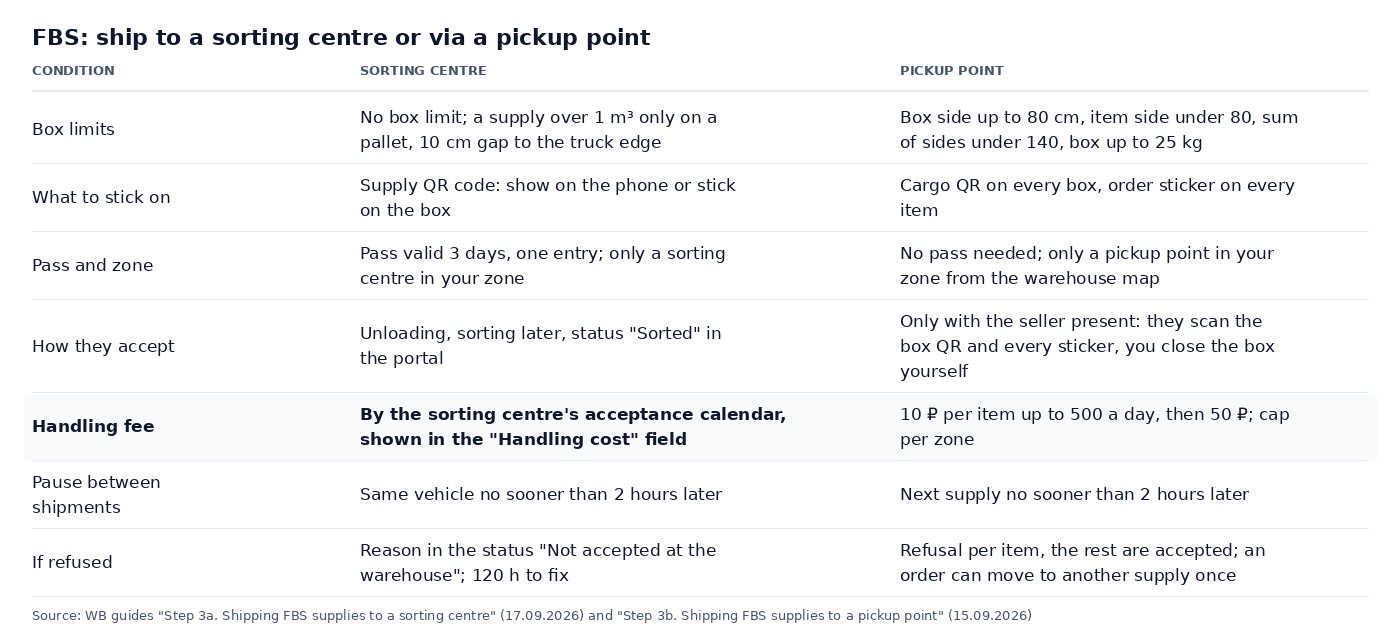
One caveat about pickup point limits for FBS worth knowing before the trip. The body of the guide "Step 3b" says a box side up to 80 cm, a box weight up to 25 kg and no limit on the number of boxes. Its own FAQ section lists the rules differently: a box up to 60 × 40 × 40 cm, up to 5 kg, total volume up to a cubic metre. We took the figures from the main text. Before the first shipment check them against the card of the specific pickup point on the warehouse map, because an employee may also refuse acceptance because the point is busy.
Frequently asked questions
Wildberries does not accept the supply, what to do? The reason is in the portal: for an FBW supply in its details, for FBS on the In delivery tab in the status "Not accepted at the warehouse". Most often it is extra labels on the box, a non-euro pallet, goods sticking out beyond the pallet, a vehicle unfit for unloading or a missing pass. Fix it and drive to the same point or another one in the same zone; no new supply is needed. For FBS you have 120 hours from the order's creation.
Can the supply warehouse be changed on Wildberries? The FBW drop-off point can be changed until you click Next at the date step. After that only a cancellation and a new supply, and a cancellation later than 72 hours before the date costs 5 ₽ per unit. The seller does not choose the storage warehouse at all; WB assigns it after acceptance.
What is a transit supply on Wildberries? A supply that travels from the drop-off point to another WB warehouse. A packing list is mandatory for it even on a per-unit pallet and on boxes, and the list states the number of pallets or boxes, the supply number, the drop-off point, the supply type and the legal entity.
How long to wait for a Wildberries supply after shipping? Under FBW unloading and pallet scanning happen on the day of arrival, per-unit acceptance takes up to 10 working days under the offer agreement, then the report appears. Under FBS goods at a pickup point are scanned in front of you; at a sorting centre the orders get the Sorted status after sorting, the timer stops and turns grey.
Is a customs declaration needed for a supply? The goods declaration number is needed if the item was made outside the EAEU and you want to sell it beyond the union. Under FBS it is also needed when a legal entity ordered such an item. The number can be added to the supply at any time via the GTD tab and an XLSX file with the barcode and the number.
Can supplies be made without a sole proprietorship? Yes, self-employed people sell their own products on WB and create supplies just like sole proprietors and companies. The only difference is the tax and the income cap, covered in our article on the self-employed on Wildberries.