What a deduction on Wildberries is: a settlement between Wildberries and the seller that is not tied to a particular order. WB writes off the fee for its services from your balance (promotion, the Jem subscription, a transit supply, unloading a truck) or returns money to you, and then the amount arrives with a minus. In the weekly report deductions sit in the "Other deductions/payouts" column, the amount is clickable, and behind it opens a window with the date, the document number and a comment. WB must issue a closing UPD for every deduction in the Documents section.
The phrase "удержания вб" is searched 1,497 times a month, plus another 494 with the spelling "вайлдберриз", and almost always the same situation sits behind it: there is an amount in the report and no idea where it came from. We read four WB guides updated between 15 July and 4 September 2026. And we looked at 32 weeks of a real store's reports: in which weeks deductions appeared and what share of revenue they reached.
In short: a deduction is not tied to an order, a penalty is; the reason is visible in the "Deduction amount detail" window and in the UPD found by document number; a payout in your favour comes with a minus; three deductions multiply the regular rate (delivery ×25, storage ×10, acceptance +1); disputes start with a support dialogue and move on to a formal claim under clause 8.9 of the offer agreement.
How a deduction differs from a penalty on Wildberries
WB separates the two in its guide outright: a penalty is in most cases tied to a particular order, say to a cancellation or a late handover. A deduction relates to other events: a service rendered, damaged property, a broken barrier at the warehouse, a transit supply. Exceptions exist on both sides, the penalty for breaking the supply plan is not tied to an order, but the rule holds in nine cases out of ten.
The difference is not cosmetic, it changes how you argue. For a penalty WB first sends a notice and charges the amount three days later, so you get a window to fix the violation. A deduction arrives as a fact: the service was rendered, the money is gone, and what is left is to check the closing document and decide whether you agree with it.
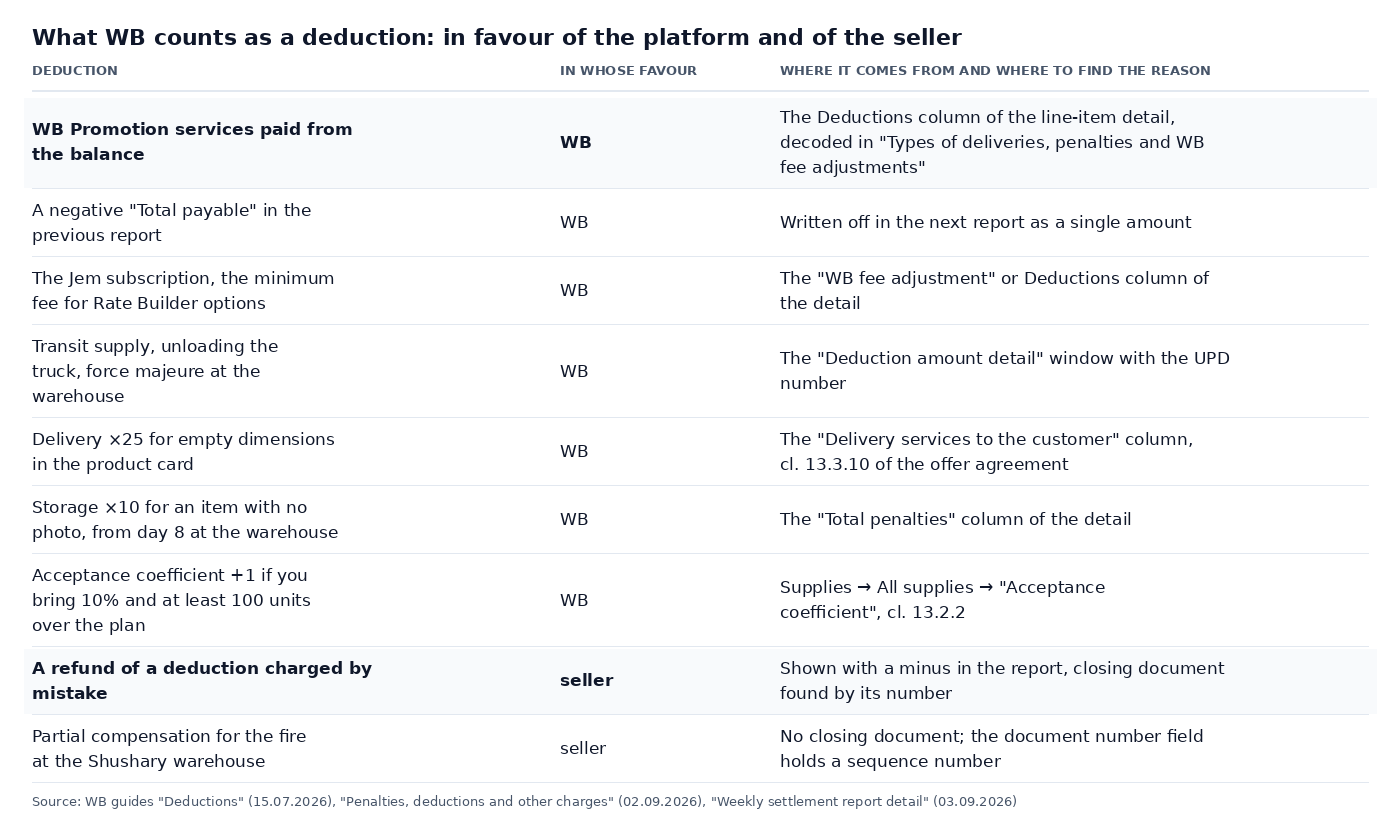
One row in this table deserves attention: a deduction can work in your favour too. A refund of an amount charged by mistake and the partial compensation for the fire at the Shushary warehouse arrive through the same mechanism, only with a minus. In the report it looks like a minus next to the amount, and many sellers read it as one more write-off.
What other deductions in the Wildberries report are
"Other deductions/payouts" is a column of the weekly settlement report where WB puts everything that did not fall into commission, logistics, storage and penalties. Most often it holds the cost of WB Promotion paid from the balance, the minimum fee for Rate Builder options, the Jem subscription and the write-off of a negative "Total payable" from the previous report.
The last one deserves a separate explanation, because it frightens newcomers. If the week's costs exceeded revenue, WB does not issue an invoice, it carries the debt into the next report and writes it off there as a deduction. In our sample this happened three times in half a year, and every time in the week after expensive logistics.
In the report detail deductions are easy to spot by their empty fields: no barcode, no subject, no supply number, because the operation is not tied to goods. The reason sits in the "Types of deliveries, penalties and WB fee adjustments" column. In the autumn of 2026 the handling fee for FBS orders at pickup points and sorting centres moved there too: it used to sit in "Total penalties", now it is in the "Acceptance operations" column with the reason "Goods handling".
Where to see Wildberries deductions and find the reason
The WB guide names two places where the "Deduction amount detail" window opens: a row of the weekly report and the statistics widget on the portal home page. In both cases you click the amount itself, and it is clickable only when it is not zero.
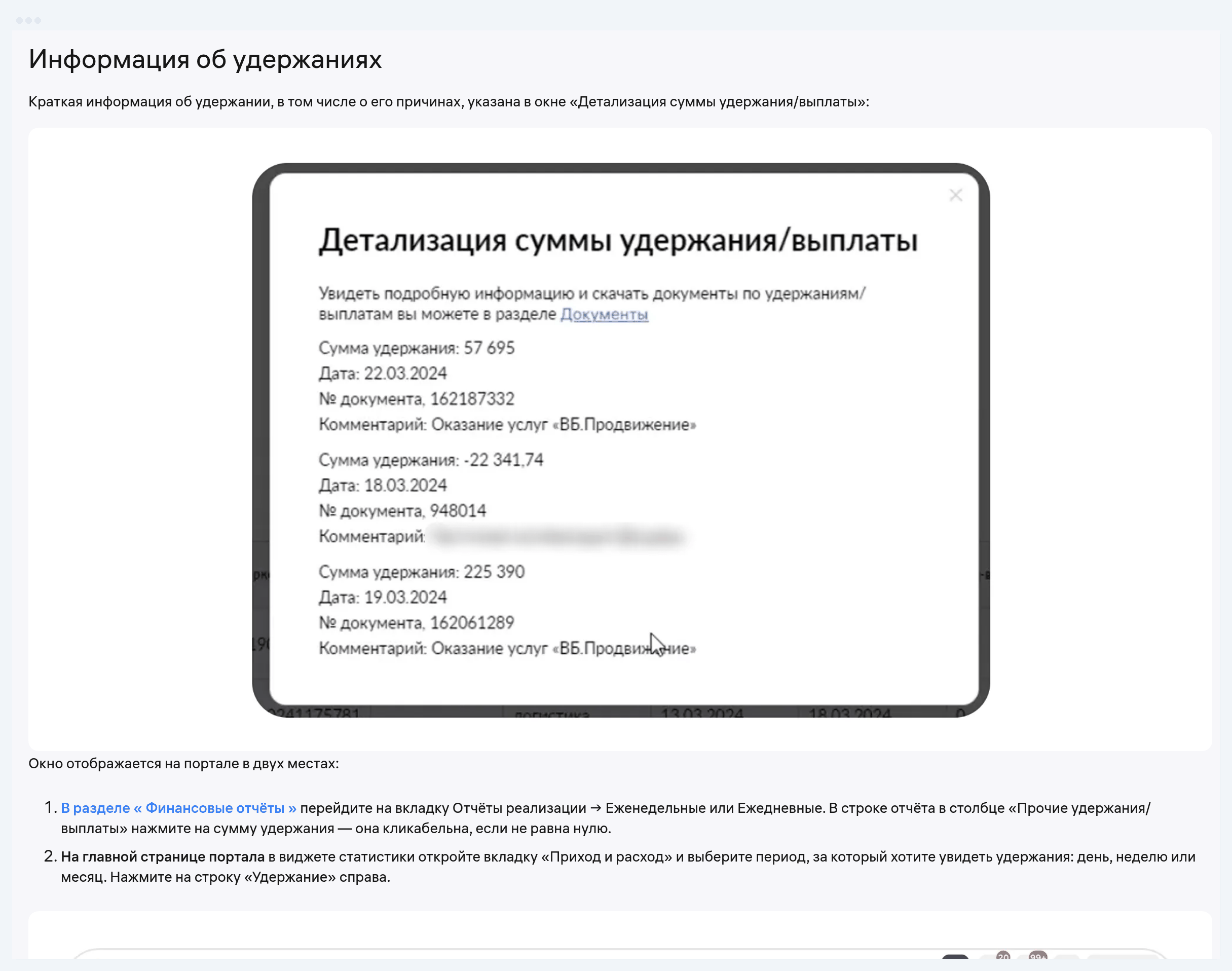
The window has four fields, and each answers its own question. The amount shows how much was written off, a minus means a payout to you. The date is the day WB issued the deduction, and it may differ from the date of the event: the platform is free to charge three days of promotion later as one amount. The document number leads to the Documents section, where the closing UPD is found by it. The comment names the reason in words, such as "WB Promotion services rendered".
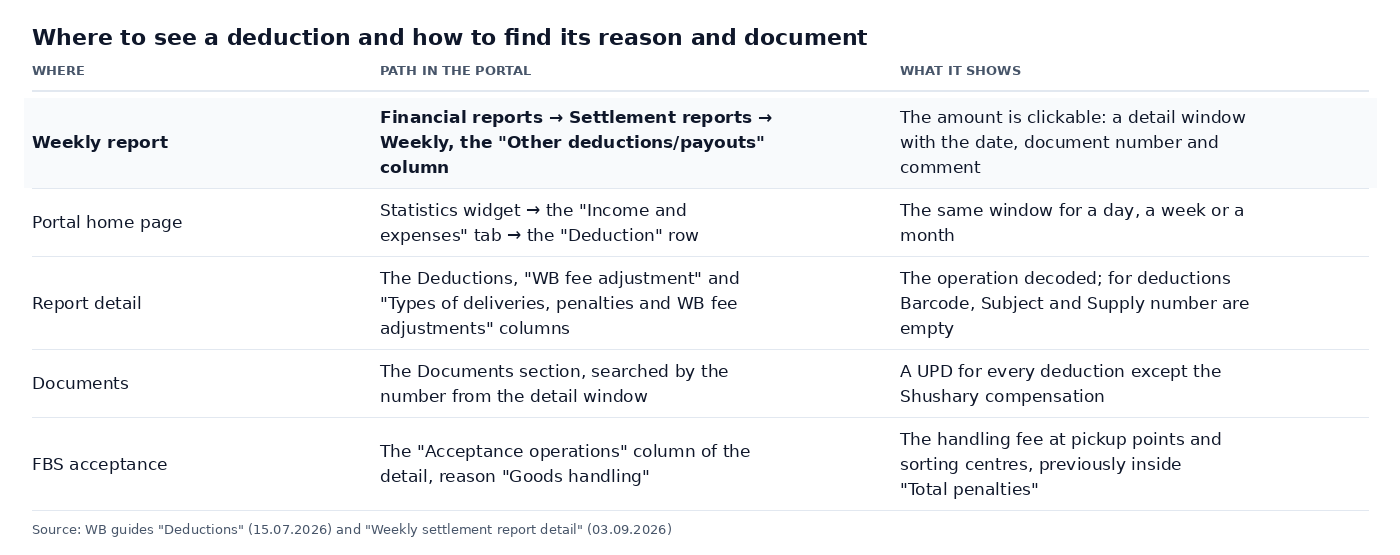
There is one exception: the "Shushary partial compensation" type has no closing documents, and the document number field holds a sequence number from WB's internal system. Searching for a UPD by it is pointless.
The acceptance deduction and two others that multiply the rate
Three deductions from the penalties guide work as a multiplier to the regular rate rather than as a sum, and that is why they hurt most. Delivery of an item whose card has no dimensions filled in is charged at the rate multiplied by 25. Storage of an item with no photos in the card becomes ten times dearer from day 8 at the warehouse, and until a photo appears the item does not sell at all. The acceptance coefficient grows by one if you bring over the supply plan by 10% and by at least 100 units.
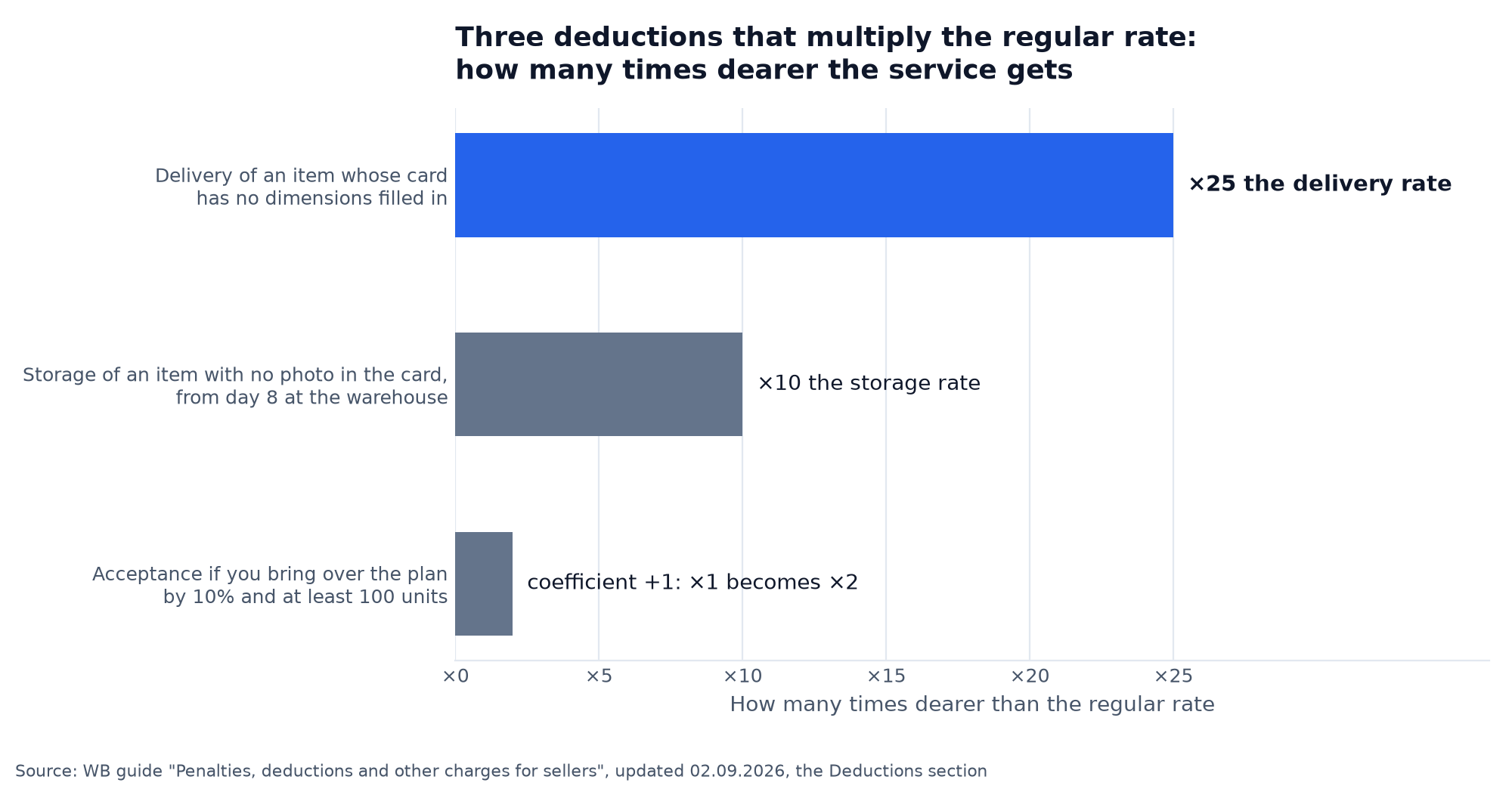
The first two share a nature: they punish not a broken supply rule but an unfilled card. Dimensions and photos are two fields a seller fills once, and while they are empty every delivery and every day of storage runs at the raised rate. The fastest way to check your cards is the stock report with the "No photo" filter, and dimensions are visible in the card itself.
The third deduction is the favourite of those who "put a bit extra into the supply". The threshold is double, and it triggers only when both conditions are exceeded at once: 10% and 100 units. The coefficient grows by one and no further if it already equals five or more, but on an expensive date even plus one is real money at acceptance.
How many deductions a real store gets in half a year
Figures from the guides say nothing about how often this happens at all. We took 32 weekly reports of a real store from February to September 2026 and worked out what share of the week's revenue other deductions and penalties took.
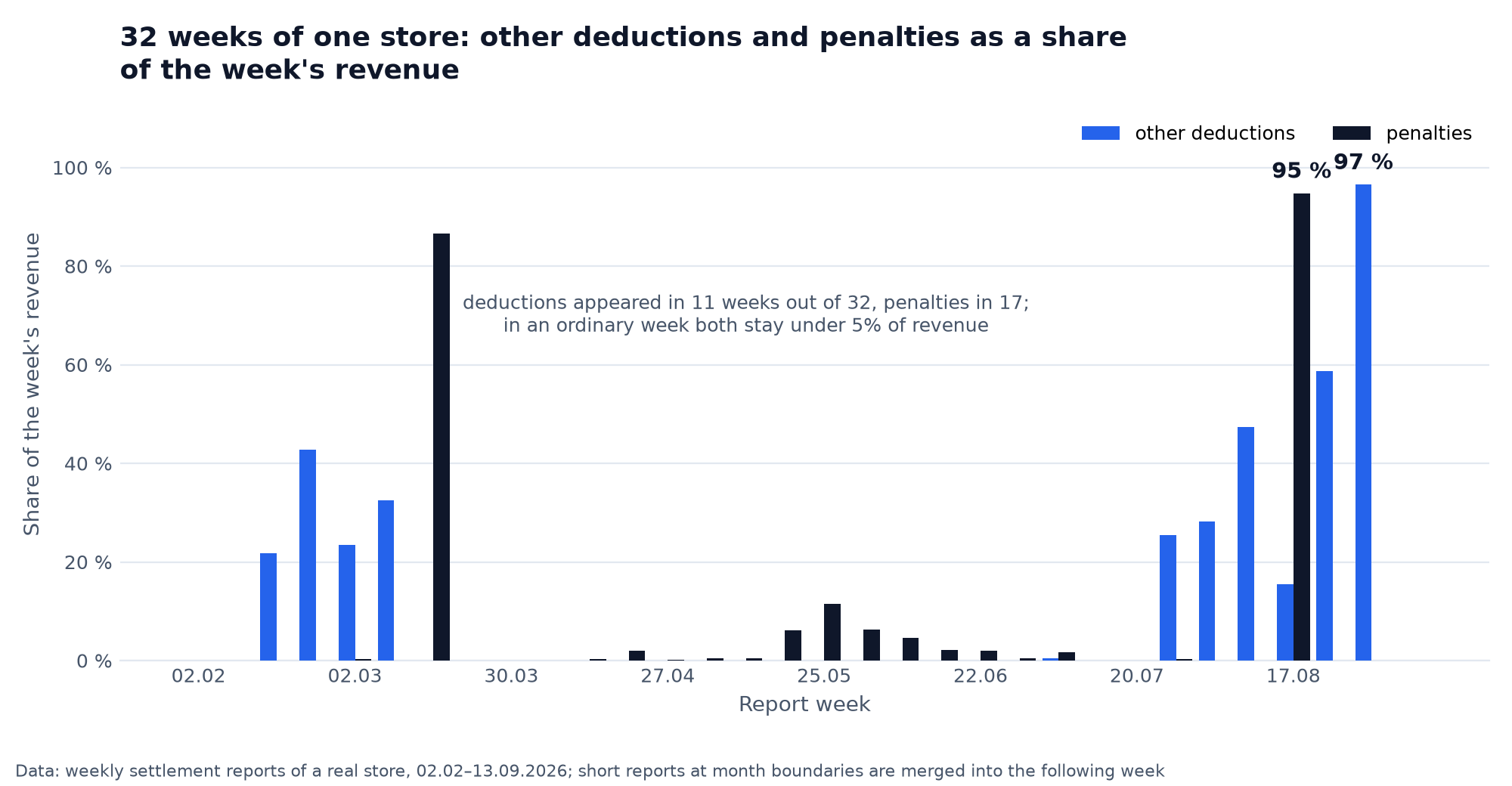
The picture is this. Other deductions turned up in 11 weeks out of 32, penalties in 17, that is roughly a third and a half of the weeks. In an ordinary week both stay under 5% of revenue and need no attention. But twice in half a year they went off at almost the whole weekly revenue: 97% at the end of August for deductions and 95% for penalties in the week of 17 August. Both weeks fell on a sales slump, and that is the key: a deduction and a penalty are counted from events, not from turnover, so on falling revenue the same amount turns from small change into a disaster.
Hence a practical conclusion. Looking at deductions in roubles is pointless, look at them as a share of the week's revenue and keep in mind that in a weak week the usual 2,000 ₽ for services will be a noticeable part of what reaches you.
How to dispute a Wildberries deduction
The order is this. First a dialogue with support: Support → New dialogue, the category and topic that fit the case, a detailed description and attachments up to 10 MB each and 50 MB in total. A request on one topic can be created once every 15 minutes, and a dialogue closes itself if you take too long to reply.
If the answer does not satisfy you, the next step is a formal pre-trial claim under clause 8.9 of the offer agreement, in its own section on the portal. WB demands six things from the document: the name of the party filing it, the total amount claimed in roubles, the grounds for that amount, a date and a signature, attachments and the numbers of earlier requests on the same case. An electronic claim is reviewed within about 20 days, a paper one takes longer. A claim missing any of the six is left without consideration, and WB asks you not to duplicate it while the review is under way.
What to prepare before the claim: a screenshot of the detail window with the date and document number, the UPD itself from the Documents section, the report row where the amount sits, and the correspondence with support including dialogue numbers. For the multiplier deductions add proof that the card field was filled in before the date of the deduction, otherwise there is nothing to argue. Checking discrepancies is easier than by eye over a spreadsheet: in Parus Seller the weekly reports and the detail sit side by side, and the payout reconciliation shows where the payable amount diverged from the calculation. How the payout itself works we covered in the article on payouts to the seller.
Frequently asked questions
Other deductions on Wildberries, what are they in plain words? Everything WB wrote off or returned outside a particular order: promotion, subscriptions, a transit supply, unloading, the minimum fee for rate options, the previous report's debt. The reason is always in the detail window, and a UPD is issued for every write-off.
Why is a deduction shown with a minus? That is a payout in your favour: a refund of an amount charged by mistake, or compensation. WB shows a write-off as an unsigned amount and a payout to the seller with a minus.
What are deductions in favour of third parties? There is no such type in the WB guides. In reports sellers most often meet under that name the settlements for platform and partner services that land in "Other deductions", and they should be sorted out by the comment in the detail window, not by the column's name.
Where to download a Wildberries deductions report? There is no separate report. The rows sit in the weekly settlement report in the "Other deductions/payouts" column and in the detail, and the closing documents are in the Documents section, found by the number from the detail window.
The acceptance deduction: what is it charged for? For handling goods at acceptance, and under FBS for handling orders at pickup points and sorting centres. Since the autumn of 2026 these amounts appear in the "Acceptance operations" column with the reason "Goods handling"; they used to be in "Total penalties". What acceptance costs by the warehouse coefficient we worked out in the article on inbound acceptance at WB warehouses.
How long do you have to dispute? The guides set no hard deadline for filing, but the closing documents and the detail stay available for a limited time, and a claim requires the numbers of earlier requests. The practice is simple: sort out an unclear amount in the week it appears in the report.