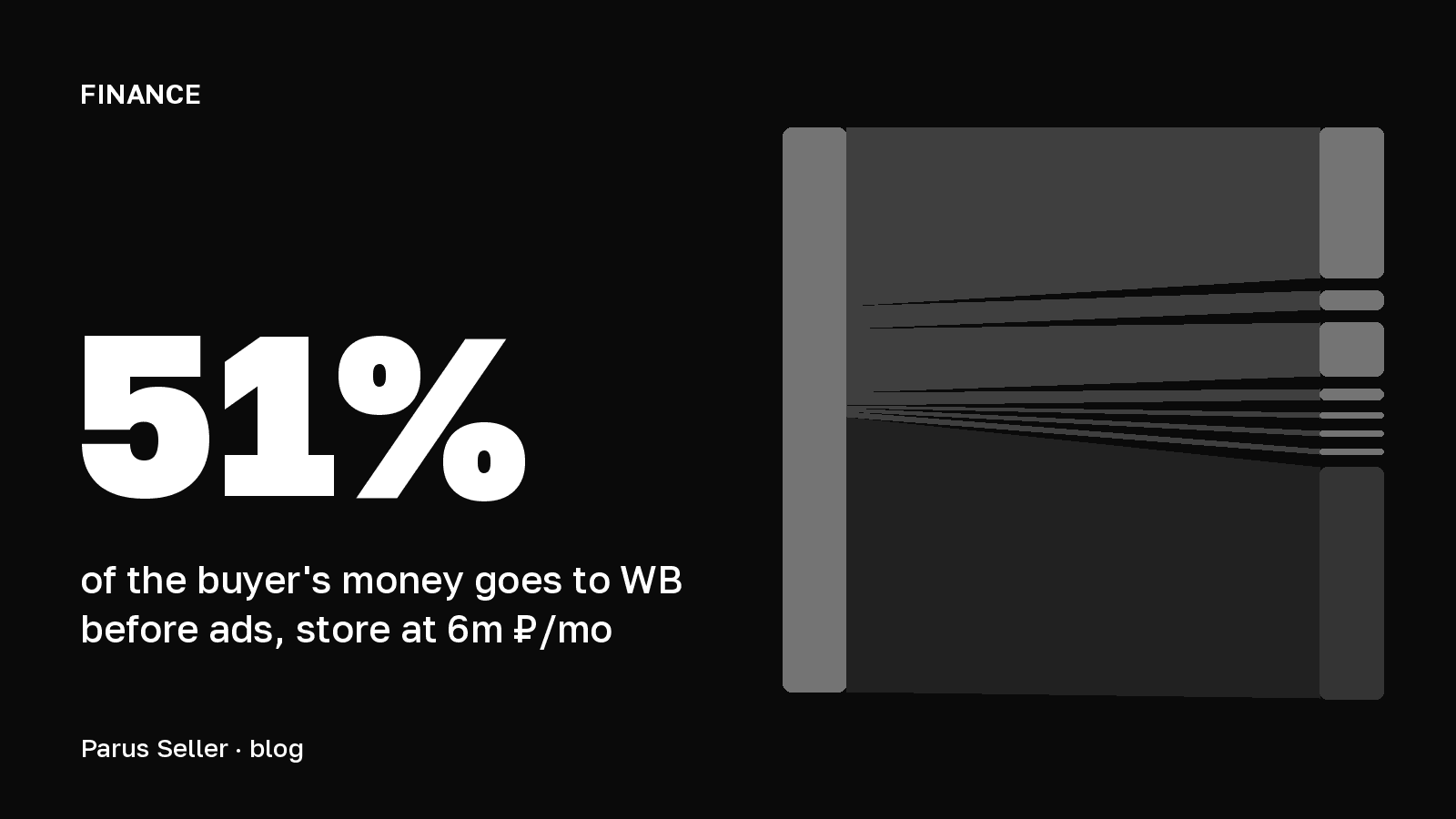
The weekly settlement report answers one question: how much money Wildberries will transfer for the week and where the rest went. The trouble is that it holds thirteen columns, two documents for a single week, and a "Payable for goods" line that newcomers take for income. We took 60 reports from one connected store over 30 weeks, checked each one against the actual payment from WB and went through the columns on those numbers.
In short: the report sits in the WB Partners portal under "Financial reports" → the "Weekly" tab, it is generated on Monday for the previous week and downloads as XLSX. Total payable = payable for goods − logistics − storage − inbound acceptance − other deductions − penalties + top-ups from WB. Across 60 reports the formula matched the payments to the kopeck. Tax on the simplified regime is charged on the "Sale" column, not on the payout.
Where to find and download the Wildberries weekly report
In the seller portal the path runs like this: WB Partners → home page → the balance widget → "Financial reports". Four tabs open: "Weekly", "Daily", "Archived weekly" and "Cashback report". For reconciling money you need the first one. Every report carries a number, a legal entity, a period and a generation date, and you can download it as XLSX with full line-item detail for each operation. The marketplace's own instruction lives in the WB help centre.
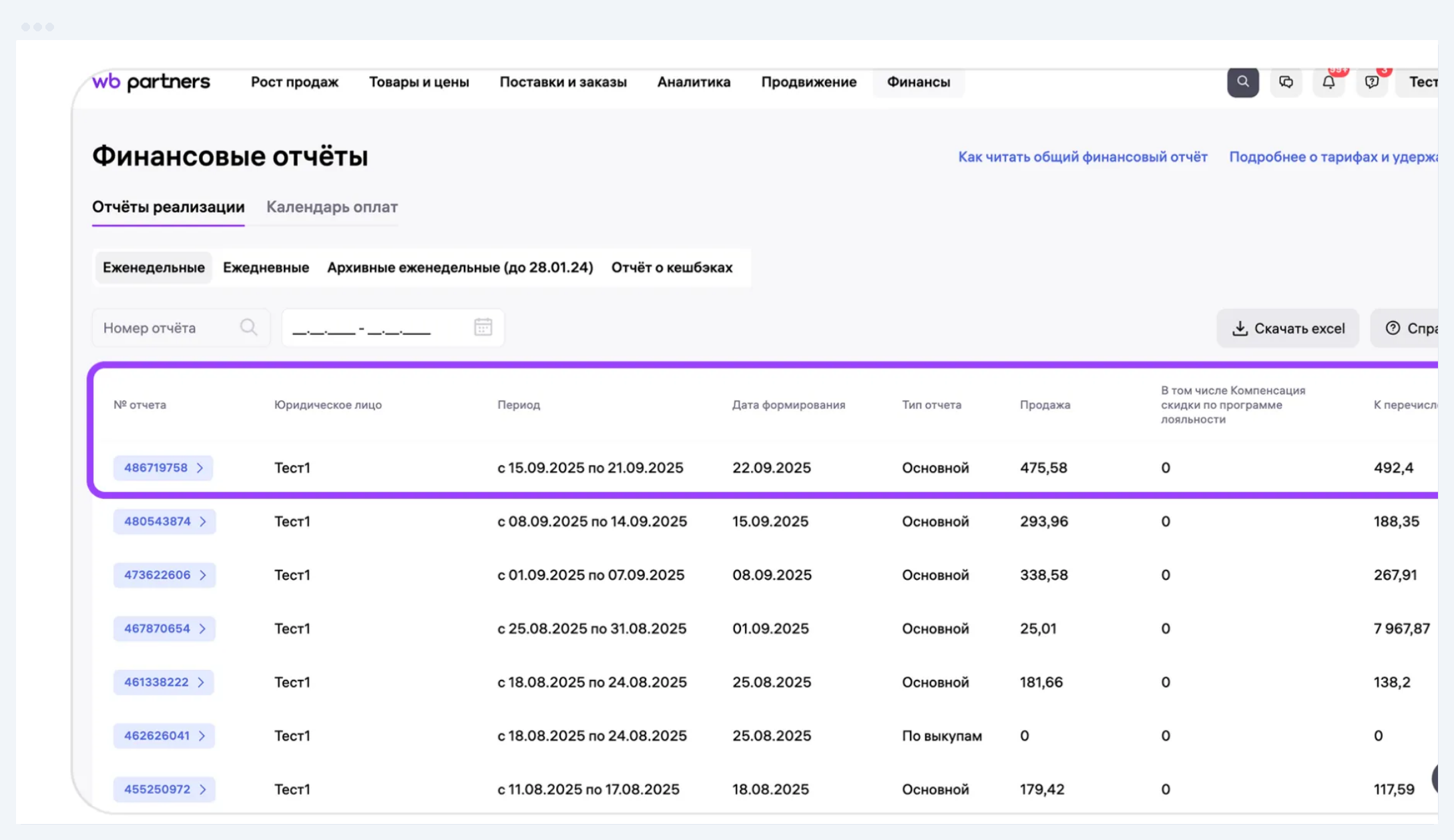
When to expect the report. Our data shows all 60 reports for February to August 2026 were generated on Monday, the day after the week closed. The week in the report always runs Monday to Sunday even when a month changes inside it: our report for 23 February to 1 March is a single document.
Why one week brings two reports
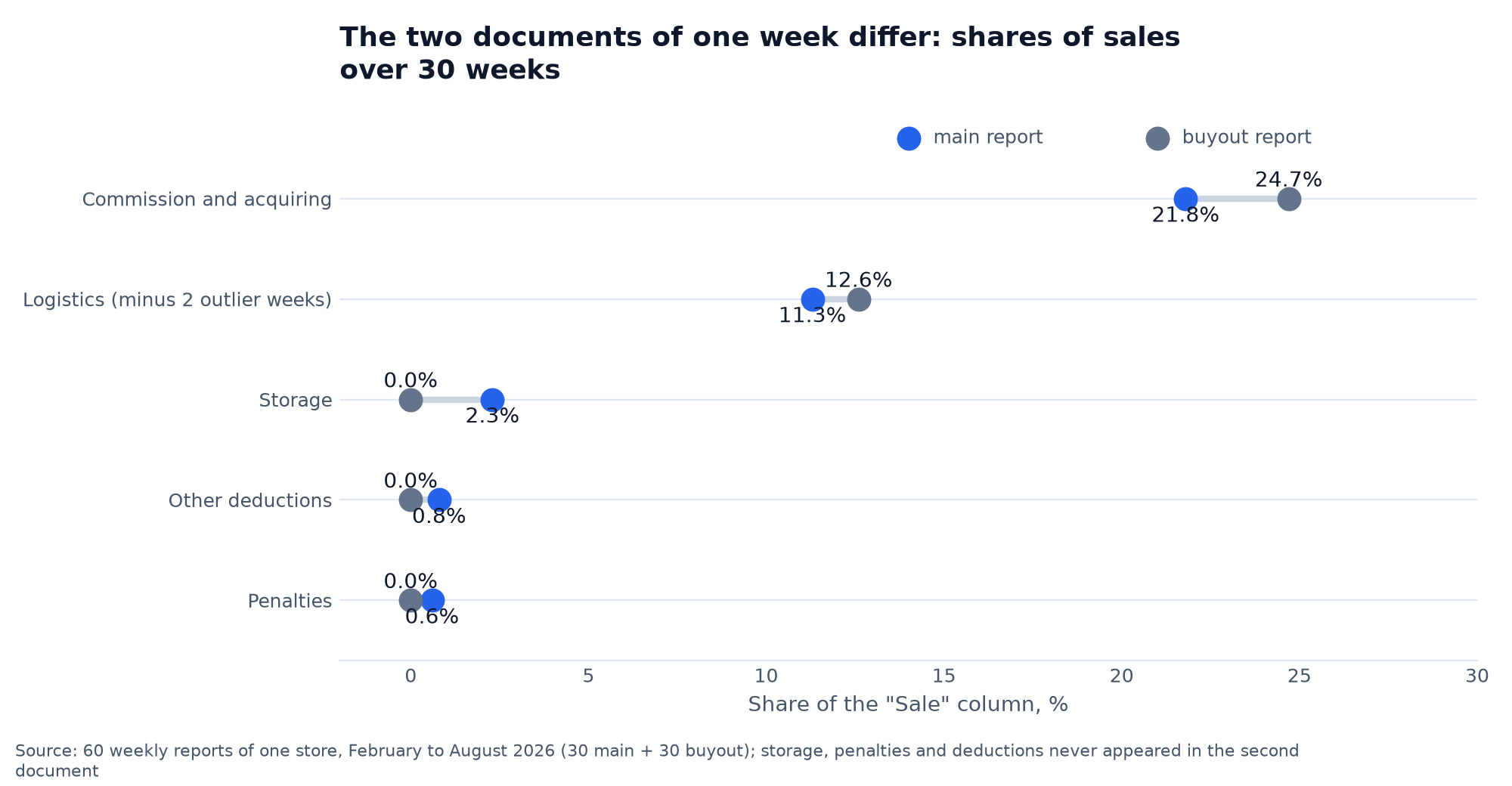
WB generates two documents for each week, and adding them up is your job. The main report covers sales in Russia and outside the EAEU. The buyout report covers sales in EAEU countries and the deals where Wildberries itself buys the goods. Our store receives both every week: 30 main reports and 30 buyout reports over six months.
The difference between them is not only geographic. In the main report commission with the acquiring fee came to 21.8% of sales, in the buyout report 24.7%. Storage, penalties and other deductions landed only in the main report for us, and in the second one those columns stayed empty all 30 weeks. Look at one document only and you see half the week.
How to read the Wildberries weekly report column by column
Take a real main report for the week of 27 July to 2 August 2026 and walk down the columns.
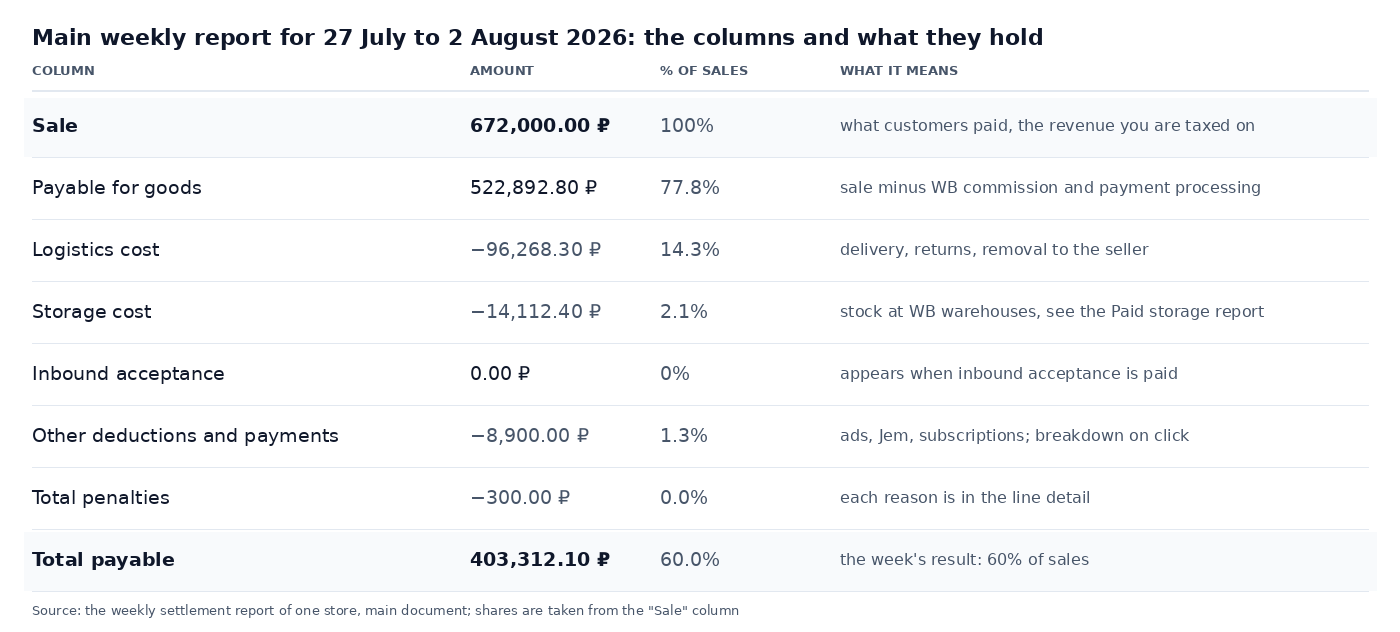
The eight columns in the table above read top to bottom as the path of the money: the customer paid 672,000 ₽, after commission and payment processing 522,893 ₽ was left, and logistics, storage, other deductions and penalties brought the week down to 403,312 ₽. Newcomers take the "Payable for goods" column for income, but logistics and storage have not been subtracted from it yet.
Next to them sit three loyalty programme columns (cost of participation, points withheld, discount compensation) and "One-off change of payout date", which is the charge for the "Withdraw now" button.
What you do with these columns next comes down to one habit: compare shares of sales week by week, not roubles. Logistics of 96,268 ₽ on sales of 672,000 ₽ is 14.3%. If sales are the same next week and logistics is 20%, go into the line-item detail and look at what changed: returns, the warehouse you ship from, or dimensions.
How "Total payable" adds up: the formula checked on 60 reports
The formula is short, and it is worth remembering, because this is what people reconcile the payment against:
Total payable = payable for goods − logistics − storage − inbound acceptance − other deductions − penalties + top-ups from WB
We checked it against all 60 reports from the store: for each one we took the sum WB actually pushed through the bank and compared it with the formula. Zero discrepancies, matched to the kopeck in all 60 cases, including the weeks that closed in the red and the weeks with large penalties. So if your payment does not match the report, the formula is not the problem: either two reports are glued into one payment, or the week is split into two documents by month, or you are comparing the main report without the buyout report.
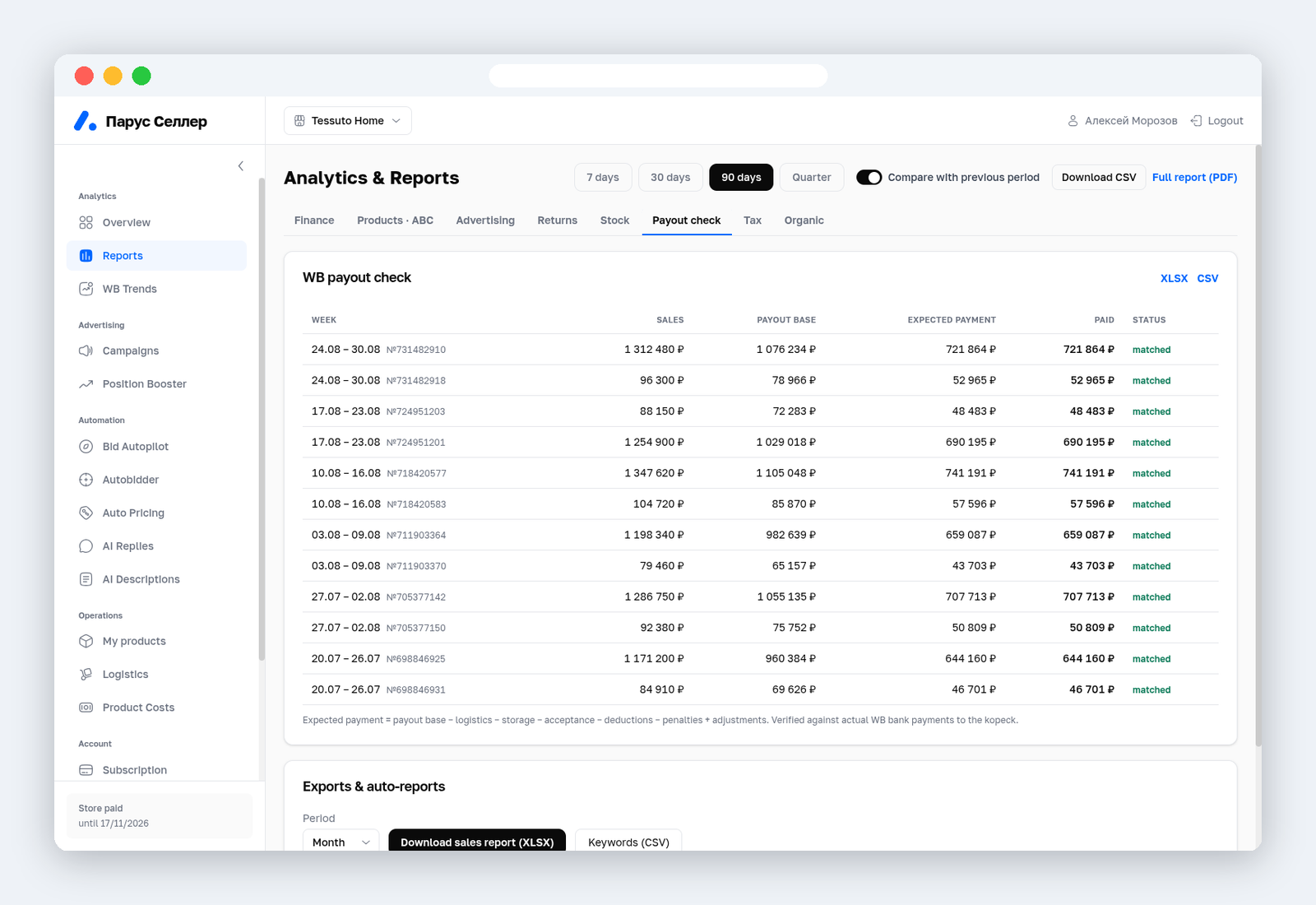
The "Payout check" tab in Parus Seller runs this check itself on every report: sales, payable for goods, the payment expected by the formula, the actual payout, and a "matched" or "discrepancy" status.
You can check by hand too, with one caveat: do not sum the line-item column as a whole. In the XLSX the rows for sales, returns, logistics and penalties lie mixed together, and the "Quantity" column holds 0 for logistics and storage. Filter by "Reason for payment" first, and only then add up.
Where the money goes over 30 weeks: our numbers
Add up all 60 reports from the store for February to August 2026 and see what is left of sales. The store sells home textiles with a turnover of about 5 million ₽ a month, and the six months passed without drama apart from one batch that WB blocked and sent back.
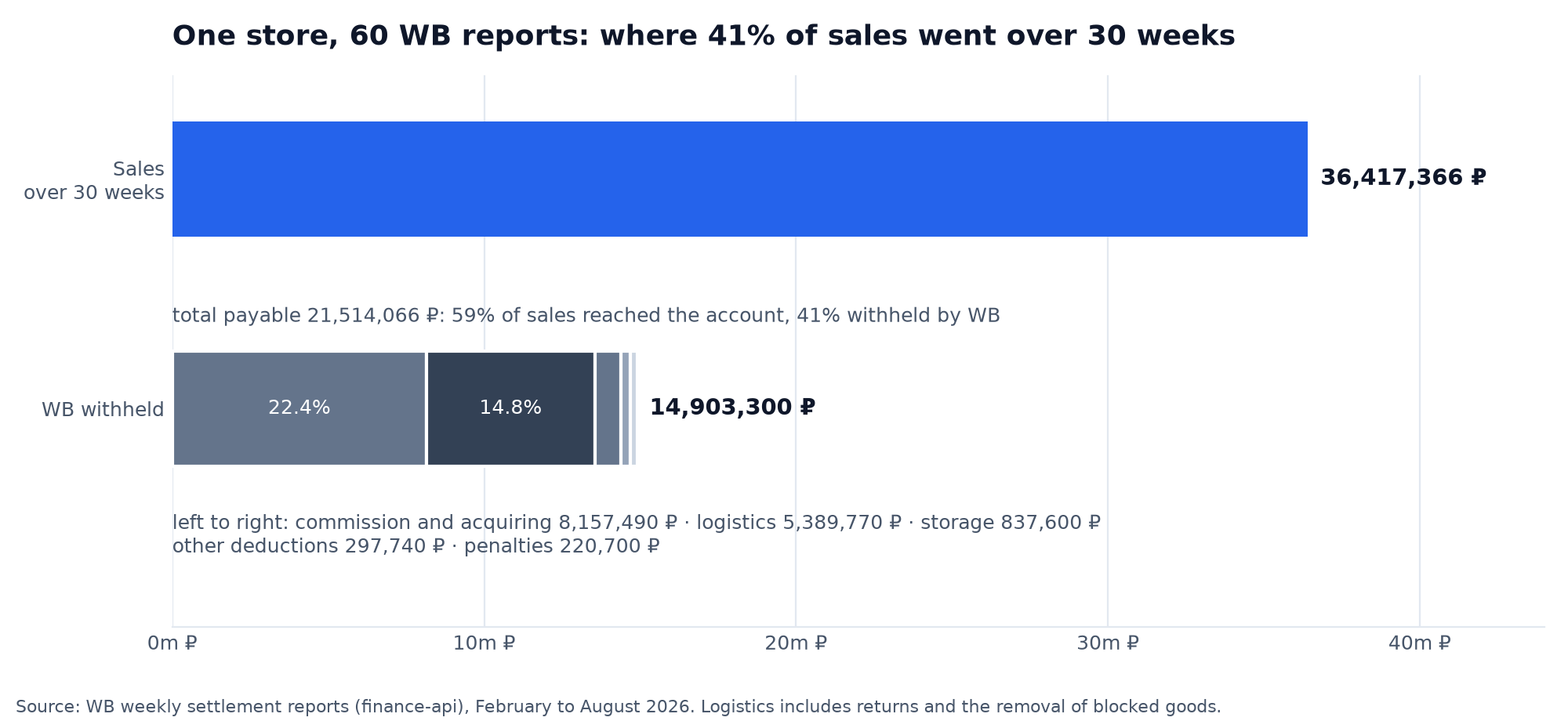
- Sale: 36,417,366 ₽
- Commission and acquiring fee: −8,157,490 ₽ (22.4% of sales)
- Payable for goods: 28,259,876 ₽
- Logistics: −5,389,770 ₽ (14.8%)
- Storage: −837,600 ₽
- Other deductions: −297,740 ₽
- Penalties: −220,700 ₽
- Total payable: 21,514,066 ₽ (59.1%)
Two of the 30 main reports closed in the red: in both weeks WB was sending a blocked batch back to the seller, and the deductions outgrew what the sales had earned. Commission took 22.4% of sales over six months and barely moved, while logistics swung from 9% to 109% week by week. That is the main thing the weekly report shows and a commission calculator never will: the commission you know in advance, logistics with returns becomes clear only after the fact. How returns multiply logistics we covered in our article on the buyout rate and what it costs in roubles.
Without the two anomalous weeks covered below, logistics in the main report took 11.3% of sales and storage 2.3%, and 62% of revenue reached the account instead of 59%: two weeks of goods being removed cost the store three percentage points over six months.
Why logistics can be larger than sales: one week taken apart
In the report for 16–22 March 2026 the store sold 1,214,000 ₽ of goods, and the "Logistics cost" column showed 1,317,740 ₽. Total payable: −502,856 ₽. The summary table cannot explain that, so we downloaded the line-item detail, 10,330 rows, and grouped it by "Reason for payment".
- Delivery to the customer on a sale: 22,620 ₽ across 380 sales. That is all the "normal" logistics of the week.
- "Return of blocked goods (from the seller on cancellation)": 3,380 rows at 250 ₽, 845,000 ₽ in total.
- "Return of blocked goods (to the seller)": another 439,685 ₽.
- Penalties: 1,175 rows at 70 ₽ for "Paid storage of returns at a pickup point for more than 3 days", 82,250 ₽ in total. We went through this penalty in our article on penalties for Wildberries sellers.
- Storage: 44,930 ₽.
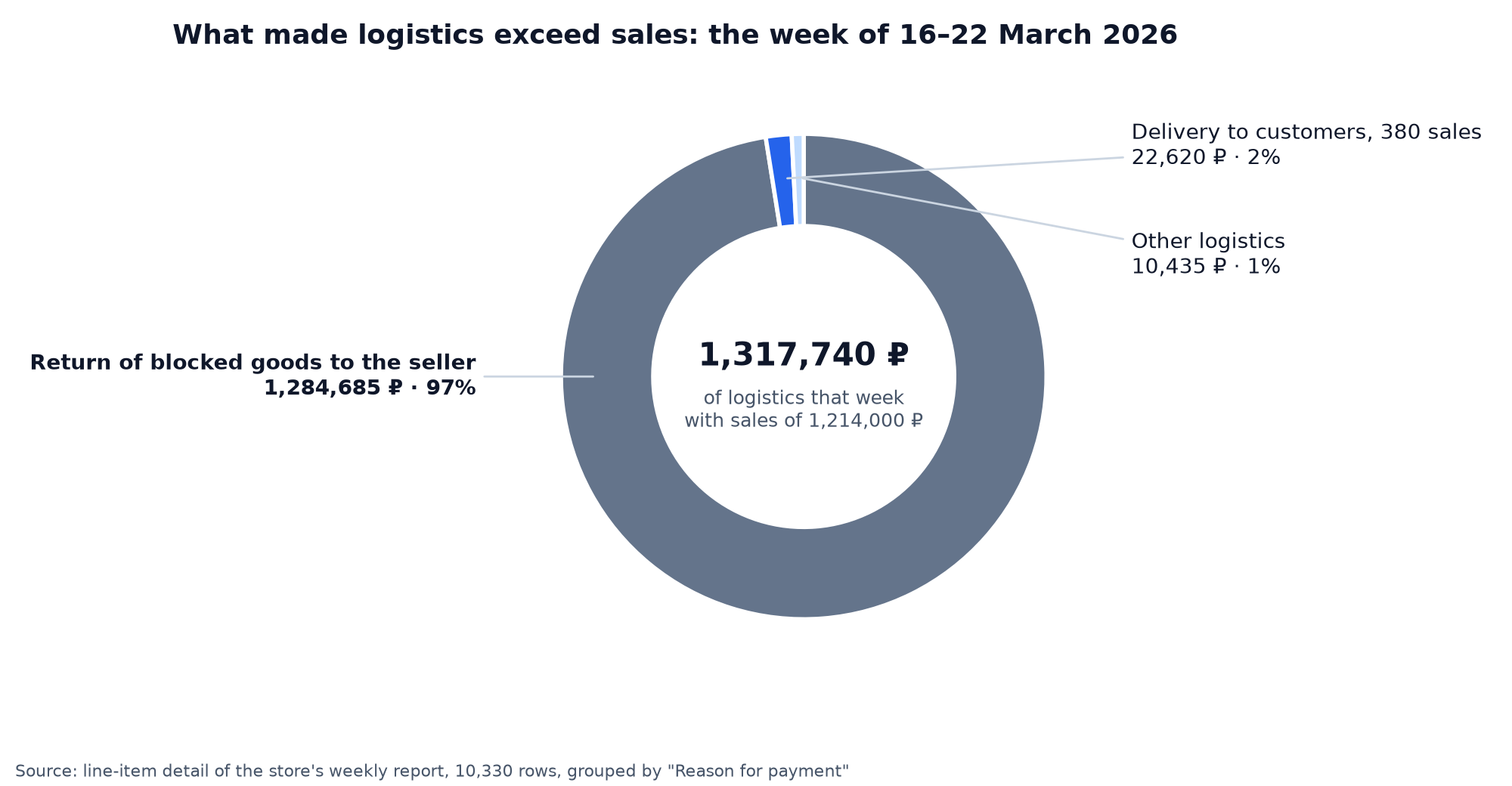
So 97% of the week's logistics has nothing to do with sales: WB blocked a batch and sent it back to the seller, charging 250 ₽ per unit for the trip and again for the actual removal. On top of that came penalties for returns sitting at the pickup point longer than three days. In a summary such operations look like "logistics went up", while in fact this is a one-off event worth checking row by row rather than dragging into the average logistics of a product.
What amount you pay tax on under the Wildberries report
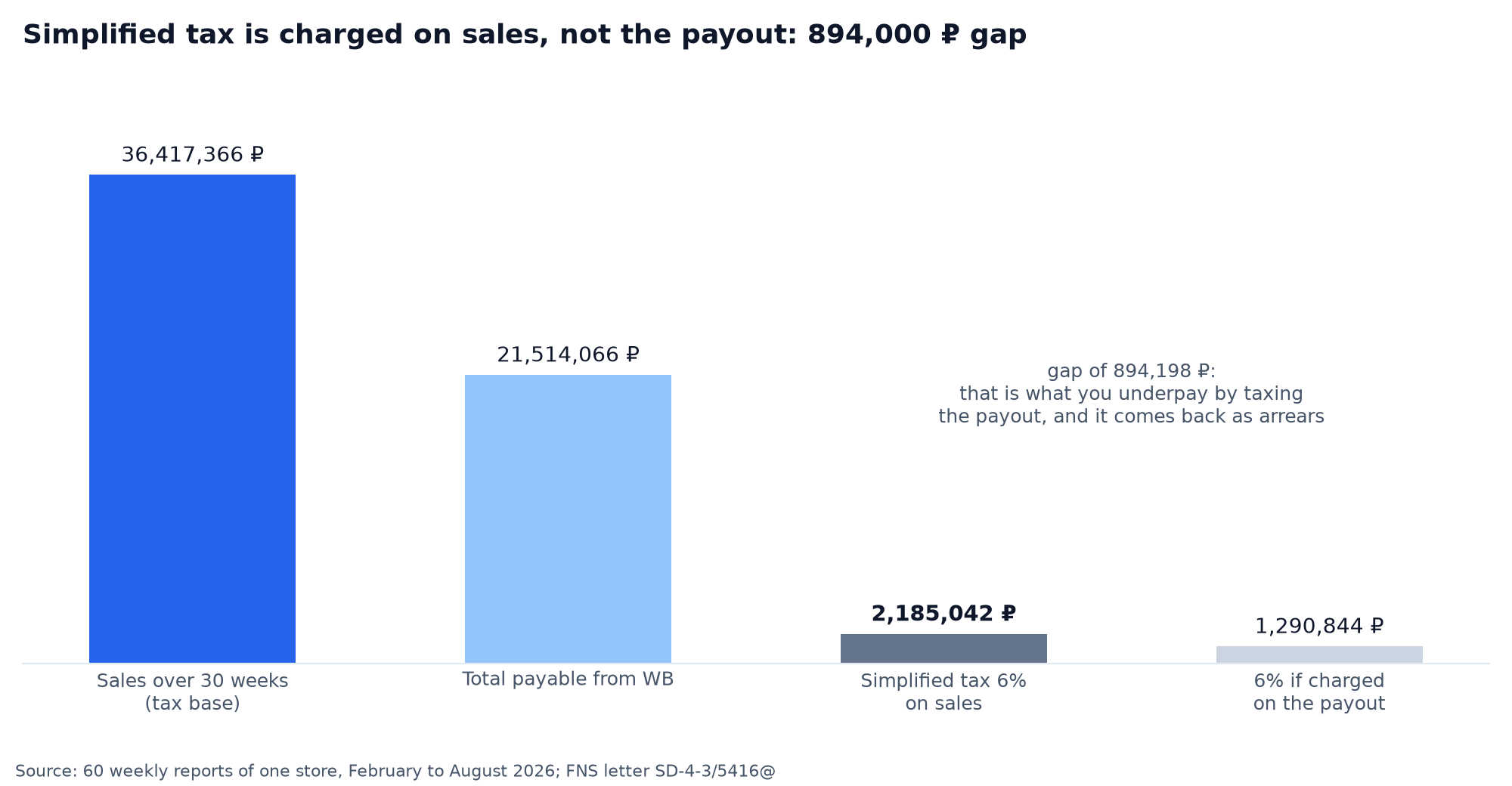
Income for the simplified tax equals the "Sale" column, not "Total payable". The Federal Tax Service explained this in letter SD-4-3/5416@ dated 8 May 2024: the seller's income is the whole sum received from customers for goods sold through the marketplace, and on the simplified tax on revenue the fee the marketplace withheld does not count as a cost. On revenue minus costs the fee can be written off, but revenue is still counted in full.
On our store it looks like this: sales over 30 weeks 36,417,366 ₽, payout 21,514,066 ₽, and the simplified tax on revenue at 6% is charged on 36,417,366 ₽ and comes to 2,185,042 ₽. Anyone who works out 6% of the payout pays 1,290,844 ₽ and gets a back-tax assessment of 894,198 ₽ plus interest. That is exactly why the "Sale" column has to be read separately from the payouts.
How to download Wildberries reports over the API
For 1C, Excel macros and your own spreadsheets the reports are pulled over the API rather than by hand. Per the WB documentation as of 4 September 2026 there are two methods: the list of reports (POST /api/finance/v1/sales-reports/list, the period parameter takes weekly or daily) and the line-item detail by report number (POST /api/finance/v1/sales-reports/detailed/{reportId}, up to 100,000 rows per call). The limit on both methods is hard: 1 request a minute.
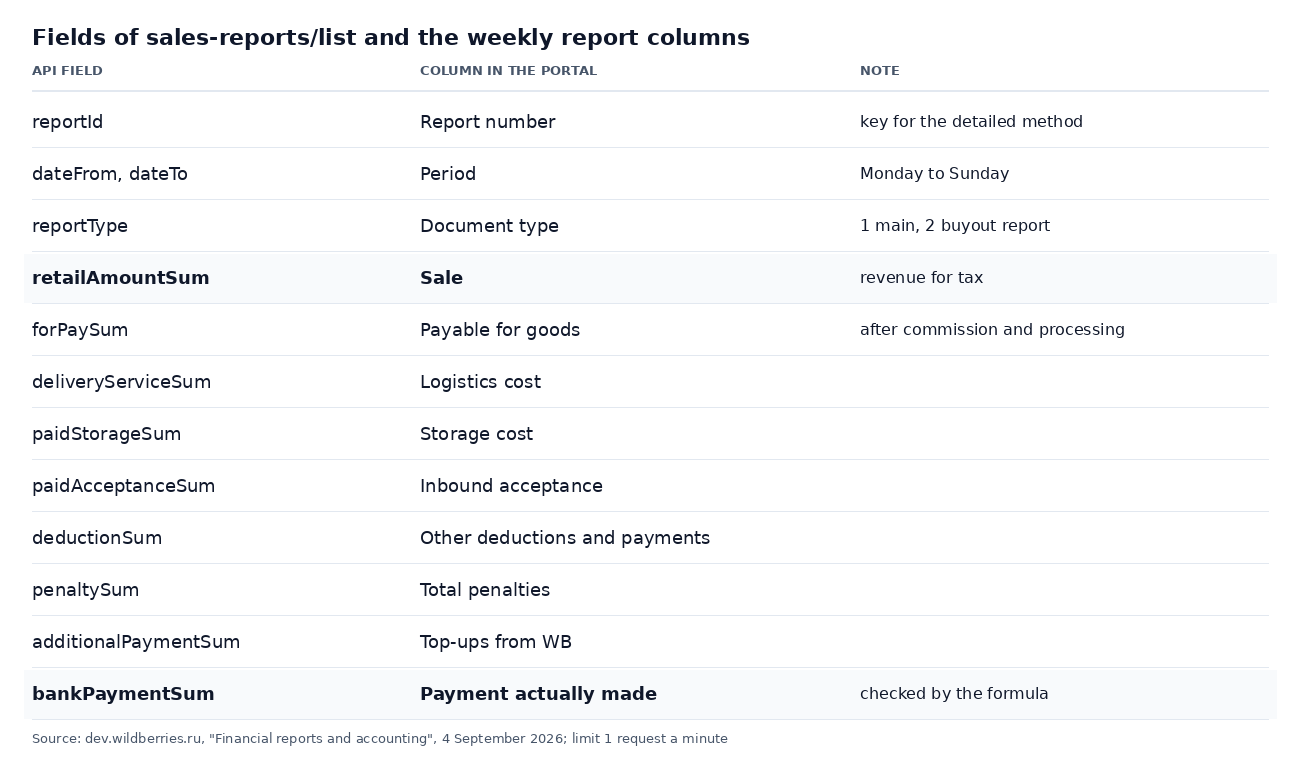
The report list holds every summary column under a technical name with a Sum suffix: retailAmountSum is "Sale", forPaySum is "Payable for goods", deliveryServiceSum is logistics, paidStorageSum is storage, deductionSum is other deductions, penaltySum is penalties, and bankPaymentSum is the payment actually made; the line-item detail carries the same fields without the suffix. These are the fields we used for the reconciliation in the formula section above. The token needs access to the "Finance" category, the account owner creates it under "API integrations", and we went through it in detail in our piece on the Wildberries API token.
How to check the report every week in ten minutes
The routine we use ourselves, and it closes 90% of the surprises:
- On Monday open both reports for the week, the main one and the buyout one, and add up "Total payable".
- Work out the shares of sales: commission, logistics, storage. Compare them with last week.
- Any share grew by more than a third: download the XLSX, filter by "Reason for payment", find the rows to blame.
- Other deductions above zero: click the sum and check that it is advertising and subscriptions, not somebody else's.
- Reconcile the actual payout against the formula, and send a discrepancy to support with the report number and the rows.
In Parus Seller steps 1, 2 and 5 run by themselves once the seller portal is connected by API key: reports are pulled once a day, the "Finance" tab shows the waterfall from sales to net profit with cost of goods and tax, and the "Payout check" tab compares every report with the payment. The account owner creates the token and revokes it in one click.
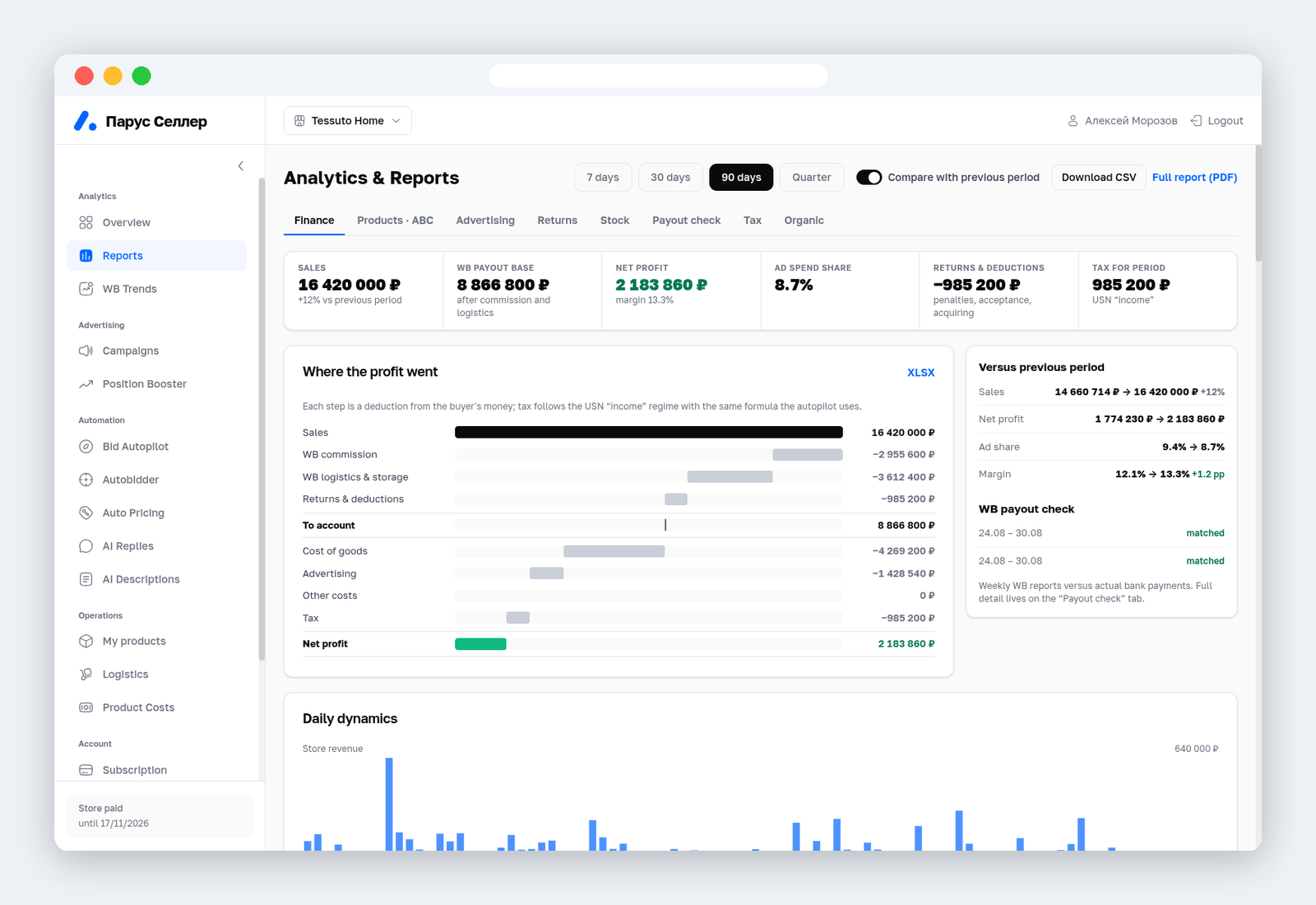
First two months free with promo code PARUS60, no card required: connect your seller portal and see your own reconciliation.
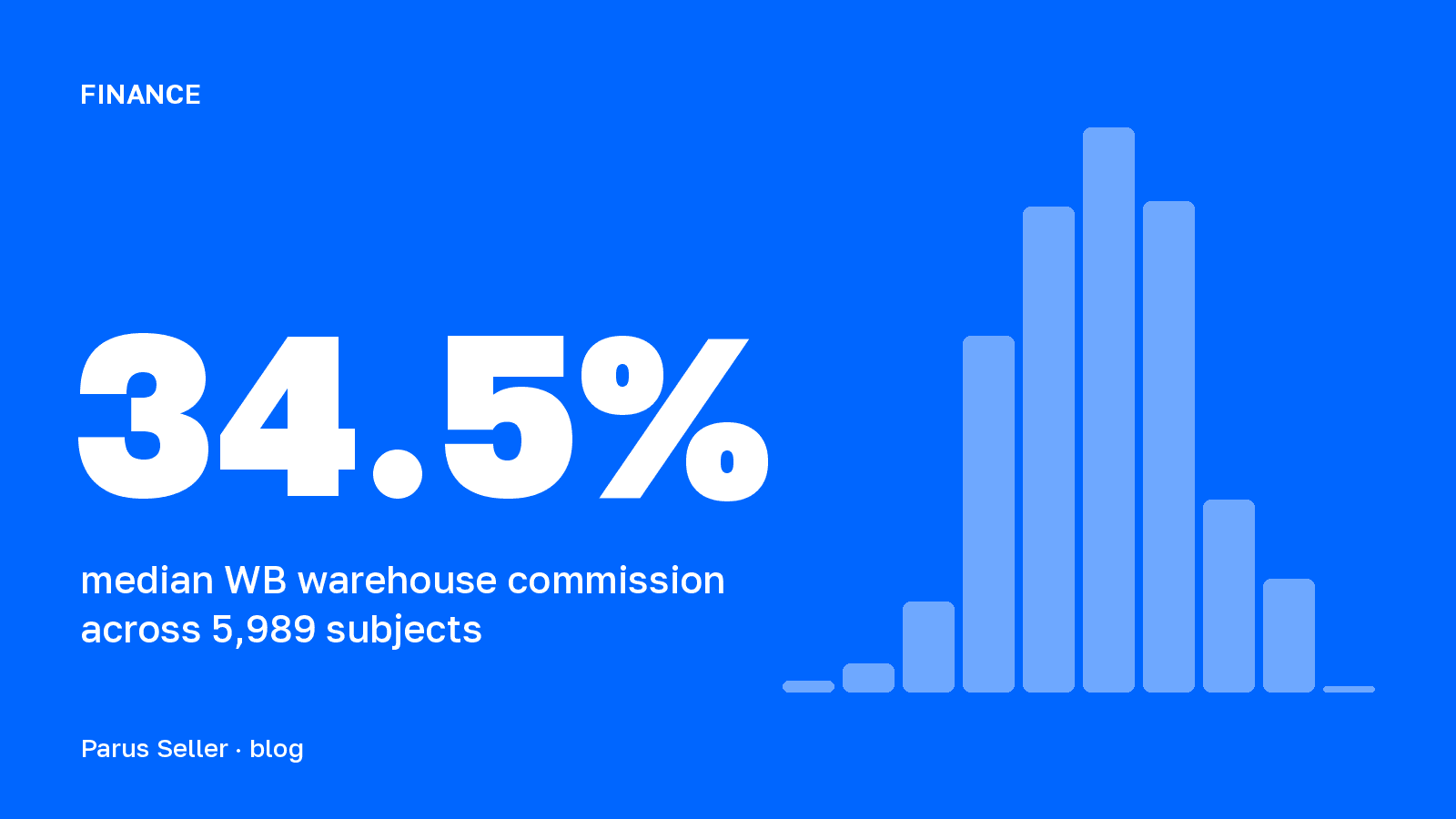
To see how much of a sale is left before the report even arrives, there is our unit economics sheet with the formula for every deduction and a table of commissions across 5,989 subjects. What the WB portal gives away free in analytics and what comes only with Jem is collected in a separate article.
FAQ
How do you read the Wildberries weekly report for accounting? An accountant needs three figures: "Sale" as revenue, WB's fee (the difference between "Sale" and "Payable for goods") as a cost on the simplified tax on revenue minus costs, and "Total payable" for the bank reconciliation. Plus the closing documents for the period from the "Documents" section.
Where do you find the Wildberries settlement report? WB Partners → "Financial reports" → the "Weekly" tab. The XLSX download button is there too. For older periods look in the "Archived weekly" tab.
Why is my Wildberries report negative? The deductions for the week outgrew what the sales earned. Most often that is return logistics, storage, or a one-off event such as goods being removed. In our sample 2 of the 30 main reports were negative, both of them weeks with a blocked batch coming back, and in both the formula matched: the minus is real, not a WB error.
What amount do you pay tax on under the Wildberries report? On the "Sale" column, that is the whole sum customers paid. This is the Federal Tax Service position from letter SD-4-3/5416@ dated 8 May 2024. The payout from WB is not the tax base.