Asked how much Wildberries takes, the platform's own help centre answers with one number: the category commission rate, anywhere from 3 to 45%. The seller then sees a different figure in the report, and it is always bigger than the rate. We took the line-item detail of the weekly reports of one connected store, 217 sales in August 2026, and checked how WB works out the payable amount. Then we broke down a month of a store turning over 6 million ₽, line by line, from the fee to the penalties. Before the payout the platform had kept 51% of the customer's money. After advertising, cost of goods and tax the seller was left with 5%.
In short: the commission is charged on the seller's price at the rate for the category and the sales model (phone cases from a WB warehouse: 38.5%), and the WB loyalty discount comes out of that same rate, paid by WB itself. On top come the acquiring fee of 4% of what the customer paid, logistics both ways, storage, inbound acceptance, penalties and other deductions. The formula "payable = seller's price × (1 − rate) − acquiring fee" matched in 214 sales out of 217. At a store turning over 6 million ₽ a month, WB took 51.3% before the payout.
What percentage Wildberries takes on a sale
The rate depends on two things: the product category and the sales model. The formula is written into clause 12.2 of the WB offer agreement, in the version dated 1 September 2026: the fee equals the seller's retail price multiplied by the sum of two coefficients, the fee coefficient (kVV) and the discount coefficient, minus compensation. The base is the seller's retail price including their own discounts, as it stood at the moment of the order. The fee coefficient is the category rate plus the surcharges for the options in WB's rate builder, minus the seller-level discount and the platform discounts. It never drops below 1%.
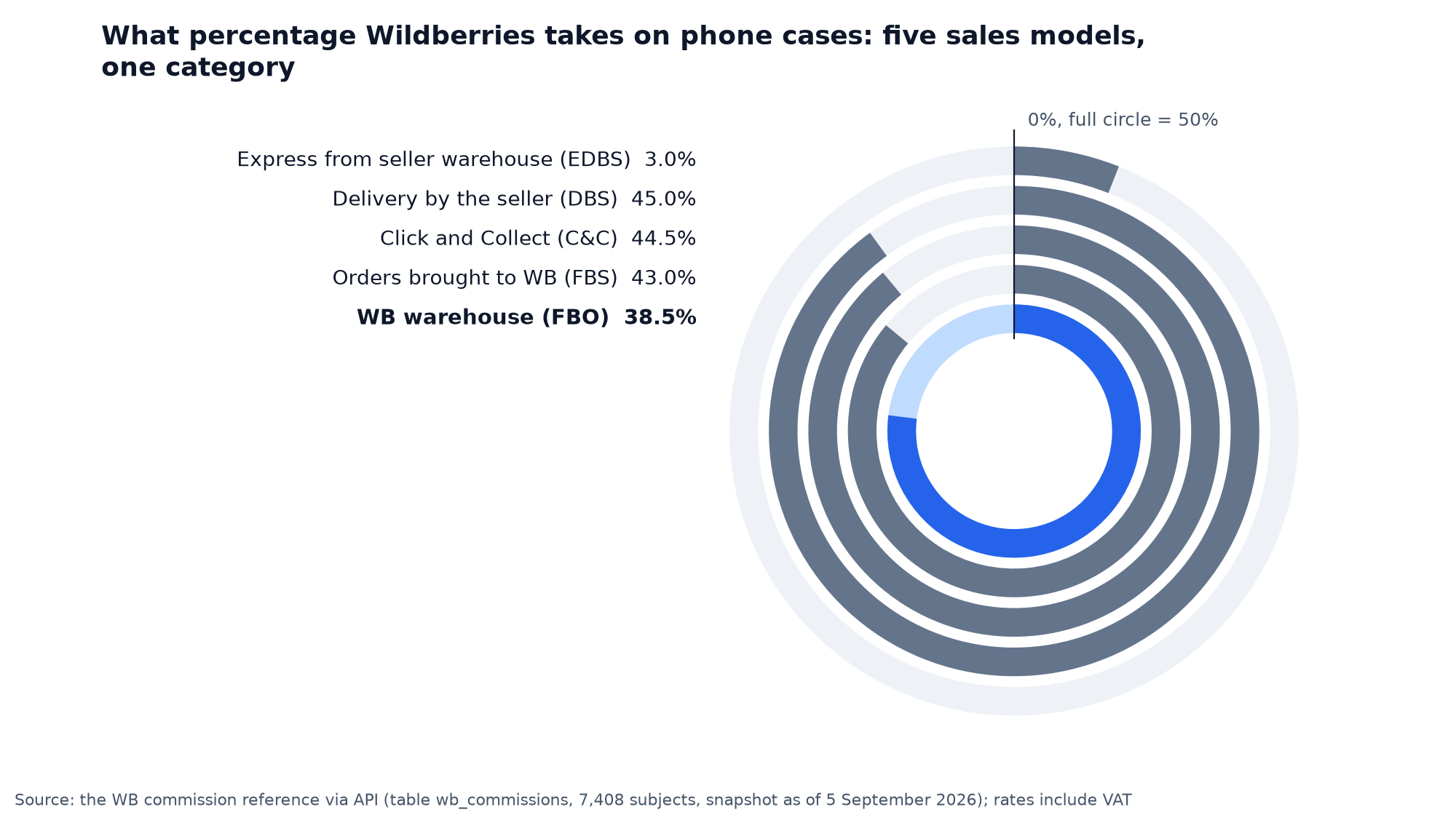
Take the category the store in this article sells in: phone cases. We pull the commission reference straight from the WB API, snapshot as of 5 September 2026. From a WB warehouse the rate is 38.5%, shipping from your own warehouse on FBS it is 43%, Click and Collect 44.5%, delivery by the seller 45%. Express from the seller's warehouse costs 3%, because WB barely does anything there.
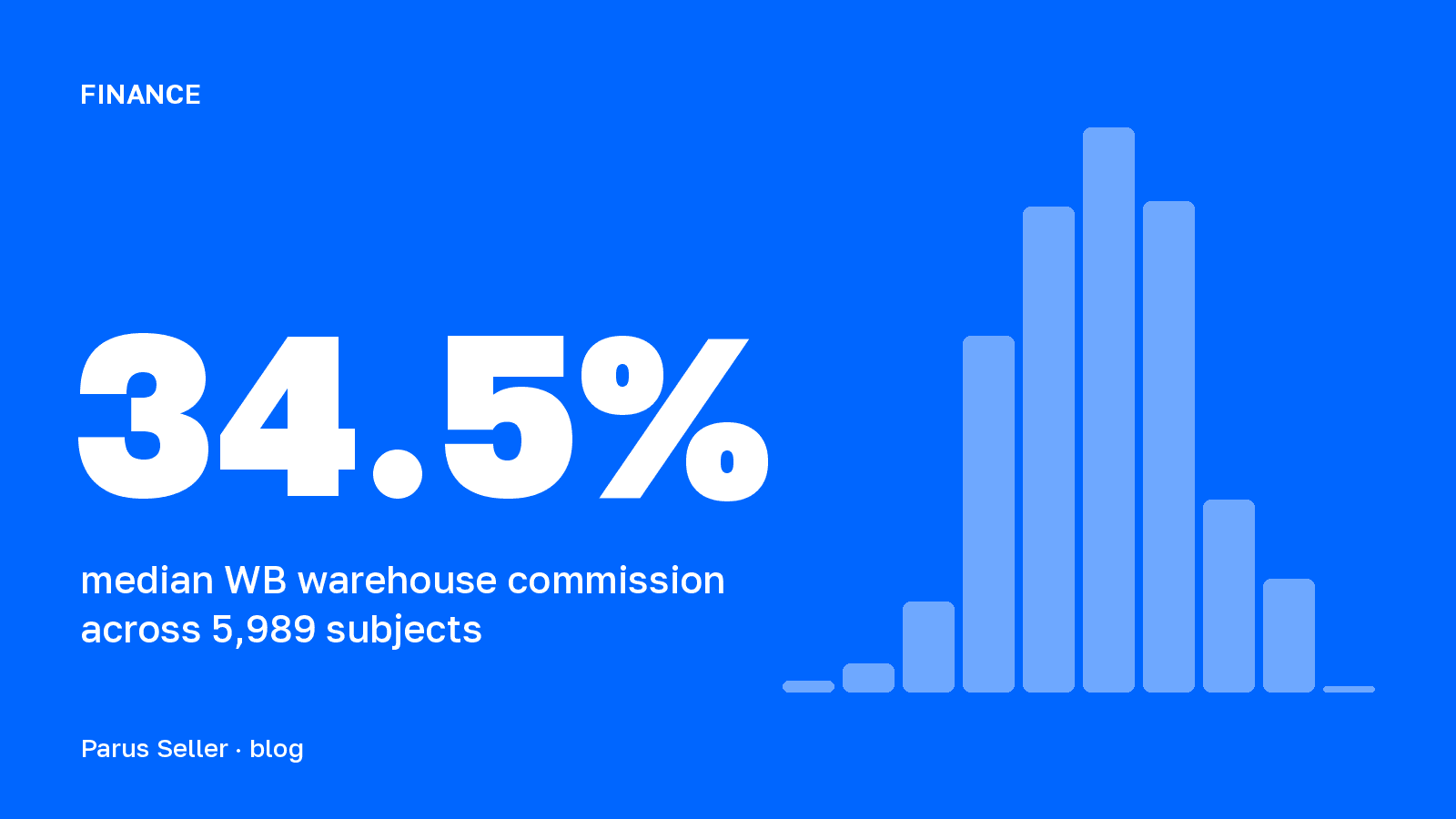
The median across the whole reference is 34% from a WB warehouse and 38% on FBS. The table covering 5,989 subjects that really sell sits in our breakdown of Wildberries commissions by category. In the seller portal the same table lives under "Supplies and orders" → "Tariffs" → "Commission", per the WB instruction dated 27 August 2026.
The rate includes VAT, and that is the first trap when you price a product: the 38.5% comes off the seller's price, not off the profit. The second trap is that the rate covers exactly one line of the report. The rest of the lines are nowhere in the commission table, and they are precisely what turns 38.5% into half of the customer's money.
What is really deducted from the price: the payable formula on 217 sales
In the line-item detail of the weekly report every sale carries a field called ppvz_for_pay, the payable amount. We checked what it is made of across 217 sales in August 2026. The formula turned out to be simple: payable = the seller's price after their own discount × (1 − the category rate) − the acquiring fee. For the week of 10–16 August it matched to the kopeck in all 86 sales. For the two weeks from 24 August to 6 September it matched in 128 sales out of 131, and the three mismatches, under five roubles each, all fell on lines with no acquiring fee, where the ppvz_reward field held a credit for handing the order over at a pickup point.
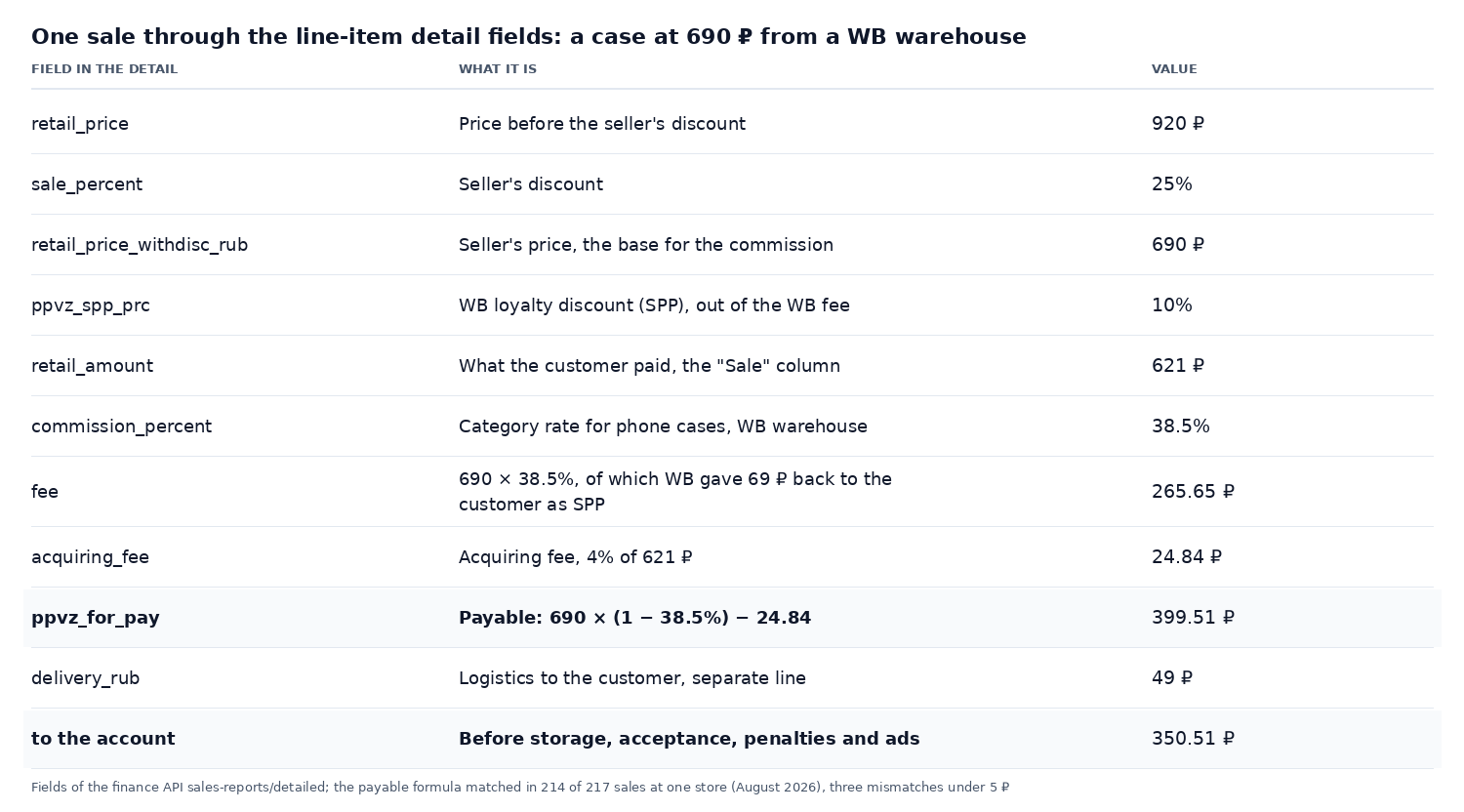
Take one sale from the store's month apart. The case is listed at 920 ₽ before the seller's discount; after a discount of 25% the seller's price is 690 ₽, and that is the base for the commission. WB then adds its own discount for the customer, a loyalty discount of 10%, and the customer pays 621 ₽.
The WB fee works out as 690 × 38.5% = 265.65 ₽, and the acquiring fee as 4% of 621 ₽ = 24.84 ₽. What is left payable is 690 × 61.5% − 24.84 = 399.51 ₽. Delivery to the customer lands in the same report on its own line, and for this store it averages 49 ₽ per sale. The account receives 350.51 ₽ for this sale, and that is still before storage, inbound acceptance and advertising.
The acquiring fee deserves its own paragraph, because other reviews quote it as "0.4 to 3%". In our lines it is most often exactly 4.0% of what the customer paid: so in 136 sales out of 217. You also meet 4.9% and 0.2–0.4%, and the size depends on the payment method. Clause 12.10 of the offer agreement describes this sum as compensation for the cost of accepting payments, which WB withholds weekly in advance and reconciles against a cost report once a month.
Does the seller pay for the WB loyalty discount
They do not. The WB loyalty discount, SPP in the seller portal, cuts the price for the customer and cuts the WB fee, and leaves the payable amount alone. You can see it in those same 217 sales: the ppvz_kvw_prc field, the fee coefficient, equals the base coefficient minus the loyalty discount in all 217 rows. At a loyalty discount of 30% our store's kVV fell to 1.45%, at 35% it formally went negative, and the sum paid to the seller did not move.
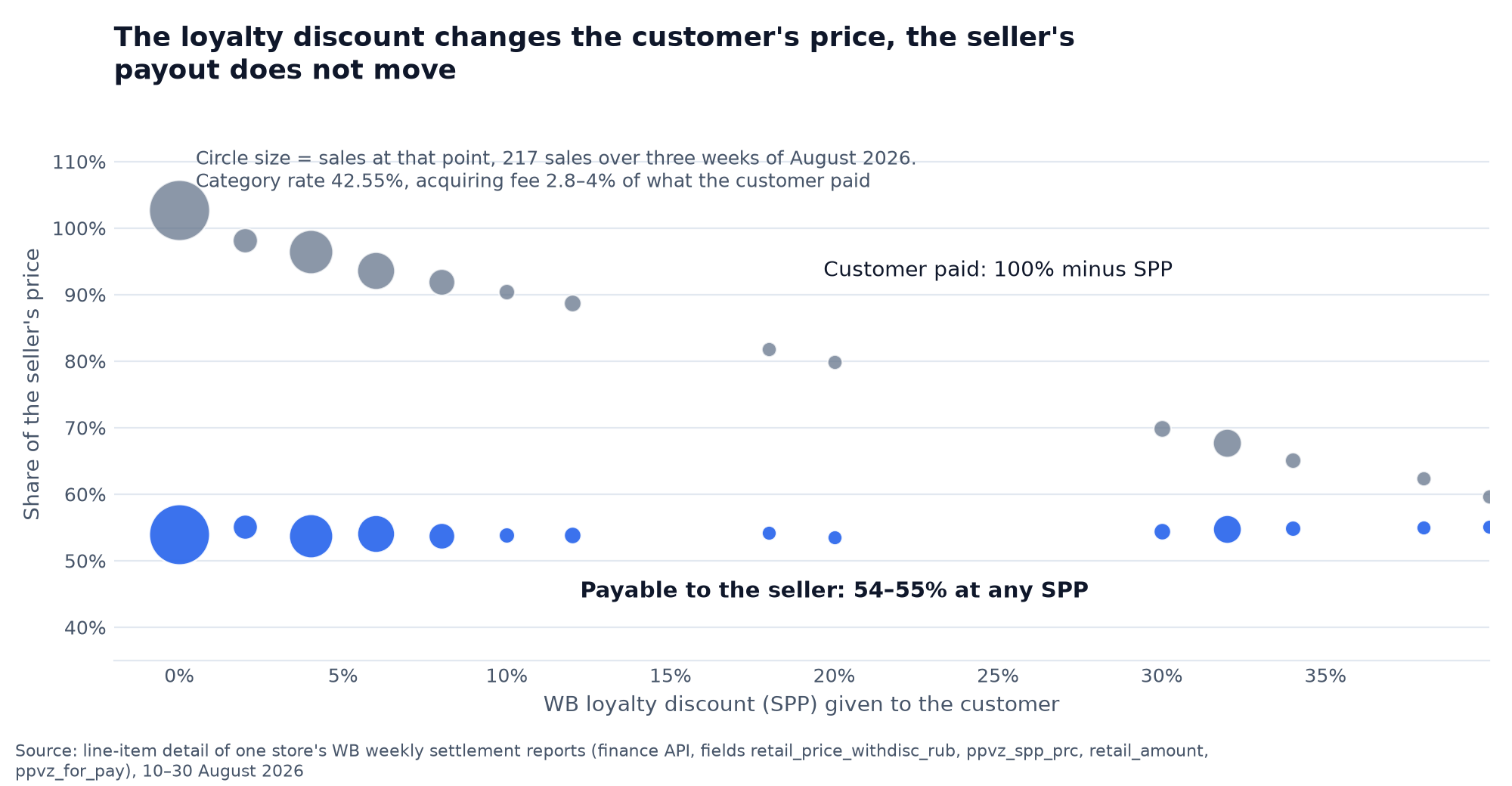
Each dot on the chart is a group of sales with the same loyalty discount. The grey customer line falls from 100% of the seller's price to 62% at a loyalty discount of 35%. The blue payable line sits at 54–55% whatever the discount: the store pays a rate of 42.55% on FBS plus the acquiring fee, and that share does not depend on the loyalty discount. The seller even gains slightly, because the "Sale" column, the one the simplified tax is charged on, comes out smaller.
There is one caveat. Under clause 12.4 of the offer agreement the seller may opt out of the WB discount on their products from the portal, and then the customer pays the full seller's price. But a listing without the loyalty discount loses to its neighbours on price in the storefront, so opting out only makes sense where WB cuts the price below your own floor.
What else Wildberries takes after the commission: logistics, storage, acceptance, penalties
After the fee and the acquiring fee, the report moves on to lines that appear in no commission table at all. In two weeks of our store's detail we counted 16 different grounds, each with its own field. Logistics goes into delivery_rub, storage into storage_fee, penalties into penalty, deductions into deduction. "Reimbursement of transport costs" sits on a separate line in rebill_logistic_cost.
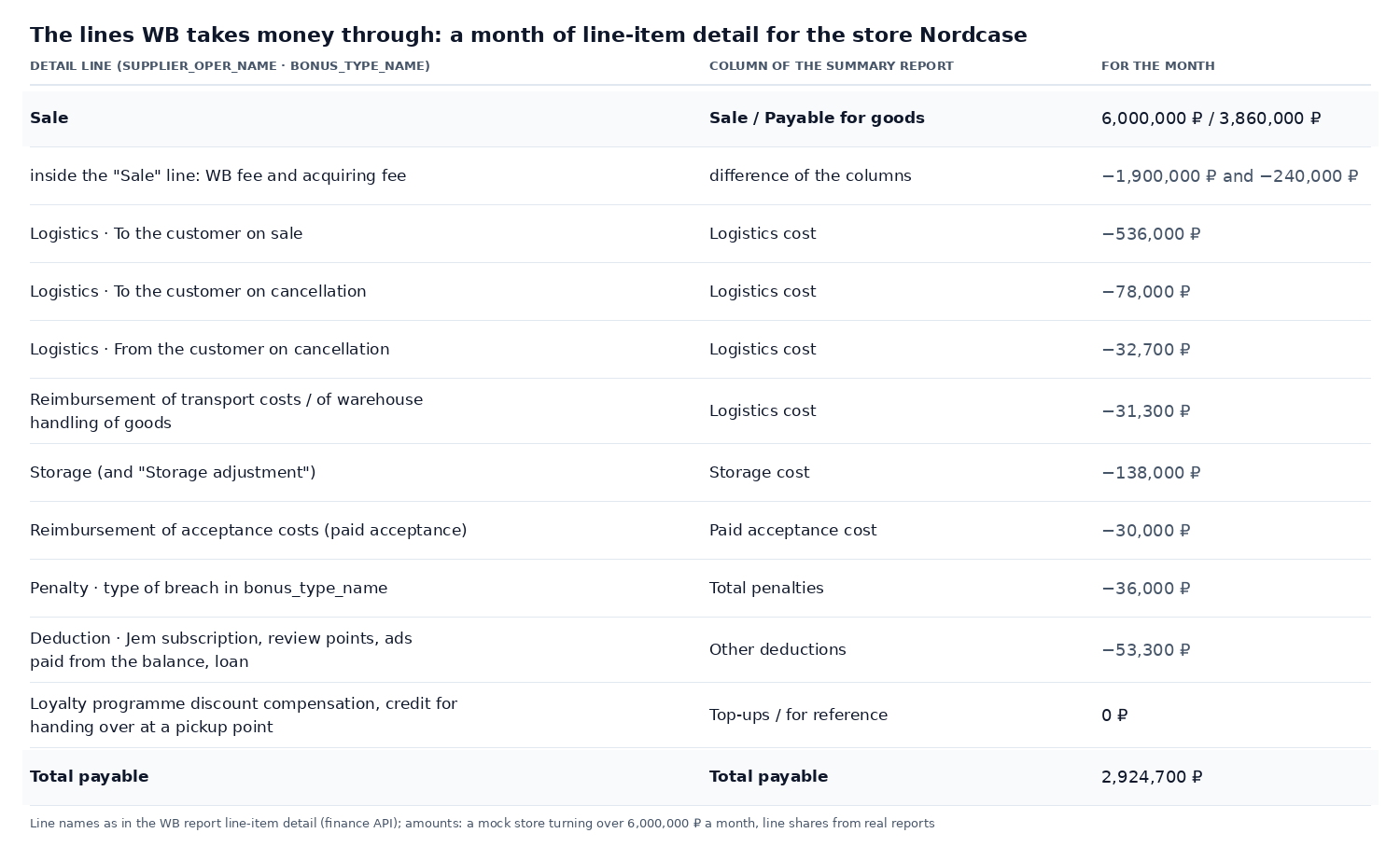
Logistics is the heaviest of them. For a phone case in August 2026 delivery to the customer cost the store 49 ₽ per sale on average. A refused order meant two trips: 55 ₽ "to the customer on cancellation" and 23 ₽ "from the customer on cancellation". At a buyout rate of 70% every sale carries 0.43 of a refused order, and logistics per unit grows from 49 to 82 ₽. How that formula plays out by category we worked through in the article on the buyout rate, and the rates by volume and the warehouse coefficients after 15 August are collected in our breakdown of Wildberries logistics in 2026.
Storage is written off daily for every litre in the warehouse and reaches the report as "Storage" lines with no link to a sale. For our store that is around 0.1 ₽ per litre per day at a warehouse with a coefficient of 100%. Paid inbound acceptance depends on the warehouse coefficient on the day of the supply, and there is more on it in the article on acceptance. Penalties arrive as a "Penalty" line with the type of breach in the bonus_type_name field. For our store the most frequent type is keeping returns at a pickup point for longer than three days, and the full list is in the breakdown of Wildberries penalties for sellers.
The "Deduction" line is the most varied of all. It holds the Jem subscription, charges for review points, advertising if it was paid from the balance, and interest on WB loans. Our store had three lines in August reading "Transfer to the borrower's balance to pay loan interest". In the summary report all of this is glued into the "Other deductions" column, and without the detail there is no way to tell what is inside.
How much Wildberries takes in a month: a store at 6 million ₽, line by line
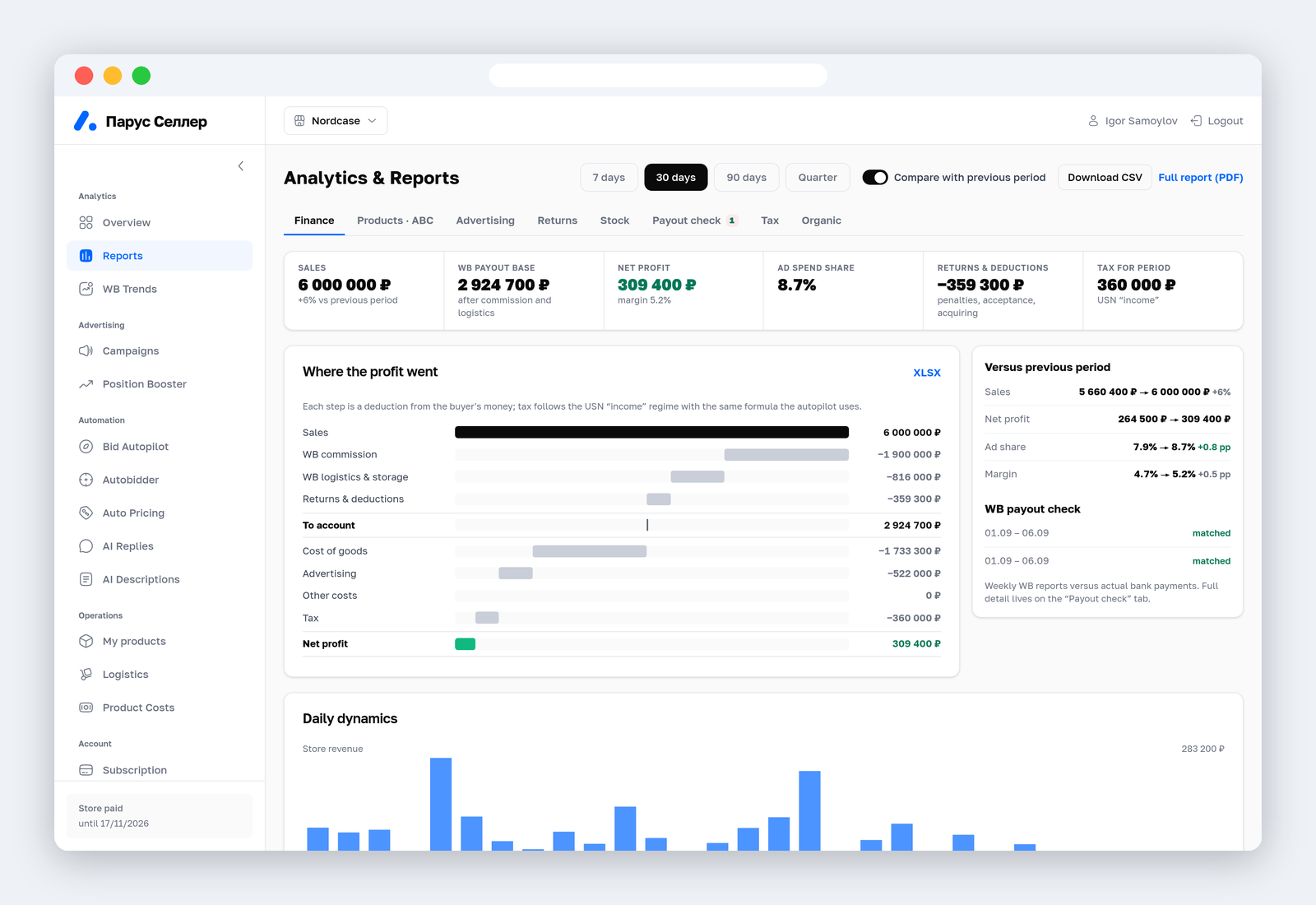
Add up a month for the store Nordcase, which sells phone cases from a WB warehouse. The seller's price for the month comes to 6,666,700 ₽, the loyalty discount averages 10%, and customers paid 6,000,000 ₽. The shares for logistics, storage, acceptance and penalties are taken from real reports across 30 weeks, which we wrote about in our breakdown of the Wildberries weekly report.
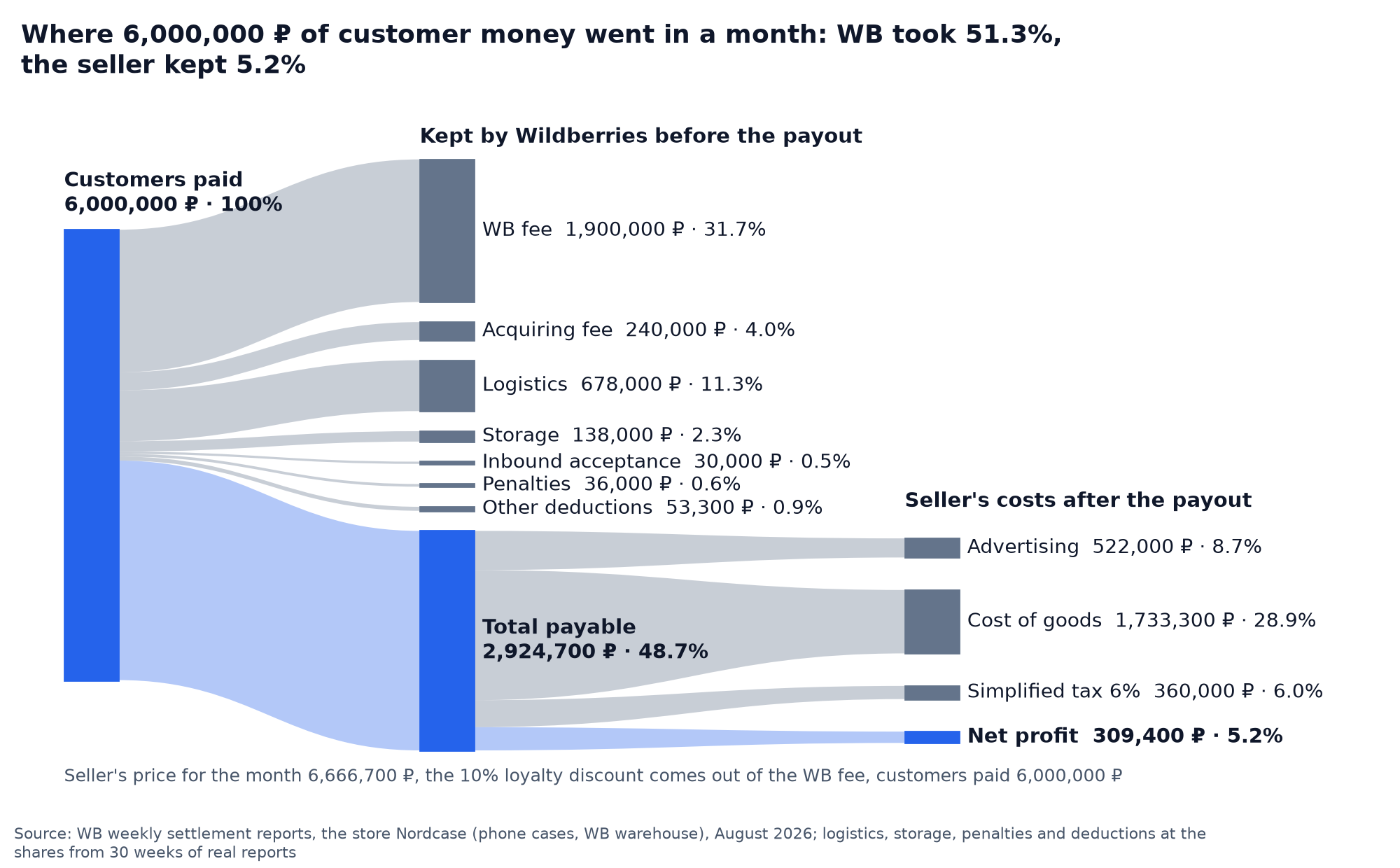
The WB fee after the loyalty discount came to 1,900,000 ₽, which is 31.7% of the customer's money, even though the category rate is 38.5%: the platform handed the difference back to customers as a discount. The acquiring fee took another 240,000 ₽. Logistics at 678,000 ₽ turned out to be the second largest line, storage 138,000 ₽, inbound acceptance 30,000 ₽, penalties 36,000 ₽, other deductions 53,300 ₽. Total payable 2,924,700 ₽, that is 48.7% of what the customers paid. That is exactly what "how much Wildberries takes" means for a real store: 51.3%, not 38.5%.
From there the seller spends the money. Advertising 522,000 ₽ at an ad spend share of 8.7%, cost of goods 1,733,300 ₽, simplified tax on revenue at 6% of sales 360,000 ₽. Net profit for the month 309,400 ₽, which is 5.2% of the customer's money and 4.6% of the seller's price. No single line looks dangerous on its own. That is the peculiar thing about the economics of WB: what eats the seller is not the rate but the sum of ten lines, each calculated by its own rules.
It makes sense to check that sum not in roubles but as shares of sales, week by week. Commission at a healthy store barely moves, whereas logistics across our 30 weeks swung from 9 to 109% of sales in the week a blocked batch came back. On the "Finance" tab in Parus Seller the waterfall from sales down to net profit builds itself out of the weekly reports, and the "Payout check" tab compares every report against the actual payment. The first two months are free with promo code PARUS60: connect your account with an API token and see your own waterfall.
Where to see where the money went in your own portal
There are two places in the WB Partners portal. First: "Analytics" → "Income and expenses", a report built on the same structure as our diagram: buyouts, commission and acquiring fee, delivery, storage, acceptance, penalties, the loyalty programme, deductions. Per the WB instruction dated 31 August 2026 the full report requires a Jem subscription. The second place is free: "Financial reports" → "Weekly", where the summary shows the columns and the XLSX with the line-item detail shows every row with the fields from this article. How to read that file column by column we covered separately.
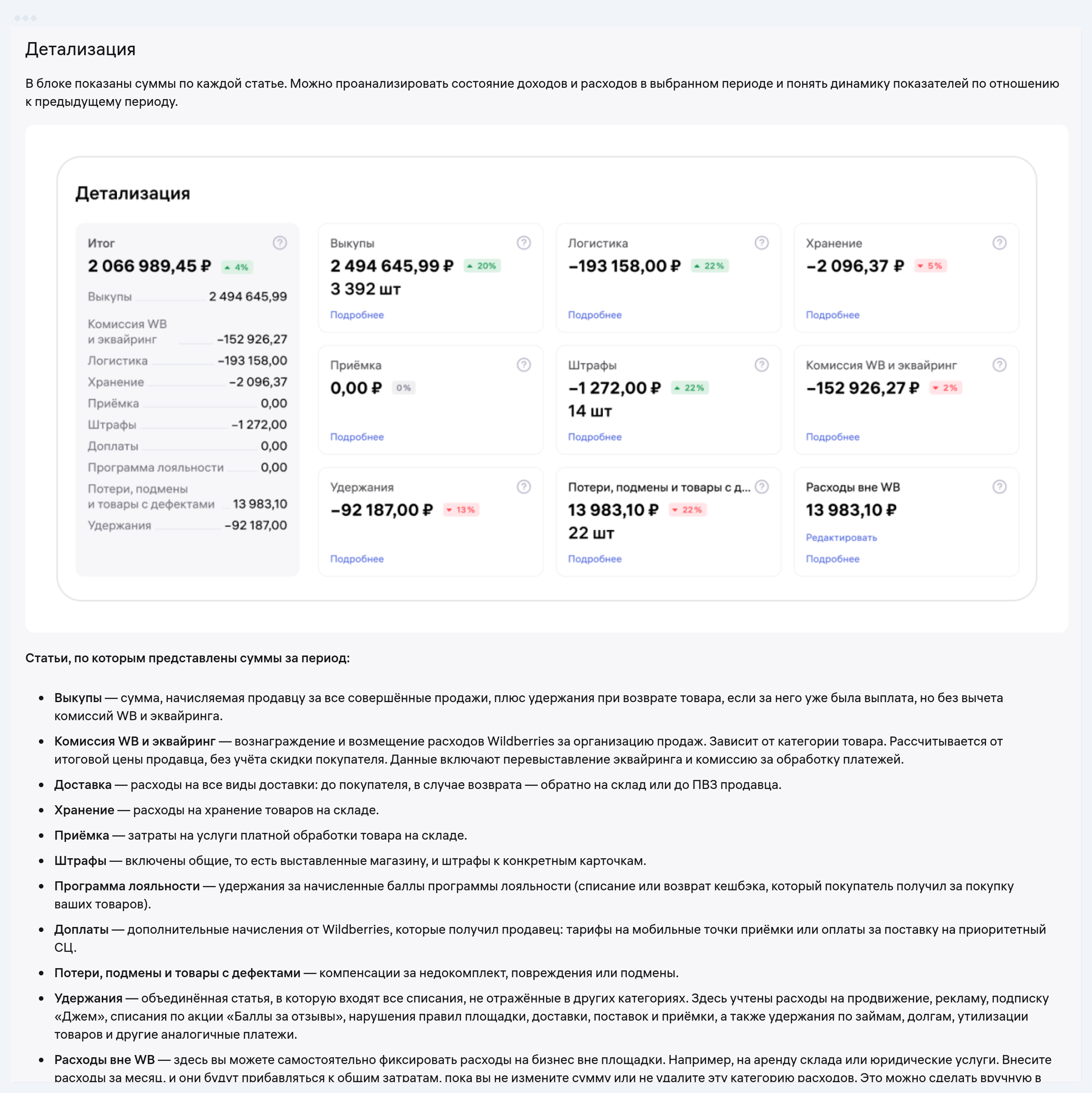
In that instruction WB itself lists what a seller's costs are made of, and the list matches the lines in our detail. Note the wording about the commission: "calculated on the seller's final price, without the customer's discount". That is the same formula that matched for us in 214 sales out of 217.
Here is a routine that takes ten minutes on a Monday. Open both reports for the week, the main one and the buyout one, and add up "Total payable". Work out the shares of commission, logistics and storage against "Sale" and compare them with last week. If any share has grown by more than a third, download the detail and filter the lines by "Reason for payment". Other deductions above zero mean advertising, a subscription or a loan is sitting inside, and you need to see it with your own eyes. In Parus Seller these steps run automatically once the account is connected with an API token; the token is created by the store owner and revoked in one click, and there is more in the article on the Wildberries API token.
FAQ
How much does Wildberries take for a returned item? There is no commission on a return: the fee on a returned sale is reversed. What the seller pays for is the travel. When a customer refuses an order, two logistics lines appear in the report: "to the customer on cancellation" and "from the customer on cancellation". For our store in August 2026 that was 55 and 23 ₽ per unit. Unclaimed goods travelling back to the seller are charged at the warehouse return rate.
How much does Wildberries take for delivery to the customer? It depends on the product's volume and the coefficient of the dispatching warehouse. For a phone case in individual packaging under a litre it is 49 ₽ per sale, averaged across the "to the customer on sale" lines for August 2026. Bulky goods are counted by the litre, and the warehouse coefficient multiplies the base rate.
How much does Wildberries take for storage? The charge runs per litre per day at the warehouse rate. For the store in this article in September 2026 that is 0.108 ₽ per litre per day at a warehouse with a coefficient of 100%, and over the month storage came to 2.3% of sales. The coefficients by warehouse are published under "Tariffs".
How much does a seller pay Wildberries in the end? At the store turning over 6 million ₽ in this breakdown the platform kept 51.3% of the customer's money before the payout. Of that, the fee is 31.7%, the acquiring fee 4%, logistics 11.3%, storage 2.3%, and acceptance, penalties and deductions another 2%. For a different category the share moves with the rate and the weight of the product, so count on your own reports rather than on an average.
What percentage does Wildberries take off the seller's price? For a case at 690 ₽ from a WB warehouse that is a fee of 265.65 ₽, an acquiring fee of 24.84 ₽ and logistics of 49 ₽. Together 339.49 ₽, or 49.2% of the seller's price. Of that, 69 ₽ went back to the customer as the WB loyalty discount, so the platform kept 39.2% for itself. Storage, acceptance, advertising and penalties are not in that figure yet.