The WB loyalty discount is a discount for repeat customers that Wildberries funds out of its own pocket. In the seller instructions it's called the "WB discount." The customer sees a price lower than yours, and you get the same amount you'd have gotten without the discount: in the report, WB reduces its own commission by exactly the loyalty discount percentage. The seller can't influence the size of the discount. It's different for every customer, and the same product can sell on the same day with a loyalty discount of 0% and with one of 31%.
"Wildberries loyalty discount" is searched around 1,800 times a month, and the breakdowns in search results argue about who pays for the discount. We didn't want to just retell them. We took 32,671 FBO sales from 21 stores between February 2025 and September 2026 from the WB sales API and checked them against the weekly reports of our test store: how much the customer paid, how much commission WB withheld, and how much reached the seller.
What is the WB loyalty discount (SPP)
WB explains this in its "How to set prices and discounts" instructions. You set the price and discount in the "Prices and discounts" section, but the customer sees a different price on the storefront. Three things lower it: the WB Club discount, the WB discount, and the discount for paying with WB Wallet. The second one is the WB loyalty discount, SPP. The instructions state it directly: "Wildberries provides this discount to customers at its own expense."
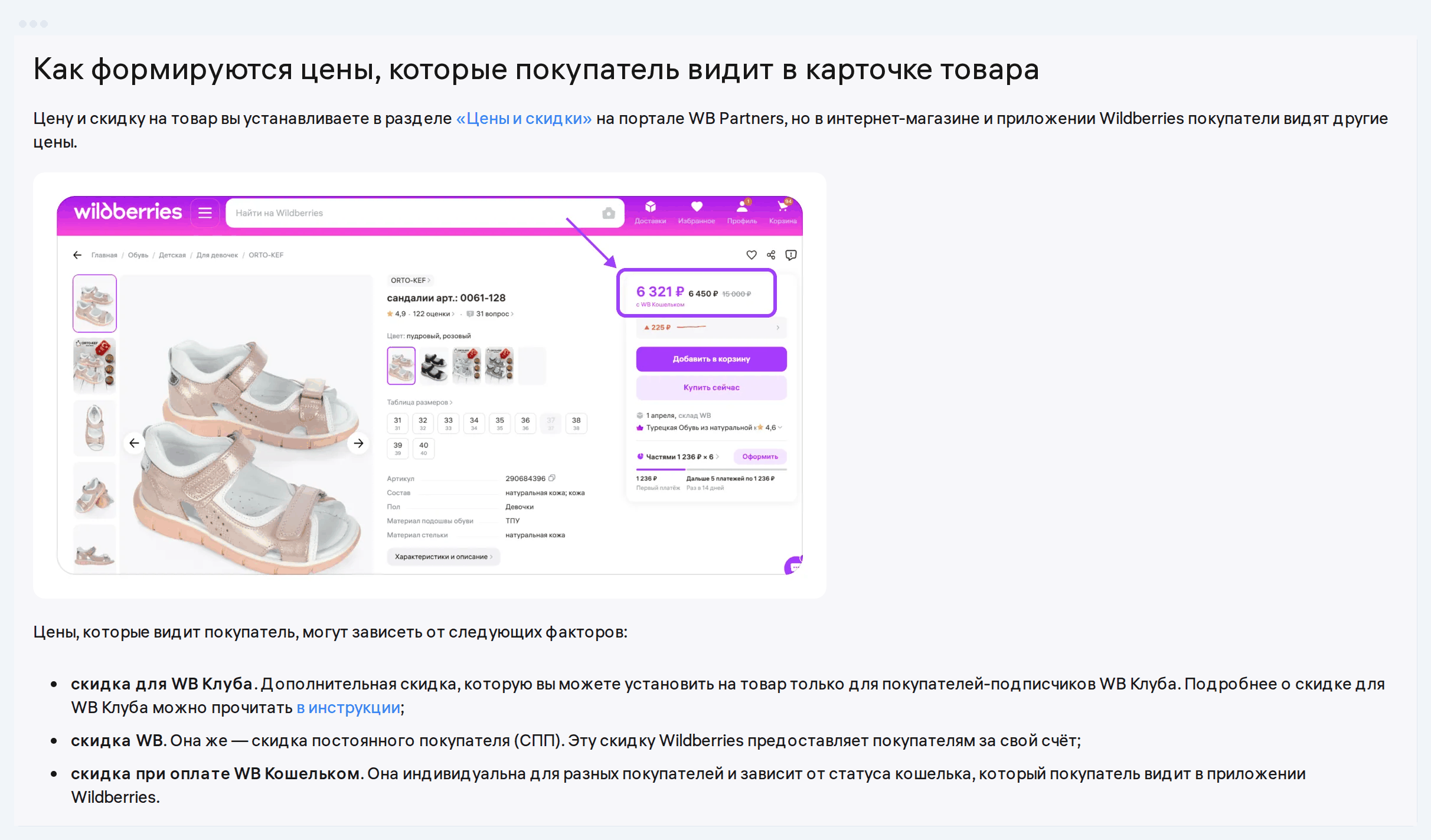
The price chain looks like this:
| Step | Who decides | Field in the sales API |
|---|---|---|
| Price before discount | seller | totalPrice |
| Price after the seller's discount | seller | priceWithDisc |
| Minus WB loyalty discount | WB | spp, % |
| Minus WB Wallet discount | WB, depends on the customer's wallet status | paymentSaleAmount, ₽ |
| Price the customer paid | final result | finishedPrice |
For the seller, the second row matters most. WB's commission and your payout are calculated from the price after your discount. Everything below that is on WB's side.
Who pays the WB loyalty discount: the seller or the marketplace
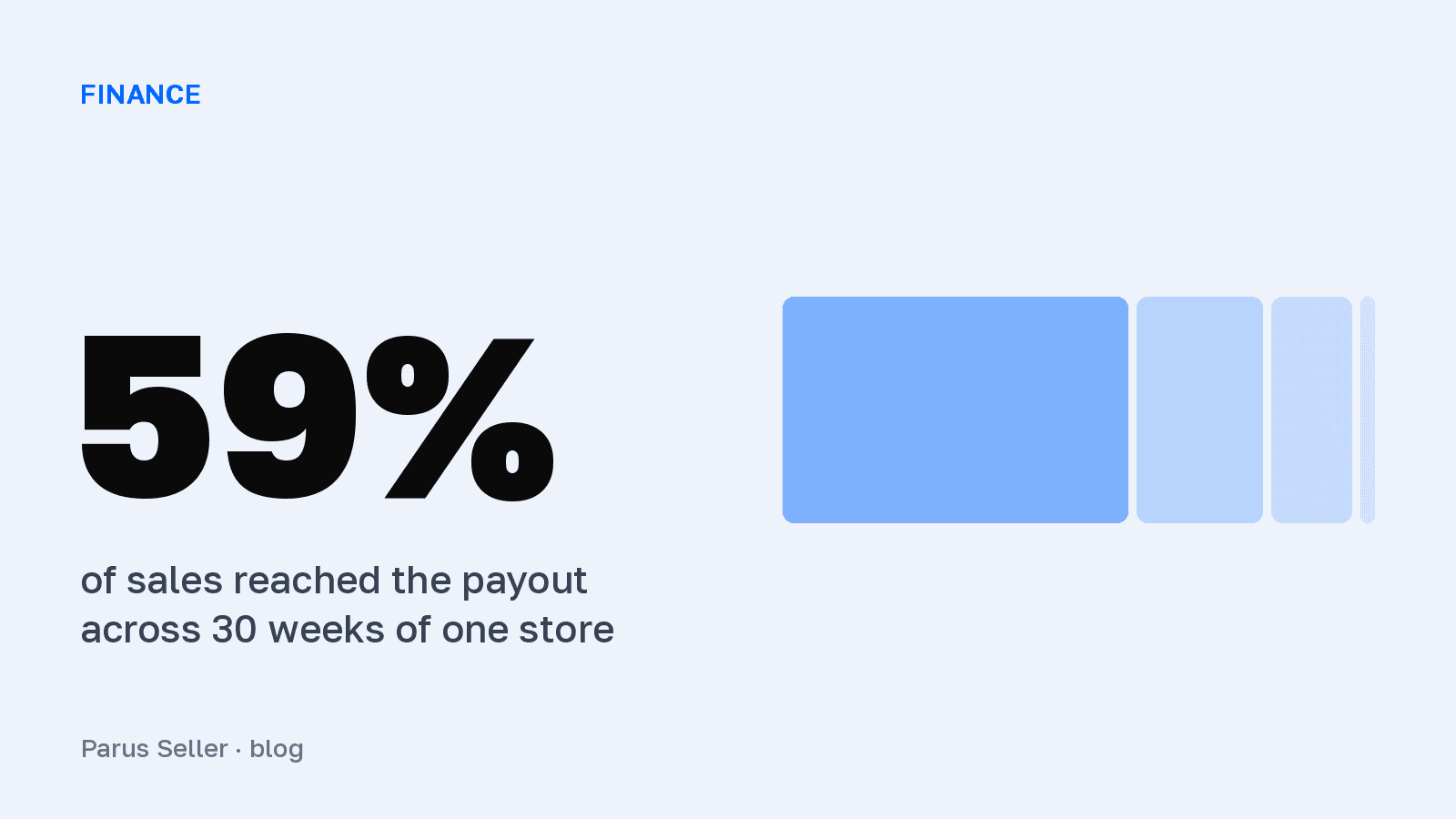
WB pays, and you can see it in the money. We took clothing sales from three stores and broke them down by the size of the WB loyalty discount. A customer with an 18–19% discount paid on average 81.5% of the price after the seller's discount, with a 30–31% discount, just 70%. The payout to the seller stays at 53.2–53.4% across all groups.
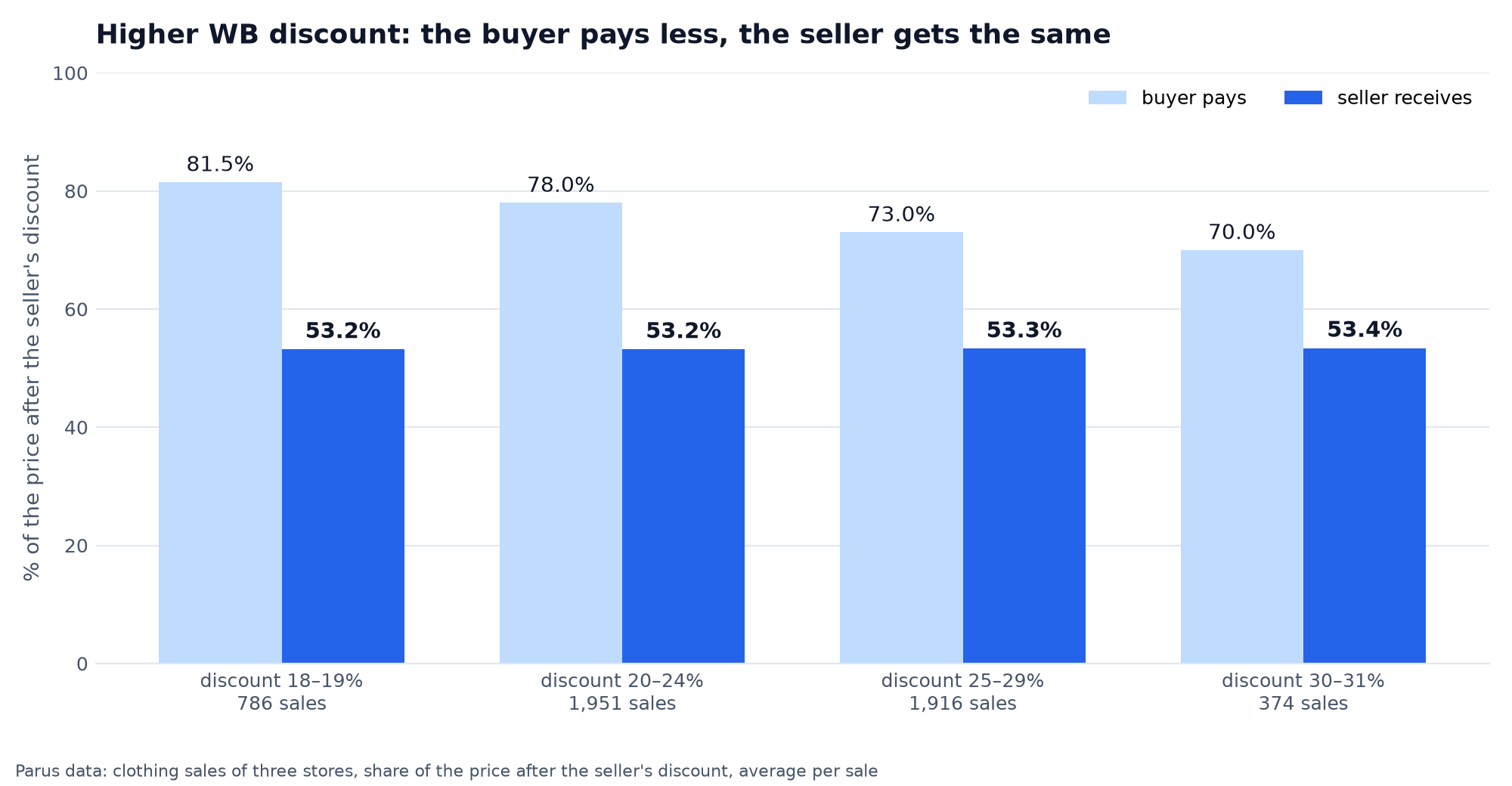
If the seller paid for the WB loyalty discount, the blue bars would drop along with the light blue ones. They stay put.
How WB offsets the loyalty discount in the report
You can see the mechanics in the line-item detail of the weekly report. Each sale has three fields: spp (WB loyalty discount in percent), kvwBase (base commission rate excluding VAT, WB's fee before the discount) and kvw (final commission rate excluding VAT). We exported sales from a test store for two weeks in September 2026 and subtracted the final commission rate from the base rate. The difference matched the loyalty discount in all 25 sales to within hundredths of a percent. This is exactly how the WB offer agreement states it, clause 12.5.2: the commission rate equals the category rate with options, minus the discount for the seller's level, minus the sum of platform discounts, which includes the WB discount.
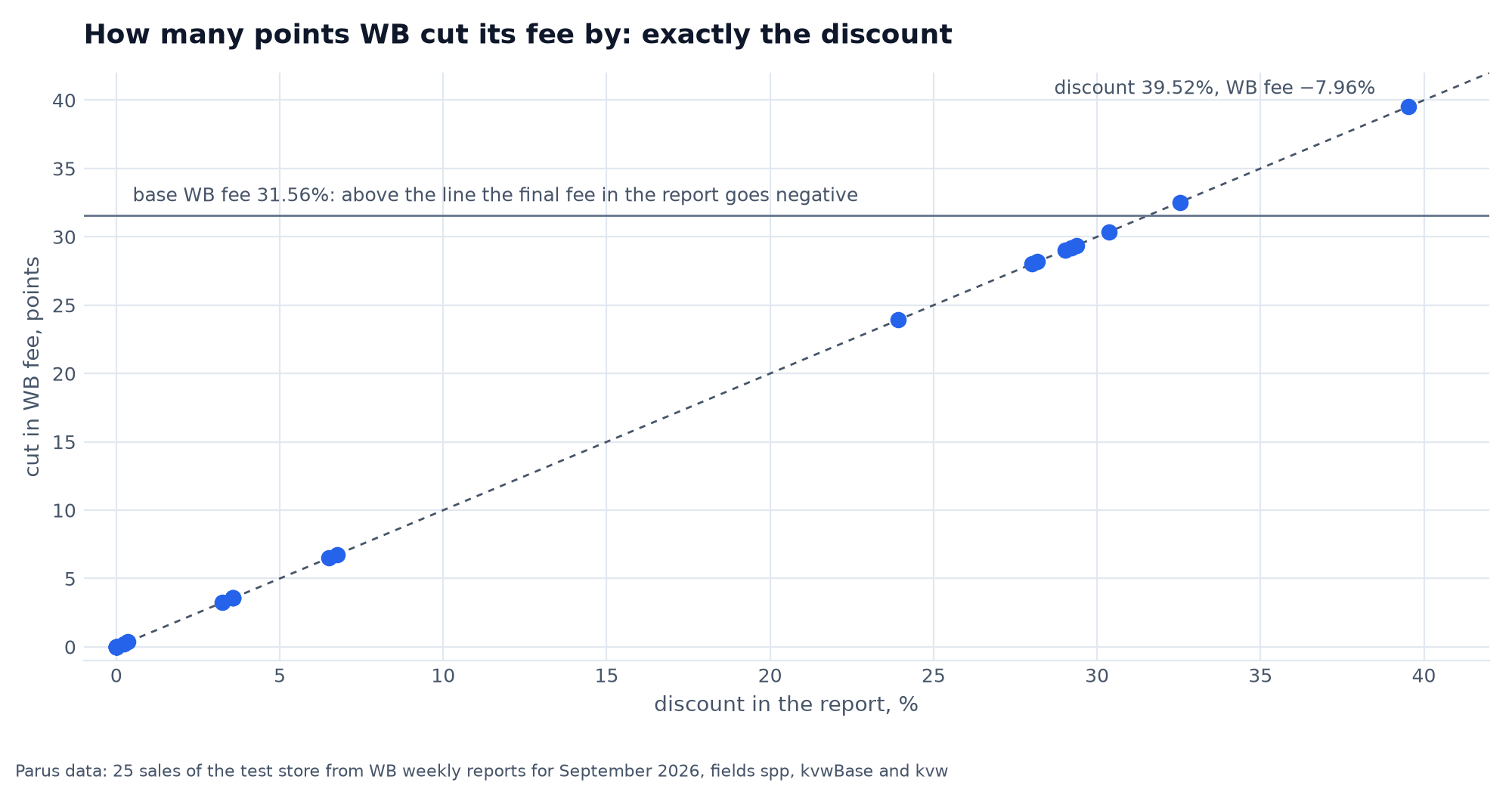
The base commission rate for the test store is 31.56%. When the loyalty discount is larger, the final commission rate goes negative: at a 39.52% discount it equals −7.96%. Even then, WB isn't working for free. The store sells from its own warehouse, so under the offer agreement a kS coefficient is added to the commission rate, 10.99% for this store, and the sum of the commission rate and kS never falls below 1%. In this sale, WB took about 3% instead of 42.55%, and gave the rest to the customer.
Here are four sales of the same product at the same price. We rescaled them to a price of 1,000 ₽ after the seller's own discount:
| Loyalty discount in report | Customer paid | Final commission rate | Payout to seller |
|---|---|---|---|
| 0% | 1,000 ₽ | 31.56% | 570 ₽ |
| 3.23% | 968 ₽ | 28.33% | 536 ₽ |
| 29.03% | 710 ₽ | 2.53% | 540 ₽ |
| 39.52% | 605 ₽ | −7.96% | 550 ₽ |
The customer paid anywhere from 605 to 1,000 ₽, but the payout stayed in a 536-570 ₽ range. The couple of percentage points of spread isn't caused by the loyalty discount: we saw a payout of 57% of the price both at a 0% discount and at a 28% discount. Other deductions in the report line cause it. We covered the report's fields in detail in our breakdown of the WB weekly report, and the full path from price to payout with logistics and acquiring fees in the article on how much Wildberries takes from sellers.
Why the WB loyalty discount changes every day
Because it's unique to each customer. Take one home appliance product in May 2026: 905 sales over the month, with the WB loyalty discount ranging from 0 to 34%. The daily average barely moved, 15 to 21% on days with ten or more sales. But within a single day the spread is huge. On 11 May the product sold 91 times, and the discount on those sales ranged from 0 to 31%.
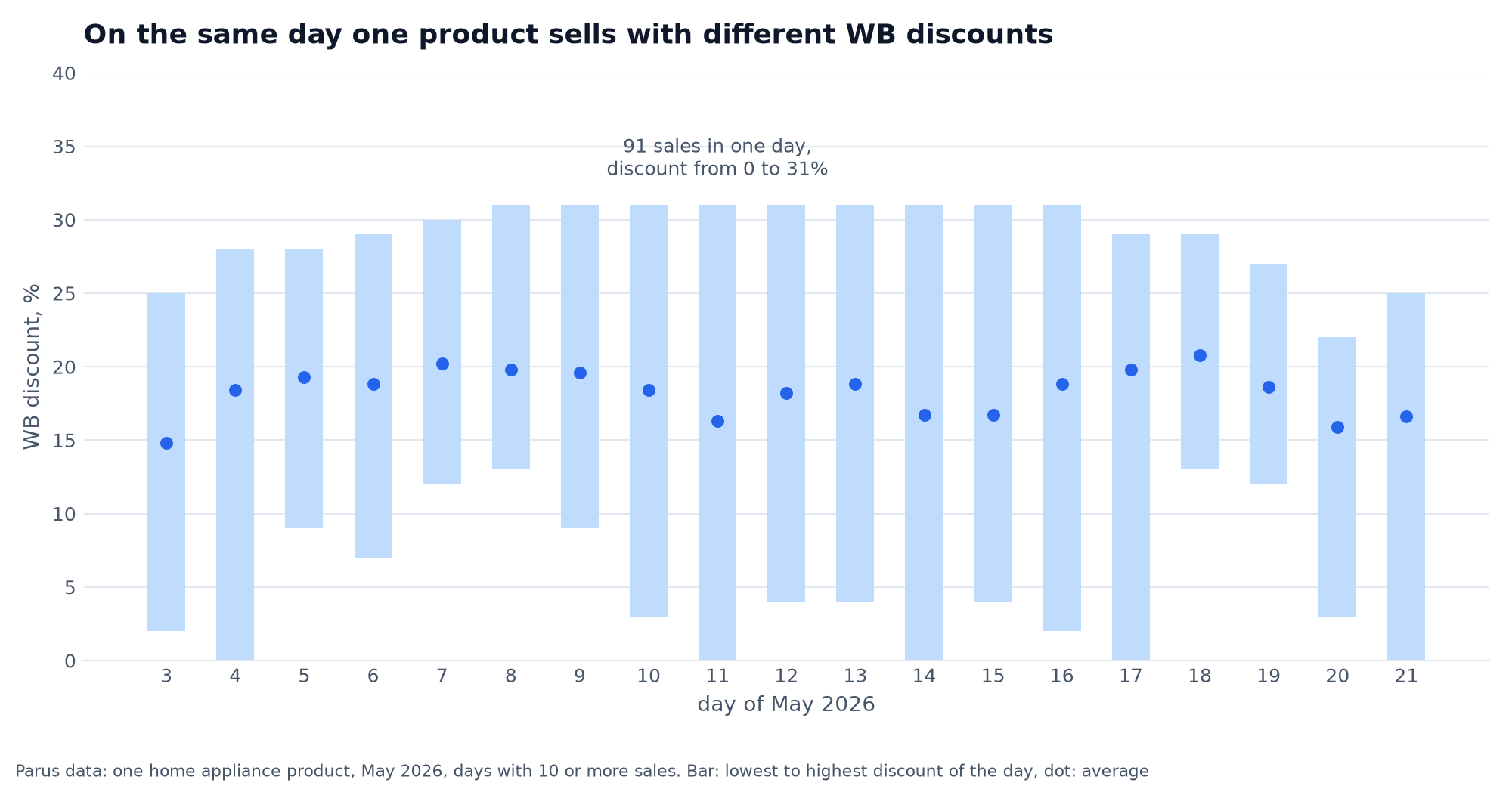
This isn't a one-off case. We checked 304 "product and month" pairs with at least 30 sales. In a typical pair, the spread between the smallest and the largest discount was 14 points, and in one pair in ten it was more than 32 points.
Here's the practical takeaway. If you open a card on your own phone and see a 25% loyalty discount, that's the discount for your account. Another customer sees a different price at the same minute.
What WB loyalty discount rates look like
Across all 32,671 sales, the median WB loyalty discount is 22%, the maximum is 45%. Every third sale went through with a discount of 25–29%, every sixth had none at all.
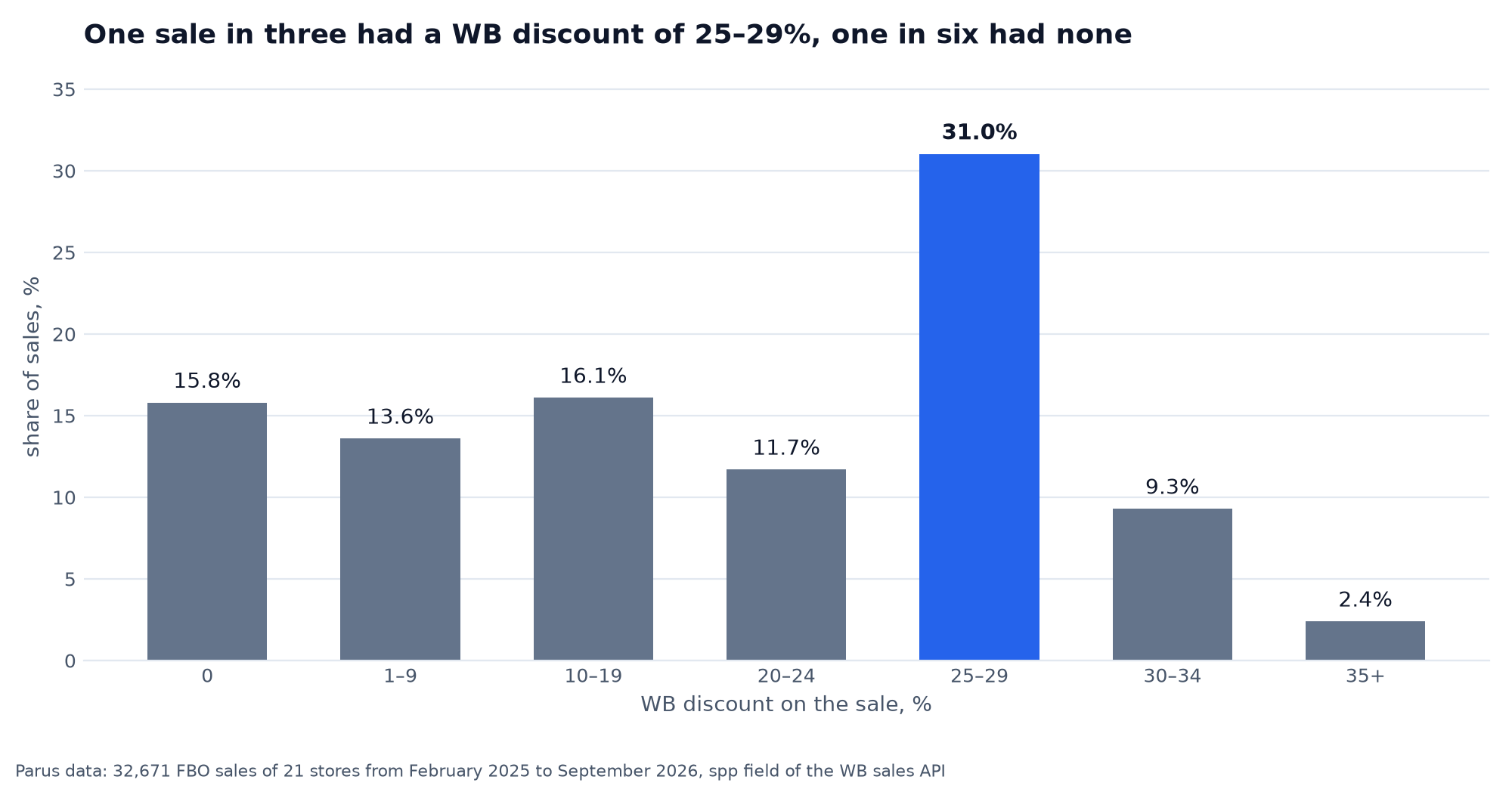
We deliberately don't draw a month by month chart of the average discount. In our data, summer 2025 had 16 to 18 stores, and by autumn 2026 only 1 to 3 were left. A monthly average says more about which stores made it into the sample than about WB's policy.
Where to see the WB loyalty discount as a seller
There are three ways:
| Where | What you see | Limitation |
|---|---|---|
| Sales API, spp field | WB loyalty discount per sale, % | excludes the WB Wallet discount, it's shown separately in paymentSaleAmount |
| Weekly report line-item detail | spp, base and final commission rate | arrives once a week |
| Product card on the WB website | price for your account | this is the loyalty discount for one customer, not everyone |
In the report, the spp field is a bit broader than in the Sales API. It shows how much lower the amount the customer paid is than the price after your discount, and it includes the WB Wallet discount. That's why the numbers in the report and in the Sales API diverge by the Wallet's share: a sale with a 20% loyalty discount in the Sales API shows up as 20.16% in the report.
To estimate the loyalty discount from the product card by hand, take the storefront price without the Wallet and compare it with the price after your discount from the "Prices and discounts" section. The percentage difference is the loyalty discount WB gave your account.
Did WB remove the loyalty discount?
This question comes up every time WB changes the interface of the storefront or reports. We checked the data as of 27 September 2026. The sales API still returns the spp field: in 586 of 588 sales from the last week in our sample, the loyalty discount is above zero, with a median of 25%. In the line-item detail of September reports, the spp, kvwBase and kvw fields are filled in, and the commission rate drops by the loyalty discount just like on the chart above. The discount is still there. Only where it's shown has changed.
Can you influence the WB loyalty discount
WB alone decides the size of the WB loyalty discount for a given customer, there's no setting for this in the seller portal. The marketplace doesn't publish the formula, and tips like "join promotions and your loyalty discount will grow" are something we couldn't verify on our data.
You can turn the discount off. Under clause 12.4 of the offer agreement, the seller has the right to opt out of the WB discount for their products through the portal and turn it back on later. In that case the customer pays your full price, and the card on the storefront looks more expensive than its neighbours. This makes sense only if the WB loyalty discount pushes the storefront price below what you're willing to show the customer.
What you can do is avoid doing anything unnecessary. Sellers sometimes raise the price to "cover" the loyalty discount. There's no need for this: you don't pay for it, and your payout doesn't depend on it. A higher price just makes the product more expensive for the customer. Calculate your product's economics from the price after your own discount, as in our unit economics calculator.
FAQ about the WB loyalty discount
Who pays the WB loyalty discount? Wildberries. In the report it reduces its own commission by exactly the loyalty discount percentage, the payout to the seller doesn't change.
Does the WB loyalty discount reduce the payout to the seller? No. In 25 sales from the reports, the payout held at 52 to 57% of the price after the seller's discount, both at a 0% loyalty discount and at a 39.5% loyalty discount.
Can you turn off the WB loyalty discount? Yes, under clause 12.4 of the offer agreement the seller can opt out of the WB discount through the portal and turn it back on later. The payout won't grow from this, only the price for the customer will.
Where can I see the WB loyalty discount in my account? In the line-item detail of the weekly report: the loyalty discount and the кВВ for each sale. Through the sales API, the spp field arrives right after the sale.
Why do different customers see a different price for the same product? Because the WB loyalty discount and the WB Wallet discount are personal. The same product can sell with a discount anywhere from 0 to 31% on the same day.
How do I calculate the WB loyalty discount? Divide the difference between the price after your discount and the storefront price without the Wallet by the price after your discount. For 1,000 ₽ and a storefront price of 780 ₽, that's 22%.
The payout doesn't depend on the WB loyalty discount, but it does depend on logistics, storage and penalties. Parus Seller pulls together all the deductions from the weekly reports and shows net profit for each product, first two months free with promo code PARUS60, no card required: connect your store.