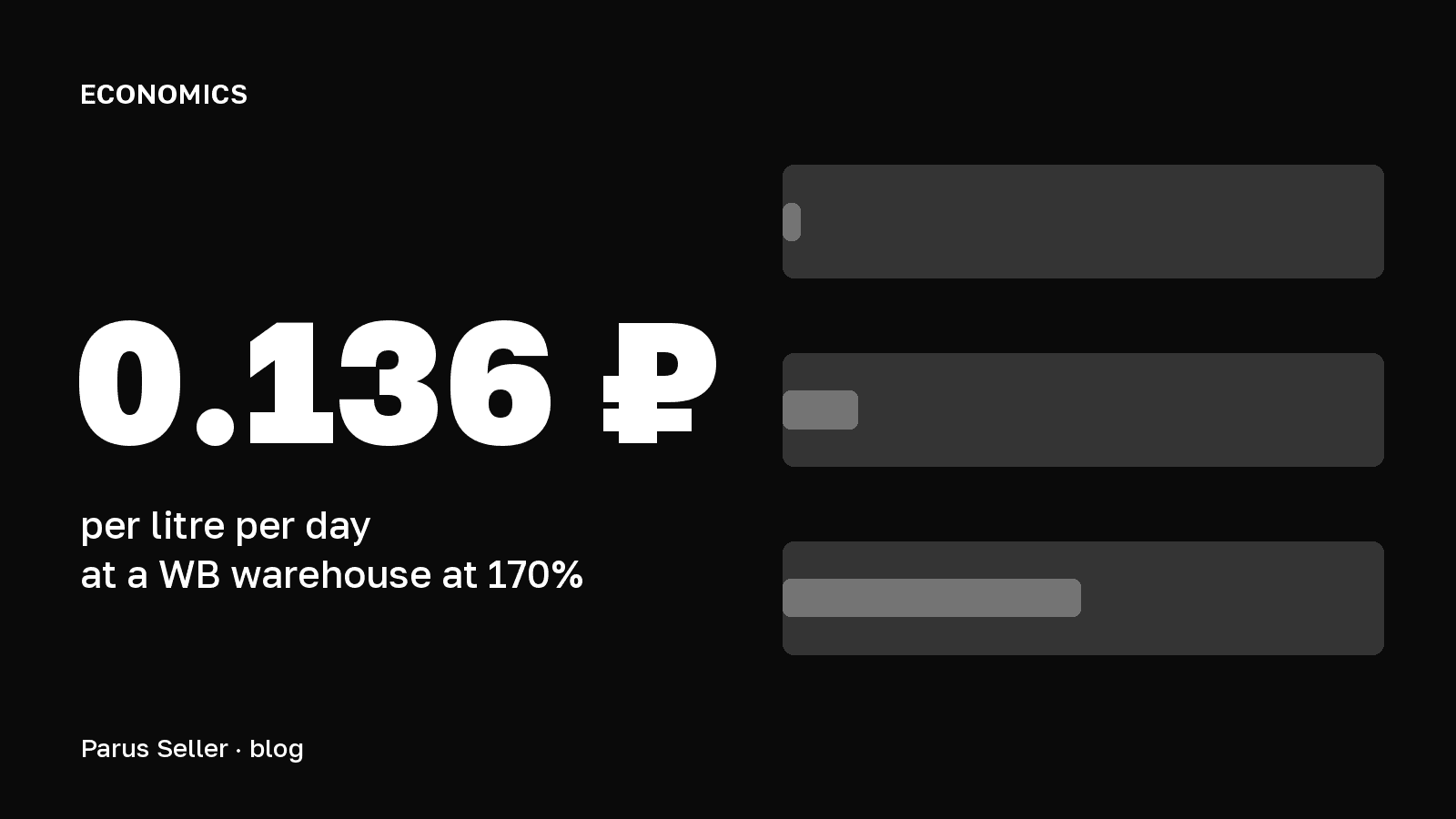
What storage on Wildberries costs in 2026: 0.08 ₽ per litre per day, multiplied by the warehouse storage coefficient. Since 15 August 2026 Russian warehouses have had a flat coefficient of 170%. A litre costs 0.136 ₽ a day, and a 30 × 20 × 10 cm box of 6 L about 24.5 ₽ a month. A mono-pallet costs 25 ₽ a day before the coefficient. The rate is locked to the supply for as long as the goods stay in the warehouse.
Storage is rarely the biggest cost line. For the store with a turnover of 6,000,000 ₽ a month that we broke down in the article on how much WB takes, storage came to 2.3% of sales. But unlike the commission, it grows every day an item stays unsold, and on slow positions it quietly eats the margin. Below are the rates from the WB instructions, the cost for items of different volume and our calculation of storage per sale depending on how many days the item sits in the warehouse.
In short: storage at a WB warehouse costs 0.08 ₽ per litre per day × the warehouse coefficient, which at the flat 170% is 0.136 ₽. A month for a 6 L box costs 24.5 ₽, for a 20 L item 81.6 ₽. An item that sits for 120 days pays almost half of its delivery cost in storage. With no photos in the product card, the rate goes up tenfold from day 8, and a return left at a pickup point costs up to 40 ₽ per unit.
What storage at a Wildberries warehouse costs
Storage at a WB warehouse is charged under the instruction dated 3 September 2026 at 0.08 ₽ per litre per day, multiplied by the warehouse storage coefficient. The volume is taken from the actual dimensions the warehouse measures on acceptance, not from the ones in the product card. At a coefficient of 150% a litre works out at 0.12 ₽ a day, at the flat 170% it is 0.136 ₽.
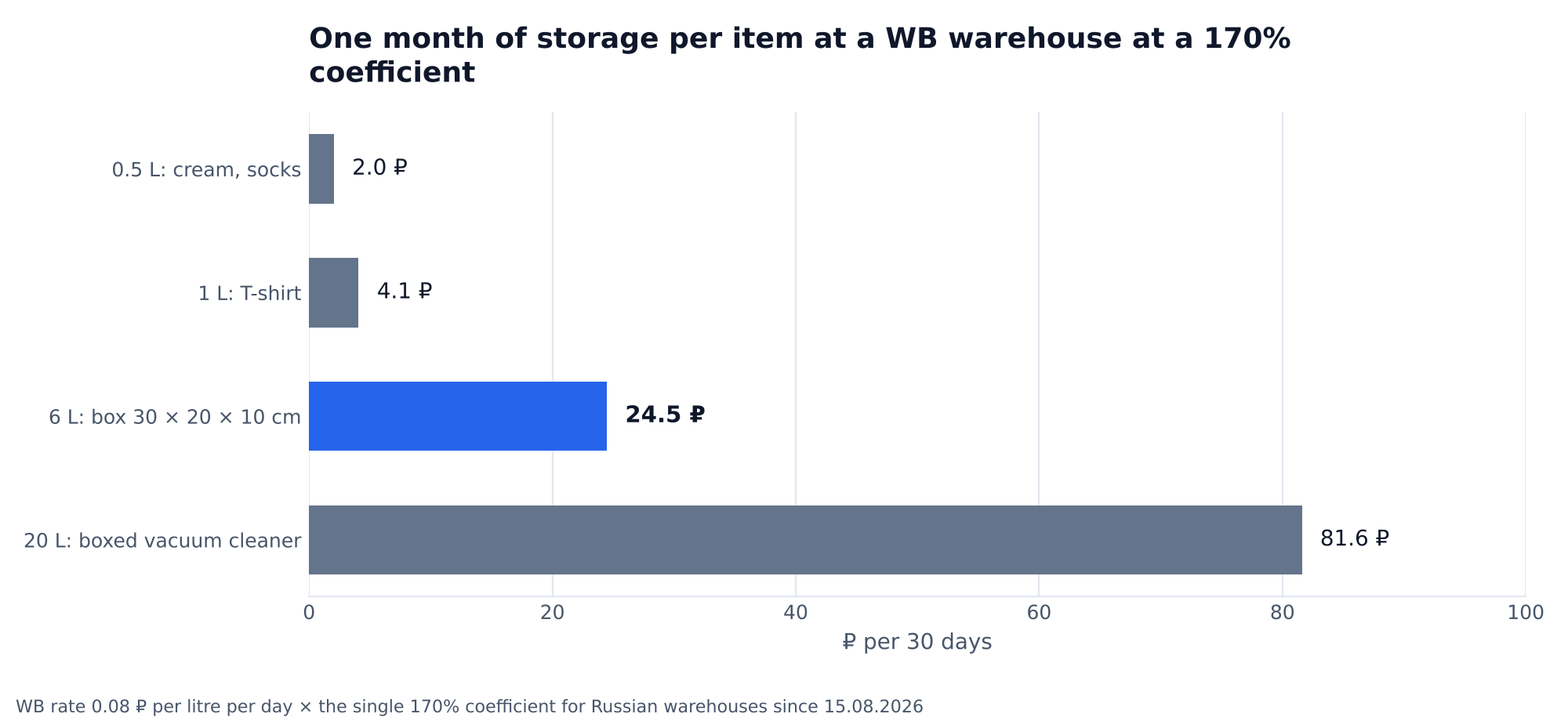
Small goods pay almost nothing noticeable for storage: a T-shirt in a bag of about a litre costs 4 ₽ a month. The 30 × 20 × 10 cm box used in all the blog's calculations costs 24.5 ₽. A vacuum cleaner in a 20 L box already costs 81.6 ₽ for every unit. So for large goods the quantity in a supply matters more than for small ones: an extra 100 vacuum cleaners in the warehouse is more than 8,000 ₽ a month.
How paid storage is charged: the supply rate and the stock rate
WB has two storage rates, and both show up in reports. The supply rate is locked when the supply is planned and applies while goods from that supply stay in the warehouse. The stock rate applies where there is no lock: for supplies created before April 2024 and for small goods a customer returned on FBS. Such a return goes to a WB warehouse and is then sold from there.
| Storage rate | Box, supersafe, single pallet | Mono-pallet | When it applies |
|---|---|---|---|
| Supply rate | 0.08 ₽ per litre per day | 25 ₽ per pallet per day | locked when the supply is planned |
| Stock rate | 0.07 ₽ per litre per day | 23 ₽ per pallet per day | supplies before April 2024, small goods returned on FBS |
Both rates are multiplied by the warehouse storage coefficient. The lock has a pleasant asymmetry: if the warehouse lowers its coefficient, it goes down for goods already there too, while a rise does not touch them. The delivery and storage coefficients are locked to a supply for 60 or 90 days depending on the category, and the acceptance coefficient is locked only to the booked slot.
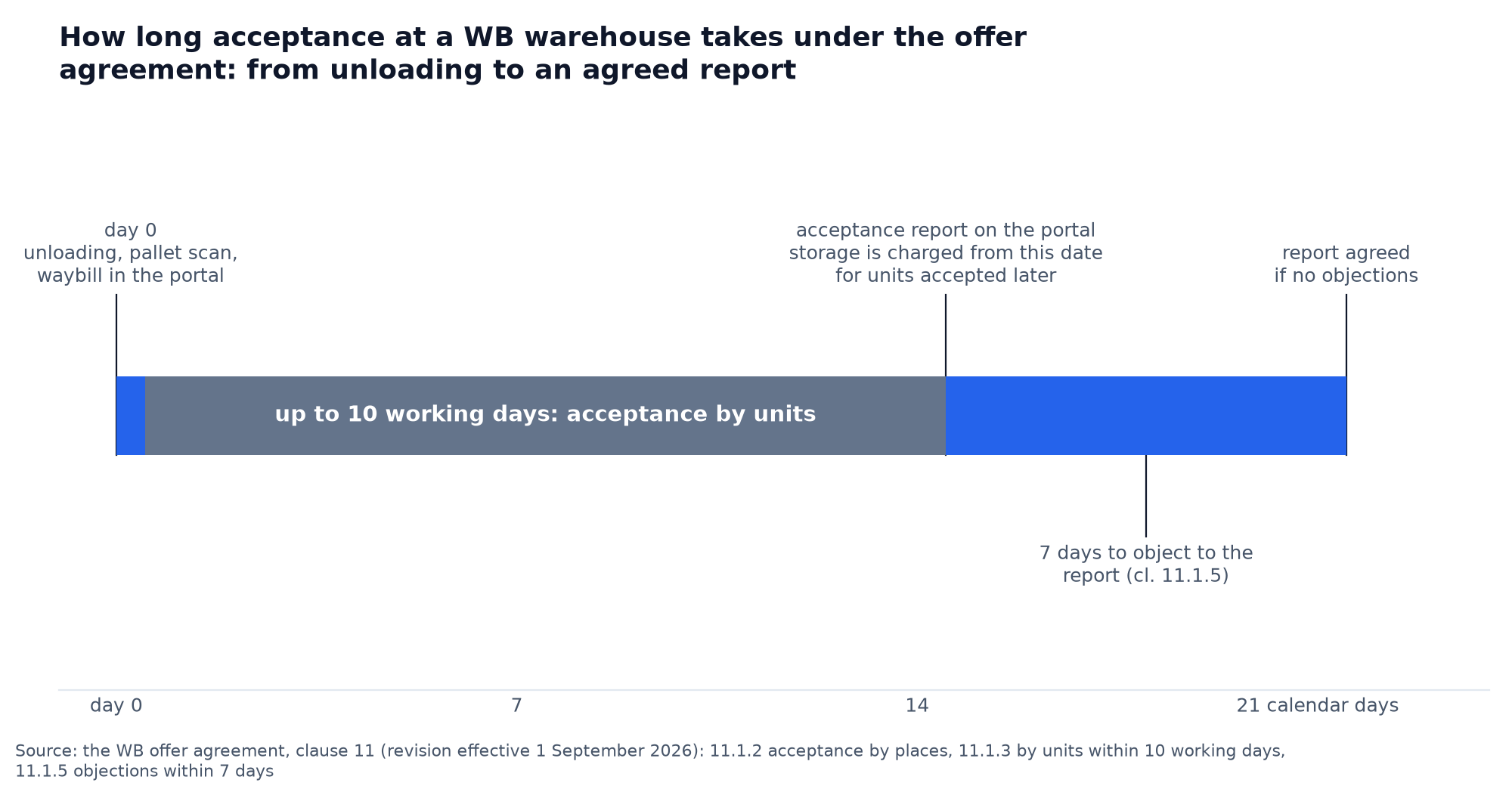
One more rule concerns late acceptance. If the warehouse accepted the goods later than 10 working days, WB counts storage for those units from the acceptance date in the report, not from the date you brought the cargo in. We covered acceptance deadlines in detail in our article on acceptance at WB warehouses.
What storage costs per sale
Storage per sale costs the number of days the item spent in the warehouse times the daily rate for its volume. For a 6 L box that is 0.816 ₽ a day: a week costs 5.7 ₽, a month 24.5 ₽, a quarter 73.4 ₽. Sell-through matters more than the rate here: the same item can pay 17 times more for storage just because it sits for four months instead of a week.
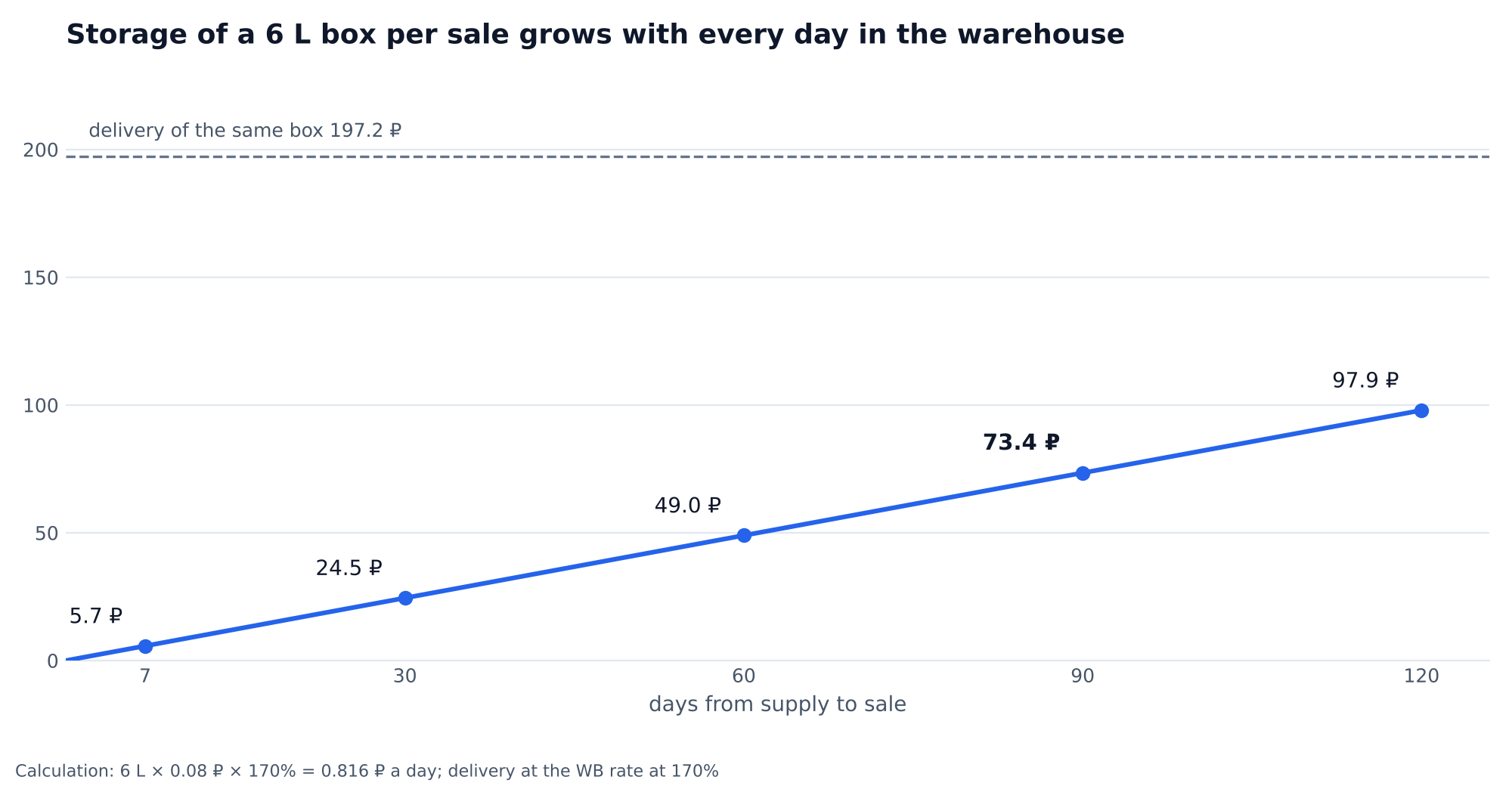
The dashed line on the chart is the delivery of the same box to the customer: 197.2 ₽ at a coefficient of 170%. An item that sells within a week pays less than 3% of its delivery cost for storage. An item that sits for four months pays almost half. On a position with a 100 ₽ markup, that difference decides whether there is any profit at all.
Hence a practical rule. Bring to the WB warehouse as much as sells in a month or a month and a half. Keep the reserve at your place or ship on FBS: under that model the goods stay in your own warehouse, and WB charges nothing for storage, with one exception for extra-oversized goods. How both models work we described in our article on supplies to Wildberries.
When storage on Wildberries gets more expensive
The regular rate goes up in three cases, and all three depend on the seller. The most expensive one is tied to the product card. Storage of an item with no photos becomes ten times more expensive from the eighth day in the warehouse, and until photos appear the item does not sell at all. A 6 L box with no photos costs not 0.8 ₽ but more than 8 ₽ a day already in the second week.
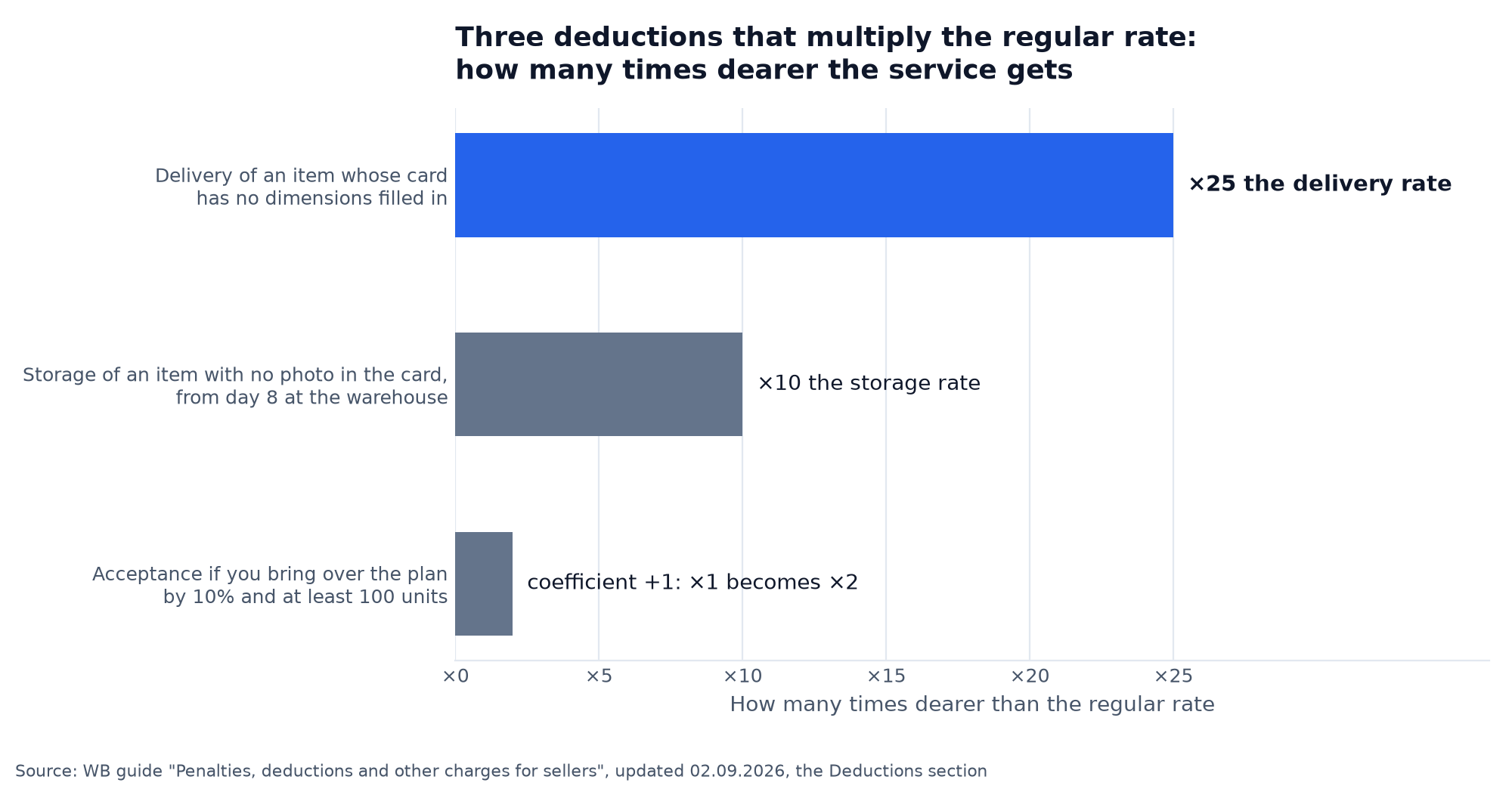
The second case concerns returns the seller did not collect from the pickup point. Under the offer agreement, since 1 October 2026 a return has to be collected within three days, counting the day it arrives. From the fourth to the seventh day WB deducts 10 ₽ a day for each unit, so up to 40 ₽ per item, and on the eighth day the item goes to the warehouse, where disposal costs 38 to 44 ₽ per unit. Before October the period was longer: the store from our breakdown of Wildberries penalties piled up 1,175 lines of 70 ₽ in one week in March, that is 82,250 ₽ for returns nobody collected in time.
The third case applies to FBS. There is only one paid storage there: an extra-oversized item brought in before the shipping date is stored at 1 ₽ per litre per day, with a floor of 100 ₽. That is more than seven times the regular WB warehouse rate, so bring extra-oversized goods in exactly on the shipping date.
Where to see storage in WB reports
WB works out the exact storage sum after acceptance, from the actual dimensions. You can see it in three places. The first is the "Paid storage" report for each item and warehouse, the second is the line-item detail of the weekly report under the "Storage" reason, the third is the balance widget on the main page of the seller portal. If the line-item detail shows a rate of 0.07 ₽ per litre, that is the stock rate: such a line will have a dash in the "Warehouse coefficient locked for the supply" column.
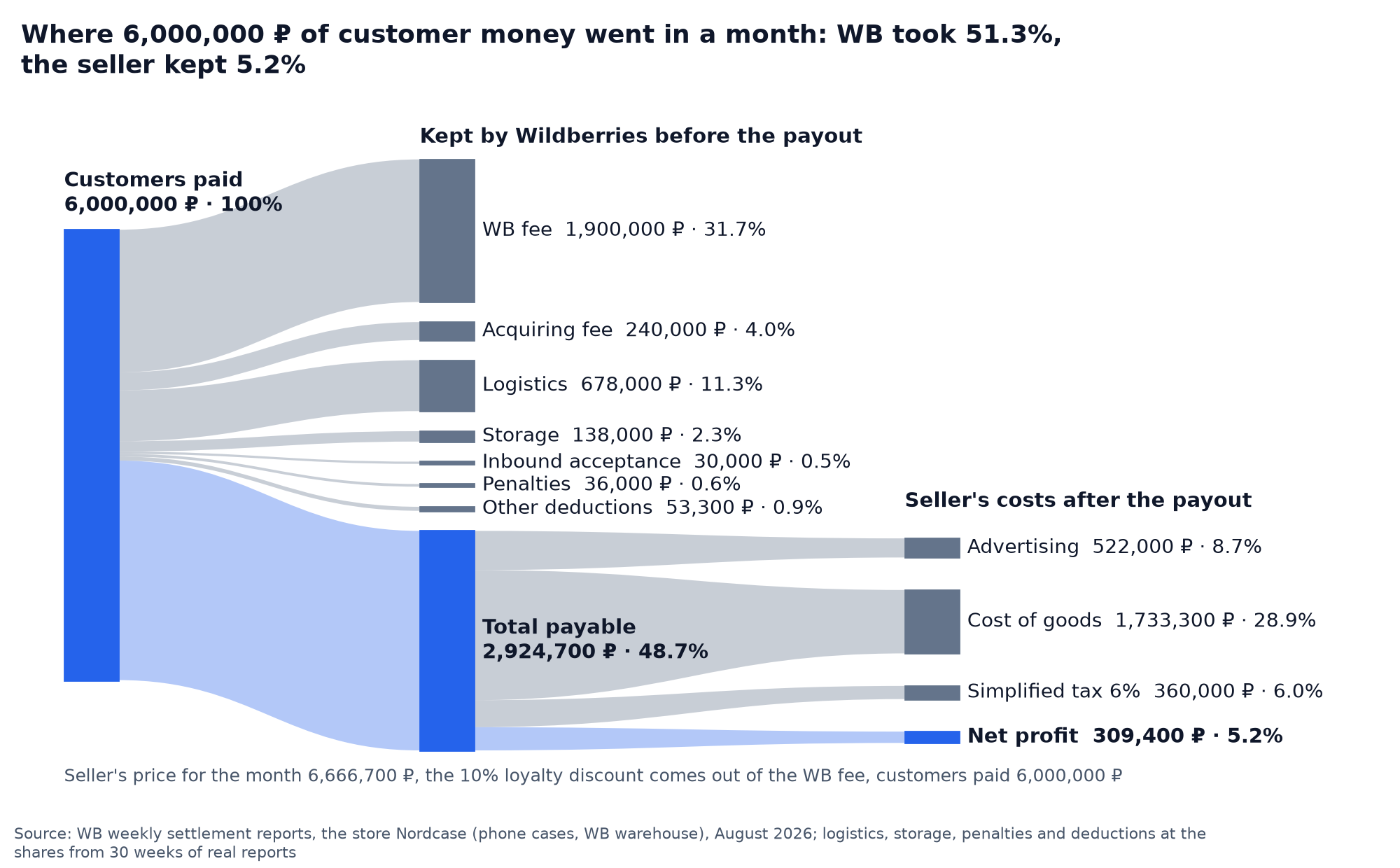
The diagram shows where storage sits among all WB deductions. For a store with a turnover of 6,000,000 ₽ a month it came to 138,000 ₽, which is 2.3% of sales, five times less than logistics and fourteen times less than the commission. That is why the overall storage share in a report almost always looks harmless. The problem only shows up by individual vendor code: slow positions pay many times more for storage than their share of sales. How to read the whole report is covered in our article on the weekly report.
How to cut storage costs
Four decisions cut storage, and all of them are made before the supply. The first is the size of the supply: bring as much as sells in a month or a month and a half. The second is the packaging dimensions. The warehouse counts litres from the actual size, and an extra centimetre on each side of a 30 × 20 × 10 cm box gives 7.2 L instead of 6. The third is a complete product card with photos and dimensions, so you do not get hit by the multipliers. The fourth is FBS for slow-selling and large goods.
The calculator below shows how much storage takes from a specific item together with the commission and logistics. The storage field is already filled in with a typical value; replace it with your own volume and time to sale.
Profit calculator for a single sale
Category commissions come from the WB API as of 05.09.2026, logistics use the basic WB rate. Every field is editable, the result updates instantly.
- Margin
- 2.5%
- Return on cost of goods
- 9%
- Break-even price
- 1,124 ₽
Maximum ad spend share that still keeps the sale at zero: 12.5%.
- WB commission486 ₽ · 40.5%
- Logistics with buyout rate92 ₽ · 7.7%
- Storage3 ₽ · 0.3%
- Ads120 ₽ · 10.0%
- Acquiring fee47 ₽ · 3.9%
- Tax72 ₽ · 6.0%
- Cost of goods350 ₽ · 29.2%
- Profit30 ₽ · 2.5%
The first supply most often decides how much you will pay for storage. If you want to open a store without mistakes on it, see how we launch a turnkey Wildberries store: the size of the first supply there is calculated from demand, not by eye.
FAQ about storage on Wildberries
How much does storage at a Wildberries warehouse cost per litre? 0.08 ₽ a day at the supply rate, multiplied by the warehouse coefficient. At the flat 170% coefficient for Russian warehouses that is 0.136 ₽ per litre per day, or about 4 ₽ per litre a month.
Why is storage in the report charged at 0.07 ₽ per litre? That is the stock rate. It applies to supplies created before April 2024 and to small goods that came back on FBS to a WB warehouse.
Is storage on FBS paid on Wildberries? On FBS the goods stay in your own warehouse, and WB charges nothing for storage. There is one exception: an extra-oversized item brought in before the shipping date costs 1 ₽ per litre per day, with a floor of 100 ₽.
How long is a return stored for free at a pickup point? Three days, counting the day it arrives. From the fourth to the seventh day WB deducts 10 ₽ a day per unit, up to 40 ₽ per item, and on the eighth day the return goes to the warehouse.
Does the storage rate change after a supply? The rate is locked to the supply. If the warehouse later lowers its coefficient, storage gets cheaper for goods already there too, while a rise will not apply to them.