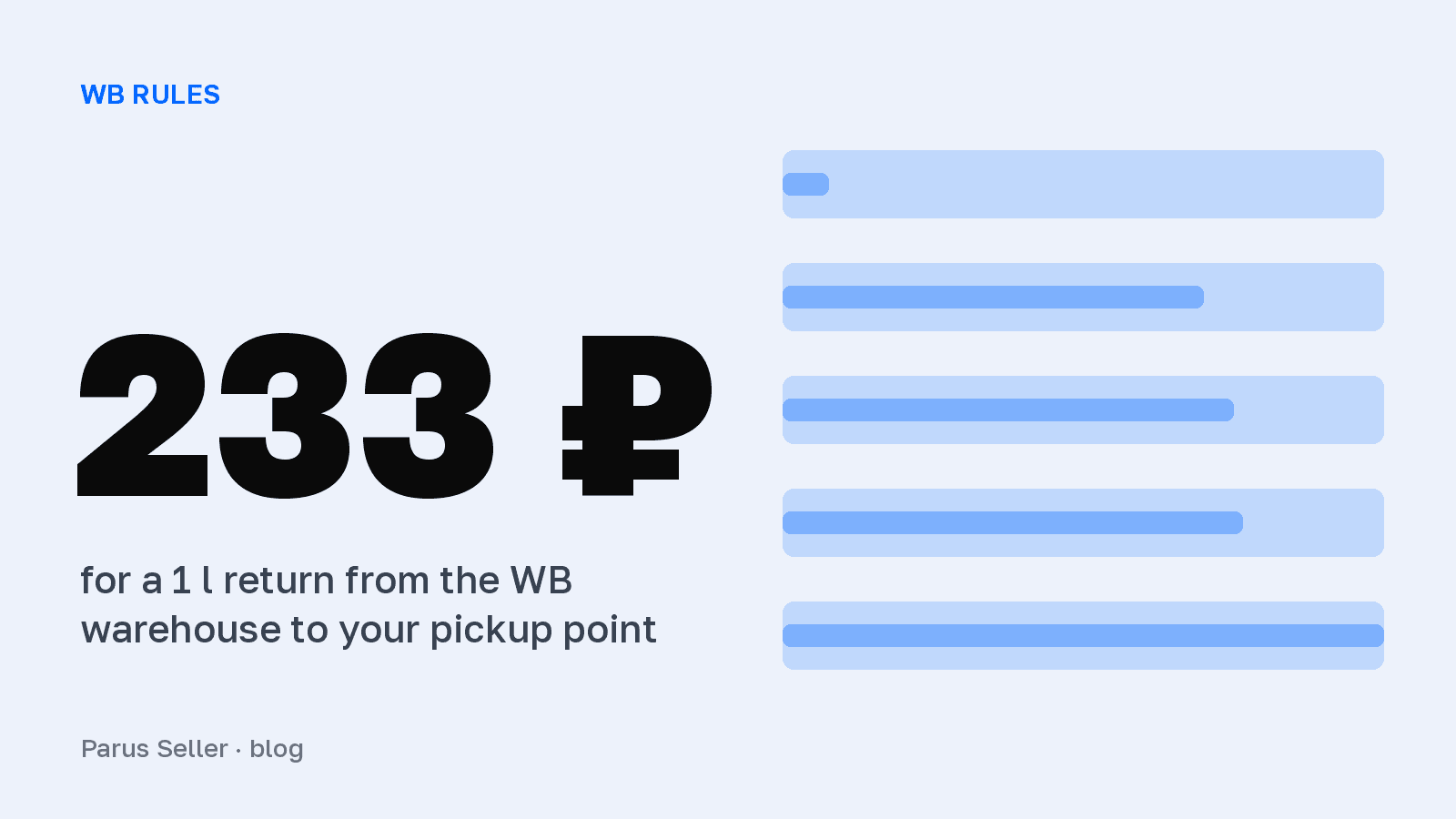
What returns on Wildberries cost the seller in 2026: a return of goods from a WB warehouse to your pickup point costs the volume base multiplied by the warehouse coefficient, plus 155 ₽; to an address, plus 255 ₽. For a 1 litre item at a coefficient of 170% that is 233.2 and 333.2 ₽. An FBS return to a pickup point costs 25 ₽ for the first litre, an uncollected return 250 ₽ per unit. A refused order (non-buyout) is paid as two trips: out to the customer at the full rate and back at the base.
The word "return" on Wildberries covers several different operations, and each one has its own price. A customer can refuse an order at the pickup point or return an item after buying it, and the seller can ask for goods back from the warehouse. Below are the rates for each type of return from the WB instructions dated 3 September 2026 and the return tariffs API, the deadlines from the offer agreement in force since 1 October, and our calculation of what returns cost per sale.
In short: a 1 l return from a WB warehouse to your pickup point costs 233.2 ₽, to an address 333.2 ₽, an extra-oversized item 1,078.2 ₽. An FBS return to a pickup point costs 25 ₽. You have three days to collect a return from the pickup point, then it is 10 ₽ a day per unit. A refused order is paid as two trips, and at a 30% buyout rate logistics per sale for a 6 l box grows from 232 to 928 ₽.
What a return of goods to the seller costs on Wildberries
A return of goods from a WB warehouse to the seller is charged differently from the return trip of a refused order. On top of the base rate for volume multiplied by the warehouse coefficient comes a fixed part: 155 ₽ for delivery to your pickup point, 255 ₽ for delivery to an address and 1,000 ₽ for an extra-oversized item. The instruction gives an example on 2.7 litres at a coefficient of 110%: 69.8 ₽ × 1.1 + 155 = 231.78 ₽.
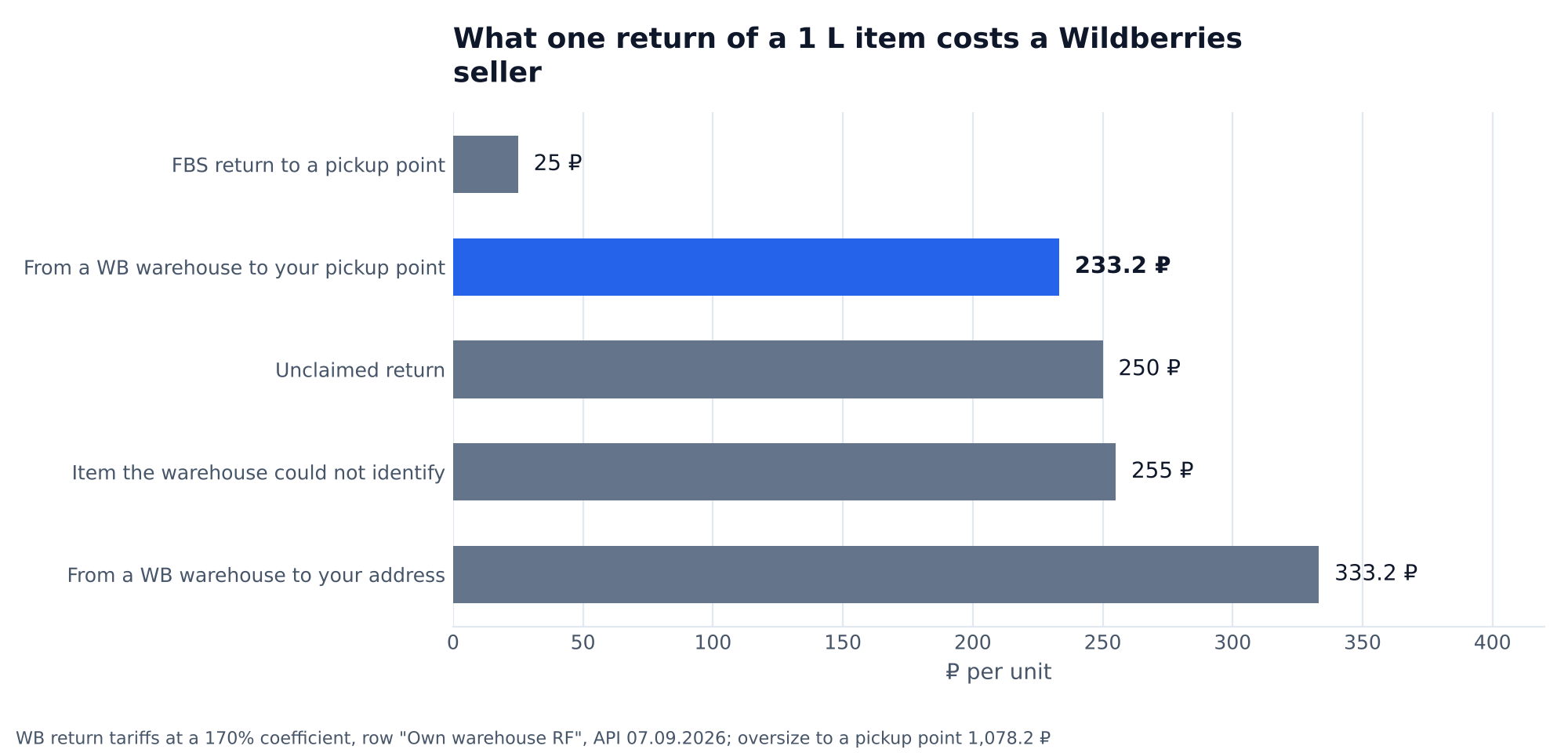
| Type of return | How it is calculated | Own warehouse, Russia, 170% |
|---|---|---|
| To the seller's pickup point | volume base × warehouse coefficient + 155 ₽ | 233.2 ₽ |
| To the seller's address | volume base × warehouse coefficient + 255 ₽ | 333.2 ₽ |
| Extra-oversized item | volume base × warehouse coefficient + 1,000 ₽ | 1,078.2 ₽ |
| Unidentified goods | 255 ₽ per unit | 255 ₽ |
| FBS return to a pickup point | 25 ₽ for the first litre + 4 ₽ per extra litre | 25 ₽ |
| Uncollected return | 250 ₽ per unit, 1,050 ₽ for extra-oversized | 250 ₽ |
Amounts are for the first litre. In the first three rows each further litre adds 23.8 ₽. The API rates and the formula from the instruction match: 233.2 ₽ adds up from a base of 46 ₽ × 170% and the fixed 155 ₽. The cheapest route here is FBS: since 7 August 2026 a return under this model to a pickup point has cost 25 ₽ for the first litre. More on the rates in our article on Wildberries logistics.
What a refused order costs the seller
A refused order costs the seller two paid trips. The trip out to the customer is charged on the full formula with the warehouse coefficient, the trip back on the volume base alone, with no coefficients: for an item under a litre that is 23 to 32 ₽. So logistics per sale is counted like this: delivery + (delivery + return) × (1 − buyout rate) / buyout rate.
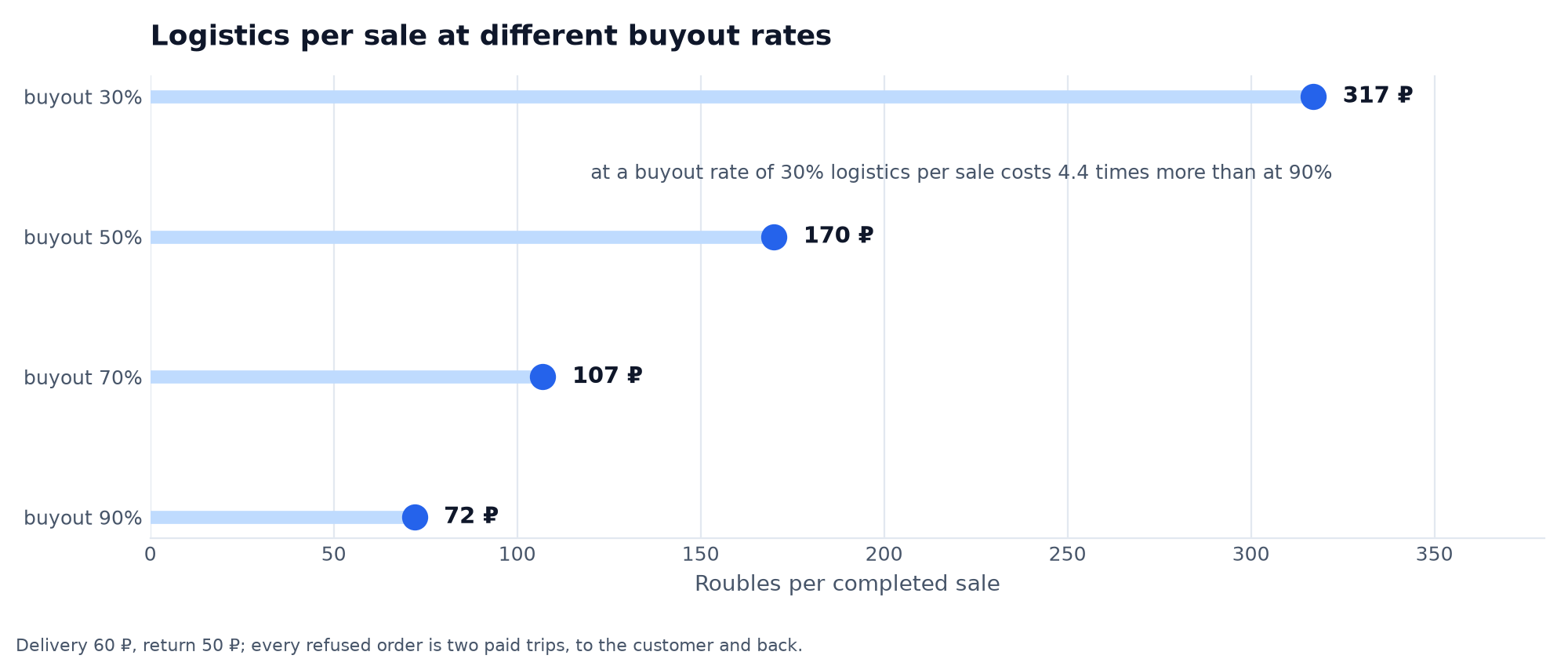
On a 30 × 20 × 10 cm box the difference looks like this. At a 90% buyout rate logistics per sale costs about 232 ₽, at 30% about 928 ₽: every unit sold carries more than two refused ones, and each of them made the trip twice. That is why the buyout rate matters more than any single return rate. How to check it and what it depends on we covered in our article on the buyout rate.
In the weekly report every refused order shows up as two logistics lines: "To the customer on cancellation" and "From the customer on cancellation". There is no commission on a return: the fee on the returned sale is reversed, and the seller pays only for the travel. For our store in August 2026 these lines came to 55 and 23 ₽ per unit. If the report has a lot of these pairs, look at the product card first, not at the rates.
How to collect a return from the pickup point and what being late costs
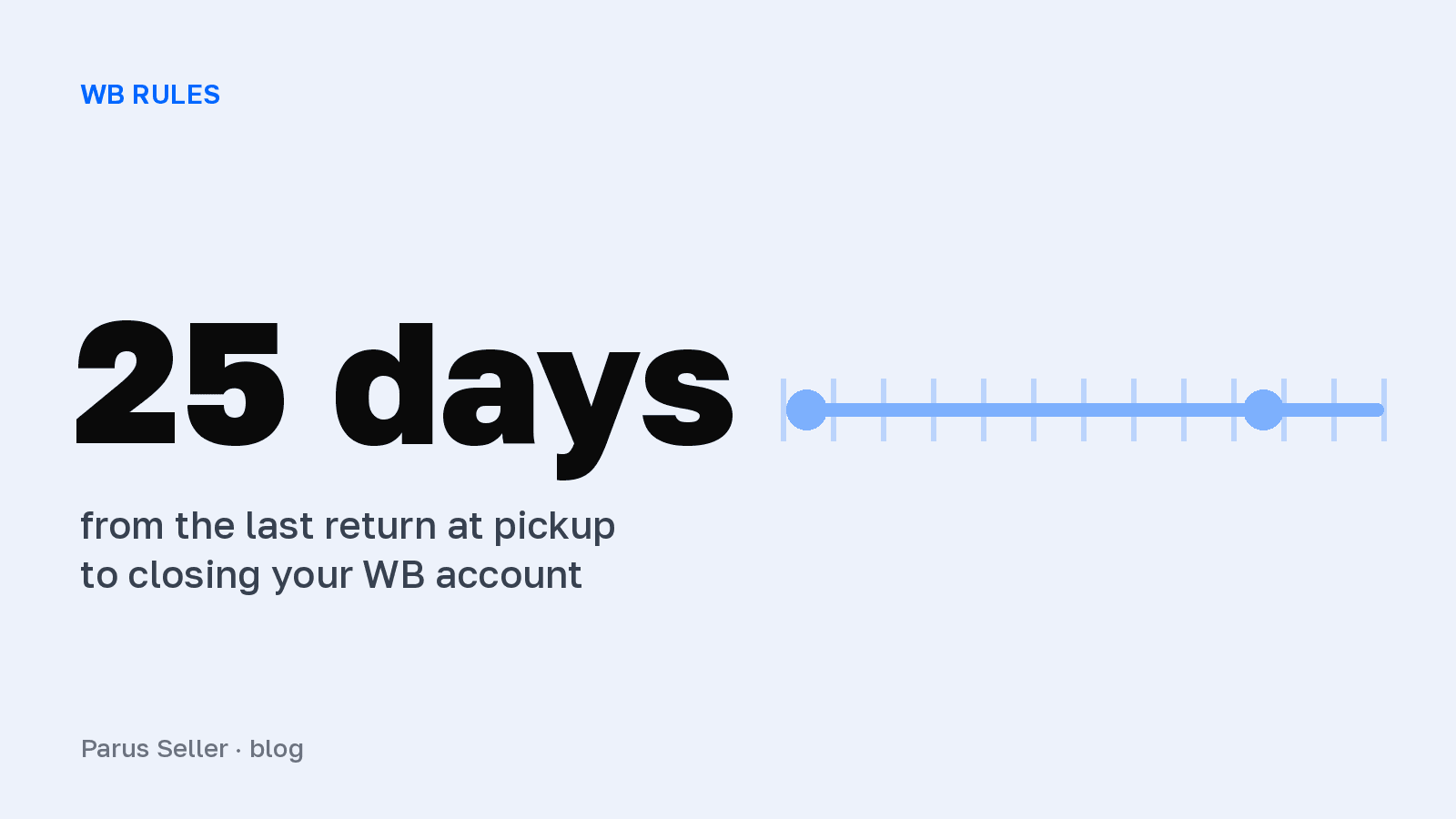
A return WB sent to your pickup point or warehouse has to be collected within three days, counting the day it arrived. That is what the offer agreement in force since 1 October 2026 says. From the fourth to the seventh day WB deducts 10 ₽ a day for every unit, up to 40 ₽ per item, and on the eighth day the goods leave for the warehouse.
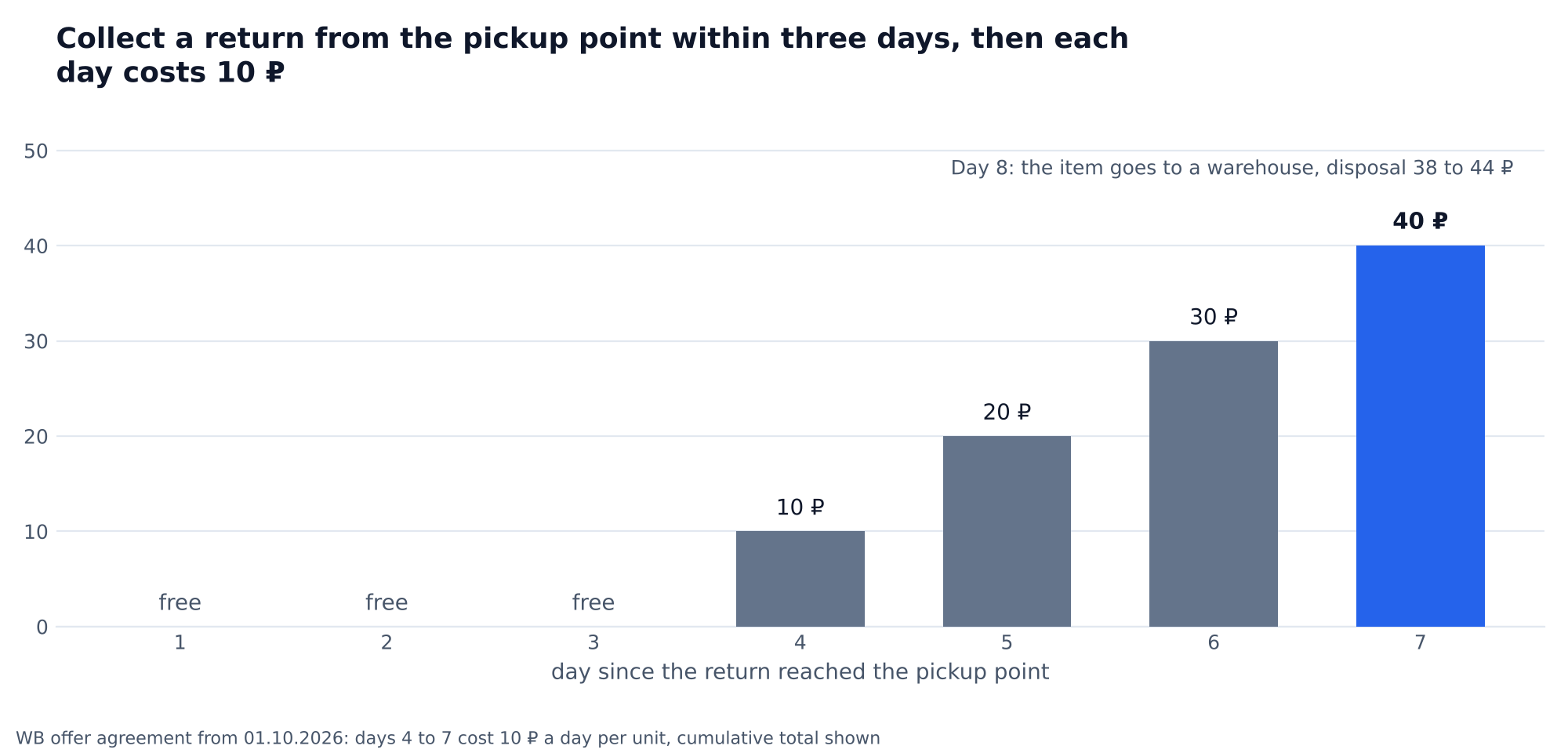
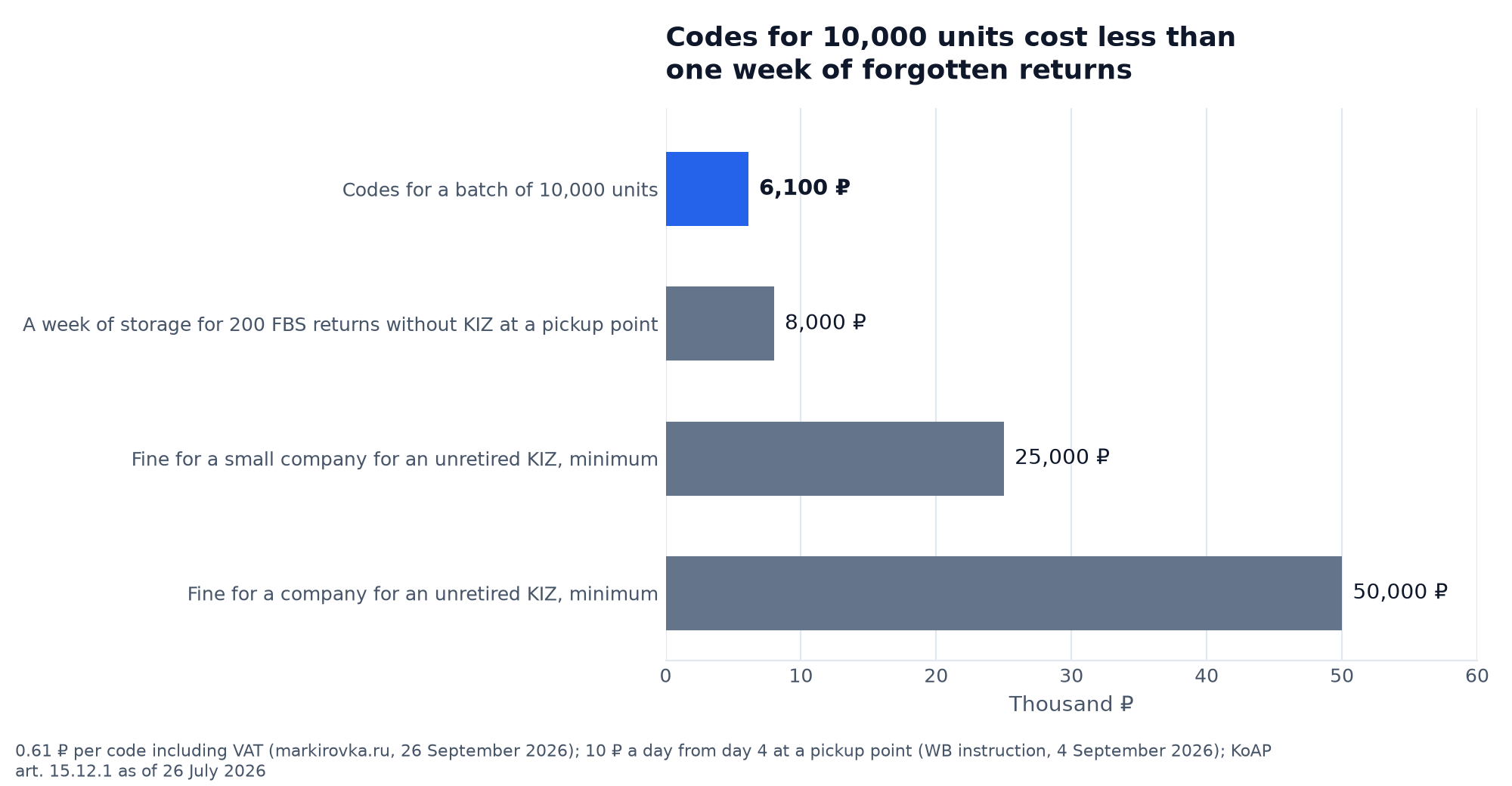
From the warehouse an uncollected return goes to disposal. Under the WB instruction dated 22 July 2026 it costs 38 ₽ per unit, while the return tariffs API on 7 September already returns 44 ₽. So a return forgotten for a week costs 40 ₽ of storage, and then disposal of goods you already paid for.
The scale of this mistake is easy to underestimate. Before October the pickup point deadline was longer, and the store from our breakdown of Wildberries penalties ran up 1,175 rows at 70 ₽ in one week of March, that is 82,250 ₽. There was one cause: WB blocked a batch and sent it back to the pickup point, and nobody collected the goods in time.
FBS and DBS returns and product marking
On FBS and DBS most returns travel back to the seller, to their pickup point. The exception is small goods on FBS: WB takes them to its own warehouse and sells them from there at the stock storage rate. Two rules that cost money apply to FBS and DBS. The first concerns marked goods. If a Chestny Znak code (Russia's product marking system) is passed without the crypto tail, then on a refused order or a return for defects the item will not go back on sale, it will go back to the seller. A full code with the crypto tail passes the check more reliably.
The second rule concerns customer requests on DBS. The seller reviews a return request within 5 days, within 24 hours for EDBS, and if there is no reply the request is approved automatically.
There are three possible responses: «Отказать», «Одобрить без возврата», where the money goes to the customer and the item stays with them, and «Одобрить и забрать товар». Requests sit in the «Возвраты покупателей» section, on the «Заявки DBS, EDBS и С&C» tab. The process is described in detail in our article on DBS on Wildberries.
You can dispute a return as well. The offer agreement gives three working days to object to a return report, and one return request through a pickup point is capped at three cubic metres. If the report has the wrong quantity or condition of the goods, file the objection within those three days: after that the report counts as agreed.
How to cut the cost of returns
Three decisions bring the cost of returns down. The first is the buyout rate: exact dimensions and photos in the product card reduce the share of refusals more than any choice of rate. The second is the sales model for slow and bulky goods: an FBS return to a pickup point costs 25 ₽ for the first litre against 233.2 ₽ from a WB warehouse. The third is discipline at the pickup point: collect returns within the first three days.
How much returns take from a specific product, together with commission and storage, the calculator below will show. Change the buyout rate in it to your own: that is the field that moves profit the most.
Profit calculator for a single sale
Category commissions come from the WB API as of 05.09.2026, logistics use the basic WB rate. Every field is editable, the result updates instantly.
- Margin
- 2.5%
- Return on cost of goods
- 9%
- Break-even price
- 1,124 ₽
Maximum ad spend share that still keeps the sale at zero: 12.5%.
- WB commission486 ₽ · 40.5%
- Logistics with buyout rate92 ₽ · 7.7%
- Storage3 ₽ · 0.3%
- Ads120 ₽ · 10.0%
- Acquiring fee47 ₽ · 3.9%
- Tax72 ₽ · 6.0%
- Cost of goods350 ₽ · 29.2%
- Profit30 ₽ · 2.5%
If you would rather not learn all this on your first batch, see how we launch a turnkey Wildberries store: the niche and the sales model there are chosen with the category's buyout rate in mind.
FAQ about returns on Wildberries
Who pays for a return of goods on Wildberries? The seller. You pay for the return trip of a refused order at the volume base, for a return from the warehouse at the rate with a fixed part, and for storage of a return at the pickup point after three free days.
How much does a return of goods from a WB warehouse cost the seller? The volume base multiplied by the warehouse coefficient, plus 155 ₽ for delivery to your pickup point or plus 255 ₽ to an address. For a 1 l item at a coefficient of 170% that is 233.2 and 333.2 ₽.
How many days does a return stay at the pickup point? Three days free, counting the day it arrived. From the fourth to the seventh day it is 10 ₽ a day per unit, and on the eighth day the goods leave for the warehouse, where they are disposed of for 38 to 44 ₽.
Can I refuse a customer's return on Wildberries? On DBS the seller has an «Отказать» button in the return request, but if you do not reply within 5 days, the request is approved automatically.