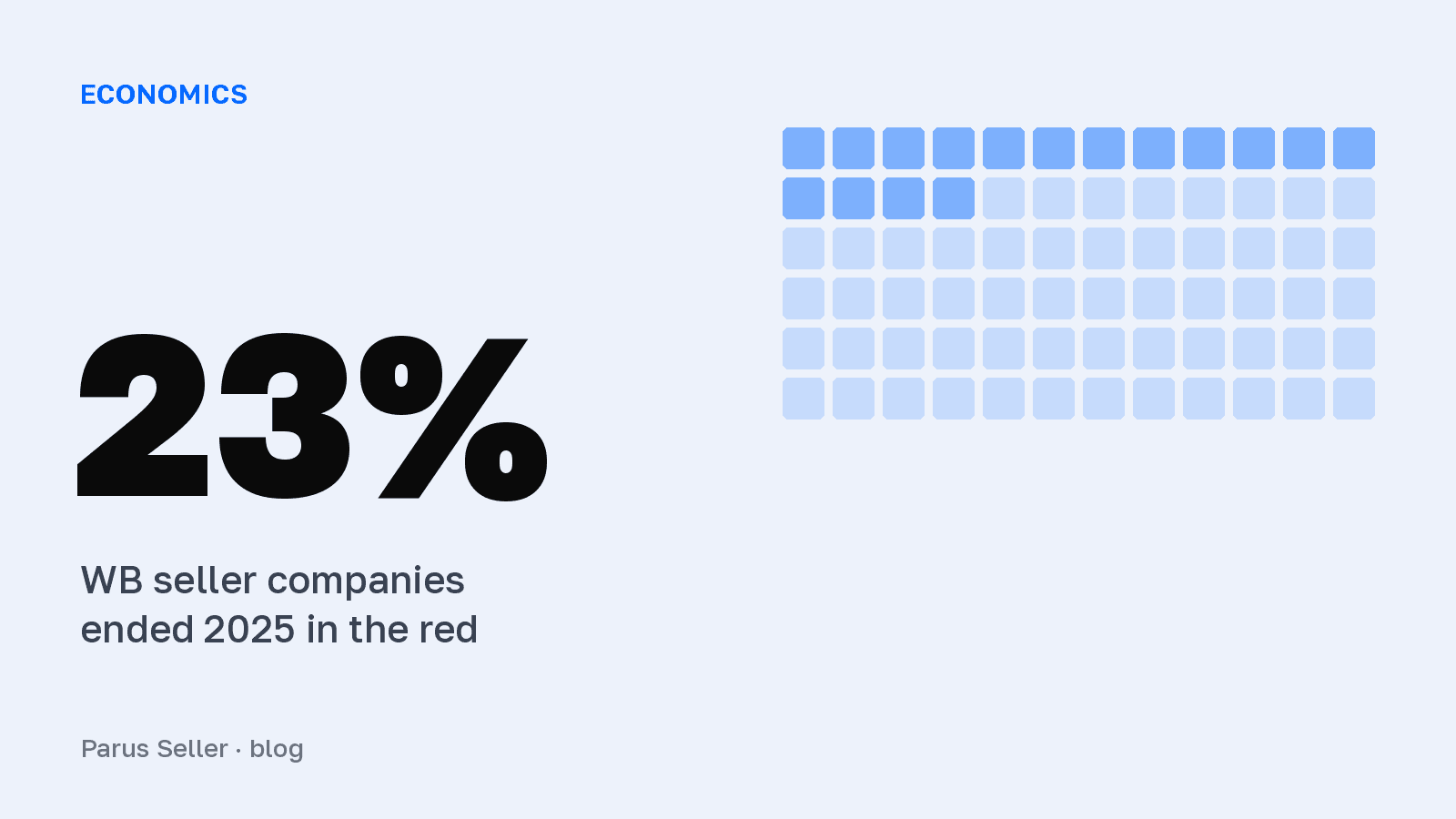
A typical company selling on Wildberries earned about 26 million ₽ in revenue and 840,000 ₽ in profit in 2025, that's around 70,000 ₽ a month. These are medians from Federal Tax Service data for 45,000 LLCs (OOO) and JSCs trading on WB. The median margin is 3.4% of revenue, and 23% of companies ended the year at a loss. There's no way to find out how much sole proprietors (IP) earn: the tax authority doesn't publish their income, and they make up four out of five WB sellers.
The query «сколько зарабатывают на вб» gets about 4,200 searches a month, «заработок на вб» another 1,600. Some of these people are looking for a job at a warehouse or a pickup point, this article isn't about that. It's about sellers: the people who list their own products on Wildberries.
Where the numbers come from and what's missing
We collected the tax IDs (INN) of WB sellers from the marketplace's catalogue and matched them against open FNS sources: financial statements (GIR BO), income and expense data, the SME registry, and data on tax regimes and headcount. The database covers 366,832 sellers, the data was updated in August 2026, and the financial figures relate to 2025.
Three caveats you need before reading the numbers.
- We only know the money for companies. Sole proprietors (IP) don't file financial statements, so their revenue is closed. All the amounts below describe LLCs (OOO) and joint-stock companies (AO), and you can't extend them to every WB seller.
- A company's revenue isn't its WB revenue. A company can also sell on Ozon, through its own store, or wholesale. This matters most for the big players: for the top 1%, revenue exceeds 8.6 billion ₽, and WB is just one channel for them.
- Profit is calculated as revenue minus costs based on FNS data. This is profit before income tax, and for companies on the simplified tax regime it can differ from what the owner actually takes out.
Who sells on WB: sole proprietors, small companies and one employee
Of 366,832 sellers, 296,702 (81%) are sole proprietors (IP) and 70,130 (19%) are companies. Almost all sole proprietors listed in the small business register count as micro-enterprises, that's 270,000 people. The picture is similar for companies: of those in the register, 80% are micro, 17% are small and 3% are medium.
The staff is small. Half of seller companies, according to FNS headcount data, have two employees or fewer. 56% have between one and five people, and 13% have no employees at all according to FNS data.
The catalogue shows the same picture. By our recount for September 2026, WB has 244,000 sellers with active cards, half of them have no more than three cards, and 32% have one. More than 100 cards belong to 10% of sellers, more detail in the article on WB analytics.
What revenue WB sellers actually make
Financial statements for 2025 are available for 44,896 seller companies. Median revenue is 25.9 million ₽. A quarter of companies didn't reach 4.2 million ₽ for the year, and another quarter made more than 117 million ₽.
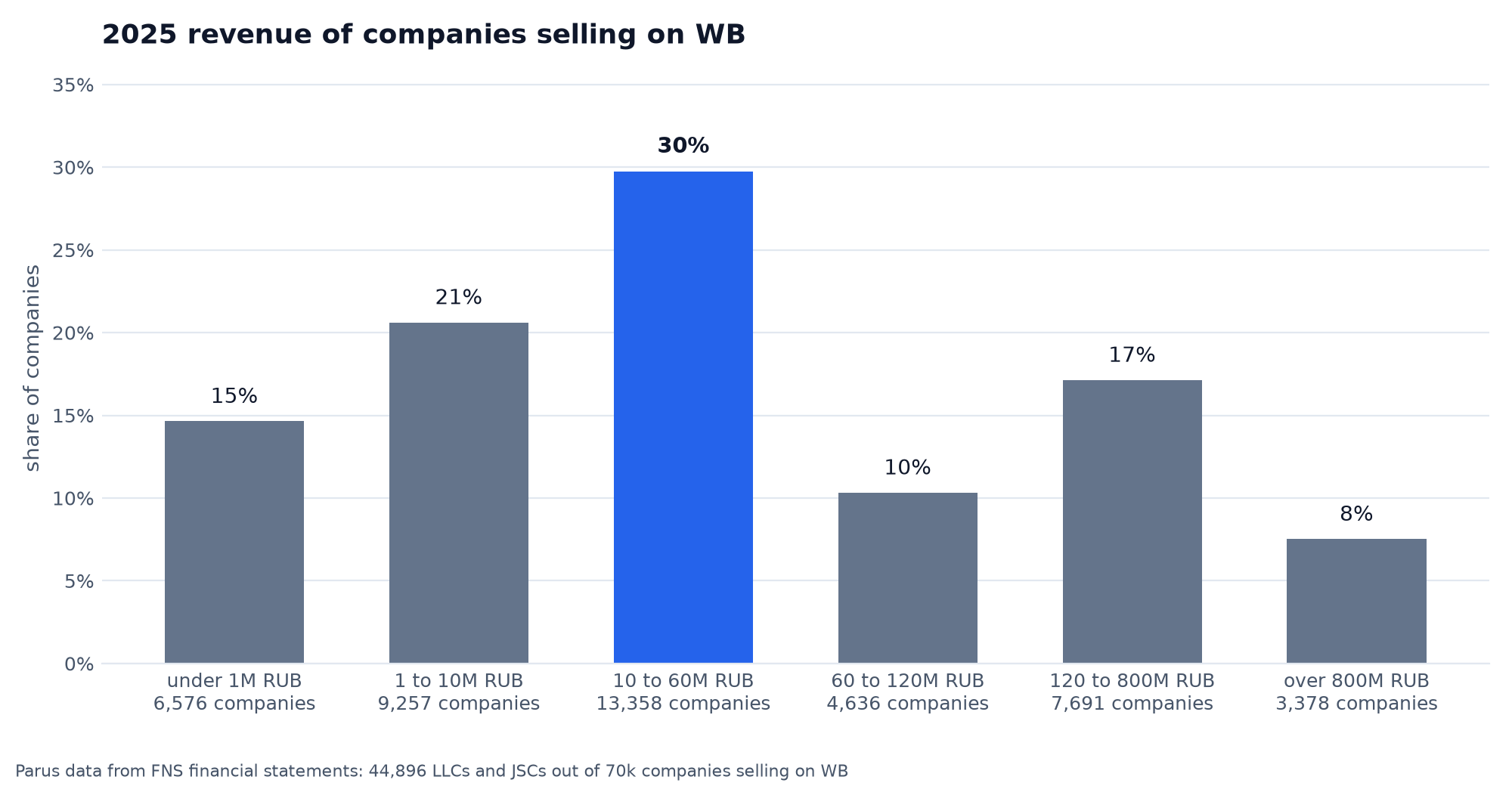
| Revenue for 2025 | Companies | Share |
|---|---|---|
| up to 1 million ₽ | 6,576 | 15% |
| 1–10 million ₽ | 9,257 | 21% |
| 10–60 million ₽ | 13,358 | 30% |
| 60–120 million ₽ | 4,636 | 10% |
| 120–800 million ₽ | 7,691 | 17% |
| more than 800 million ₽ | 3,378 | 8% |
Every seventh company made less than a million rubles for the year. That's 83,000 ₽ a month before deducting purchasing costs, commission and logistics, meaning the company is testing a niche more than living off WB.
How much sellers earn on Wildberries after tax
We have income and expense data for 2025 from 42,736 companies. 76% of them are in the black, 23% in the red, the rest at zero.
| Profit for 2025 | Amount |
|---|---|
| Median | 840,000 ₽ |
| Lower quartile | up to 9,000 ₽ |
| Upper quartile | from 5.6 million ₽ |
| Top 10% | from 27 million ₽ |
The median margin, that is, profit as a percentage of revenue, is 3.4%. It barely depends on size: companies with revenue up to 10 million ₽ show 3.0%, companies above 120 million ₽ also show 3.0%. What does depend on size is the share of companies operating at a loss.
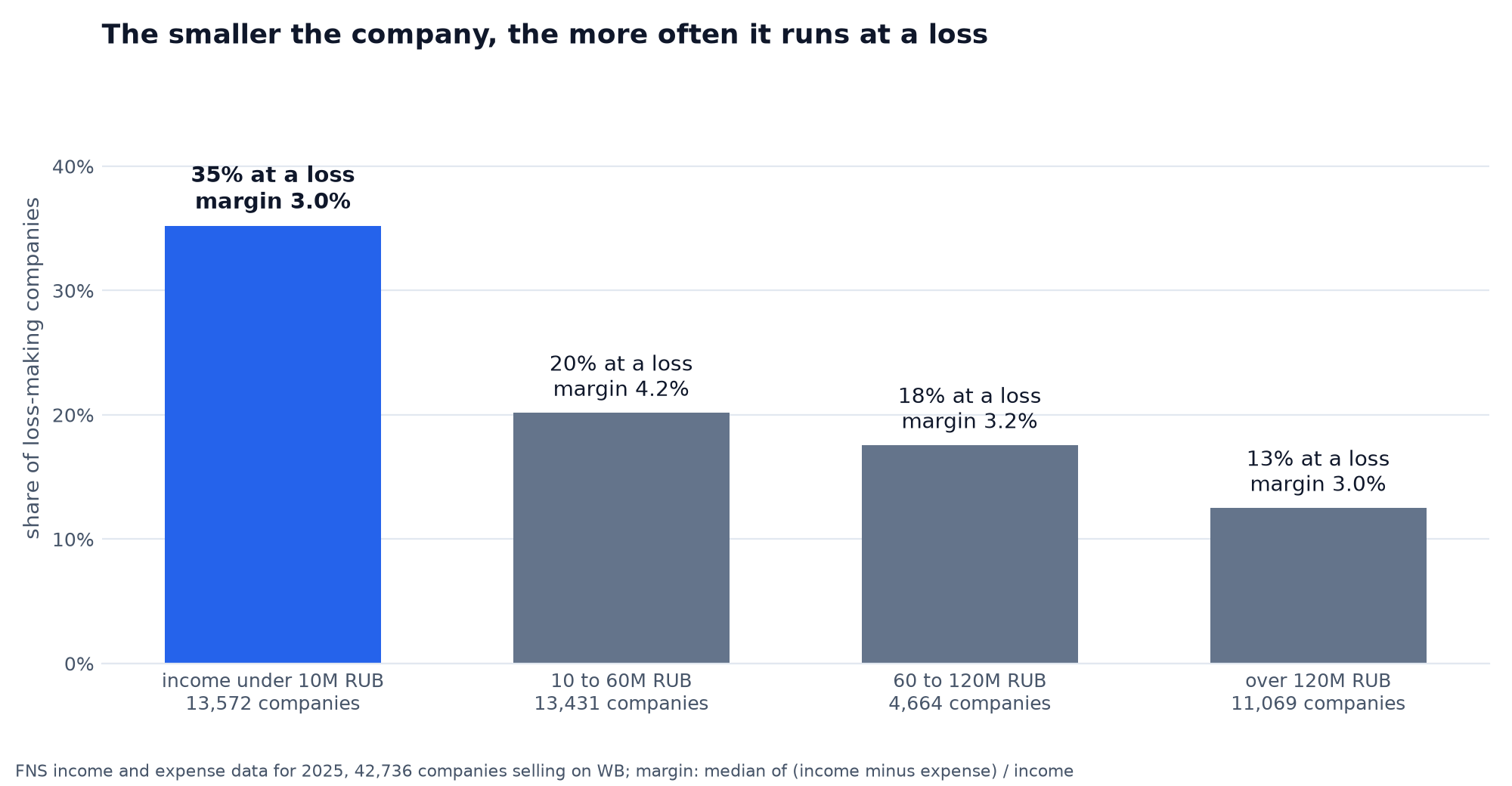
Among small companies, with revenue up to 10 million ₽ a year, one in three is running at a loss. Among large ones, from 120 million ₽, it's one in eight. The data doesn't say why, but the explanation suggests itself: a small seller has less of a buffer to survive a failed purchase or ad campaign.
Who earns more: traders or manufacturers
Every company in EGRUL has a main line of business under OKVED. We split WB seller companies by this code and looked at revenue and margin for 2025 in groups with more than 500 companies.
| Main line of business | Companies | Median revenue | Median margin | In the red |
|---|---|---|---|---|
| Wholesale trade (46) | 12,770 | 41.9 million ₽ | 2.5% | 21% |
| Retail trade, including online (47) | 9,247 | 17.1 million ₽ | 5.2% | 25% |
| Apparel manufacturing (14) | 1,755 | 29.5 million ₽ | 4.1% | 26% |
| Food manufacturing (10) | 1,300 | 60.5 million ₽ | 3.2% | 22% |
| Auto parts trade (45) | 1,083 | 43.1 million ₽ | 2.7% | 19% |
| Chemical manufacturing, including household chemicals and cosmetics (20) | 1,038 | 36.7 million ₽ | 3.3% | 23% |
| Furniture manufacturing (31) | 710 | 47.6 million ₽ | 2.9% | 23% |
| Other finished goods: toys, sporting goods, jewellery (32) | 688 | 35.0 million ₽ | 4.5% | 23% |
| Textile manufacturing (13) | 636 | 45.6 million ₽ | 3.7% | 18% |
Retail has the highest median margin: 5.2%, twice that of wholesalers. But retail also has more companies in the red, one in four. It looks like wholesalers use WB as just another sales channel: high turnover, thin markup. Manufacturers sit in the middle, 3 to 4.5%, with apparel companies posting a higher margin than furniture and food makers.
How much tax do sellers pay
The median amount of tax paid by a seller company is 453,000 ₽ a year. Most work under the simplified scheme. Among sole proprietors (IP), 241,000 ₽ (81%) is paid under the simplified tax on revenue (USN) and 29,000 ₽ under the patent system. Among companies, 29,000 ₽ is paid under the simplified tax on revenue (USN) and 4,900 ₽ under the automated simplified tax (AUSN).
We covered how much WB withholds from a seller before the money even reaches taxes in the article on how much Wildberries takes from a seller.
How much can a newcomer earn on Wildberries
There's no ready answer in rubles, but the median gives you a benchmark. At a 3.4% margin, every 100,000 ₽ of monthly profit needs about 2.9 million ₽ of monthly revenue, or 35 million ₽ a year. That's above the median: half of the companies on WB never grow to that turnover.
Higher margins happen, but you have to calculate them per product: purchase price, WB commission, logistics, storage, advertising, returns and tax. If less than 10% of the price is left on a listing after all these lines, one mistake with advertising or a promotion can push it into the red. You can break the price down line by line in the unit economics calculator.
The numbers above lead to a few practical conclusions:
- Don't count income from revenue. 26 million ₽ of revenue at the median margin gives 840,000 ₽ of profit a year.
- Keep a reserve. Every third small company is running at a loss, and the first months on WB usually go into finding an assortment that works.
- Check the niche before you buy stock. We covered how to gauge demand and competition from open data in our article on what to sell on WB.
FAQ on earning on Wildberries
How much do sellers earn on Wildberries per month? The median seller company earned 840,000 ₽ in profit in 2025, about 70,000 ₽ a month, on revenue of around 2.2 million ₽ a month. There's no such data for sole proprietors.
Is it worth selling on Wildberries? Three out of four companies ended the year with a profit, the fourth with a loss. Small companies fall into the red more often than large ones: 35% versus 13%.
What margin do sellers on Wildberries get? The median is 3.4% of revenue, according to FNS data for 2025. For individual products it can be higher, but across the whole company it stays at a few percent.
How many sellers on Wildberries work as sole proprietors? 81% of sellers in our database are sole proprietors (IP), 19% are companies.
To land in the profitable 76%, you need to see profit for each SKU, not just revenue. Parus Seller calculates profit accounting for commission, logistics, storage, advertising and cost of goods, and shows which products are pulling your store into the red. First two months free with promo code PARUS60, no card required: connect your store.