The most profitable thing to sell on Wildberries is what's in demand, where the leaders haven't taken the whole market, and where you can break into the top 100 without a long build-up. We checked all three conditions on our own data for 3,072 WB subjects. The niches that most often suit a newcomer are those where the top ten hold 25–60% of confirmed sales and the entry threshold for the top 100 is low. There aren't many like that among large subjects: fabric softeners, toothpastes, modeling clay, thermal socks, press-on nails, instant porridge.
Article 8 of 26 in the topic {hub}. All articles in the topic
People search for "what to sell on wb" about 1,750 times a month, and another 830 times they type out "wildberries" in full. Almost all the articles in the search results answer with a list of "hit products," without figures. We started from the data. In September 2026, we took 31.1 million active WB product cards that had been on the storefront in the last 30 days, merged the color variants of each product, and got 20.4 million product groups. Then we counted every subject with 300 groups or more. We excluded adult products from the analysis.
How to choose a niche on Wildberries: three numbers
WB doesn't give out sales for someone else's product card. We compare niches by confirmed sales: this is a lower bound, and actual sales are higher. That's why the article has no units or rubles, only shares and indices. They show which niche is bigger and where it's more crowded, but you can't use them to calculate revenue down to the ruble.
For each subject we calculate three numbers:
- Demand index. Confirmed sales of all products in the subject over its entire history. The most purchased subject, dietary supplements, is set at 100. An index of 50 means half as much.
- Share of the top ten. What portion of the subject's confirmed sales went to its ten best-selling products. 90% means customers mostly buy from the leaders.
- Entry threshold index. Confirmed sales of the product in hundredth place in the subject. The level we consider within a newcomer's reach is set at 100. An index of 2,000 means the hundredth product stands twenty times higher.
One number without the other two is misleading. High demand with a leader share of 90% means the market exists, but it belongs to someone else. A low threshold combined with low demand means there are no competitors, and no customers either.
The biggest subjects by demand
Products that people buy often and cheaply have the highest demand index: supplements, T-shirts, creams, sneakers, sweets.
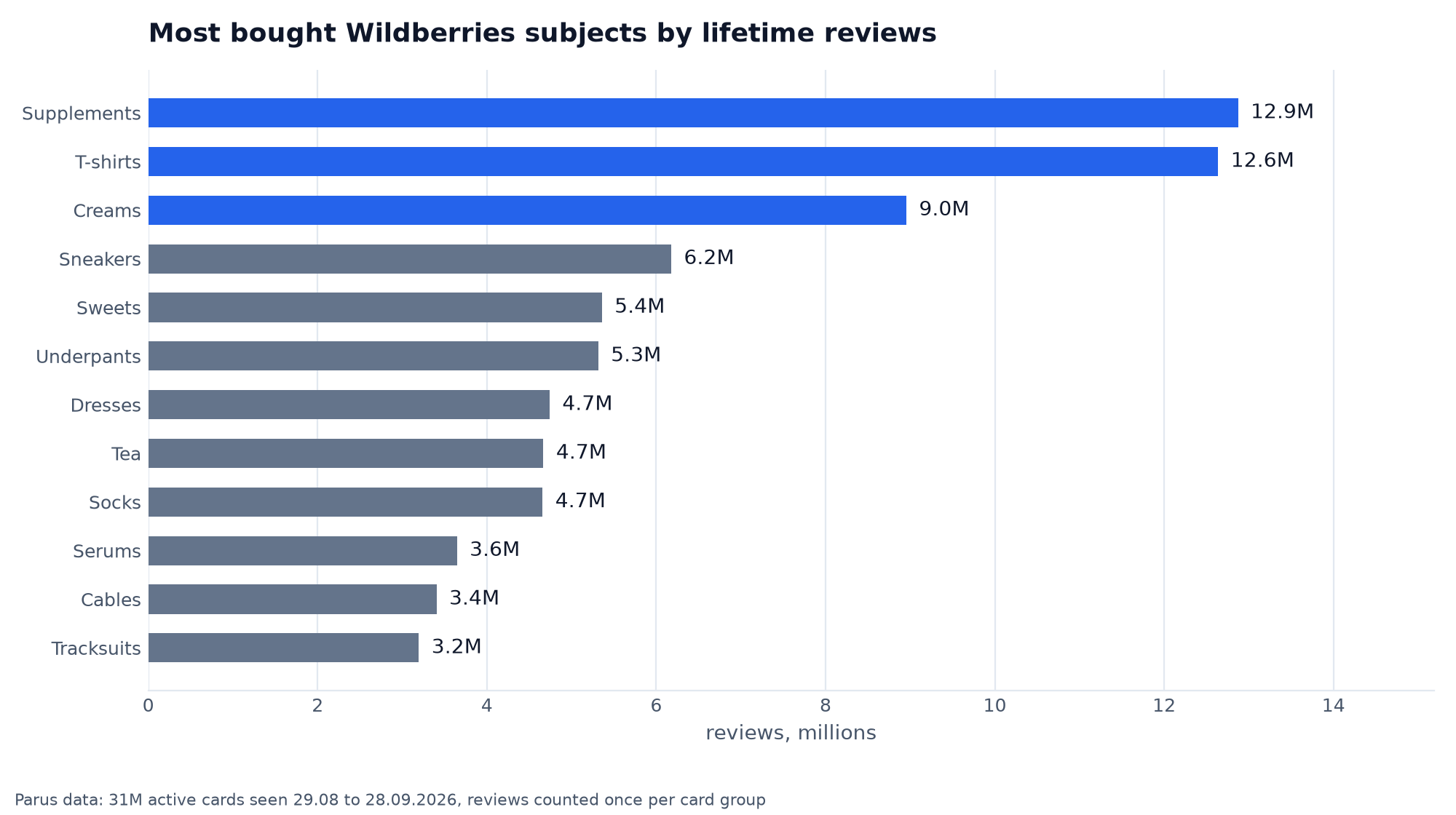
Demand here is huge, but there are also thousands of sellers. T-shirts have 145,400 product groups and 8,190 sellers, and the entry threshold index is 7,900: the 100th product stands 79 times above the level within a newcomer's reach. In supplements, the threshold is 7,100. A new card with no sales history will land several thousand places behind the 100th product. On top of that, clothing, footwear, cosmetics and supplements are subject to Chestny ZNAK marking, more on that below.
Demand is split unevenly. Only 10.6% of product groups in our analysis have confirmed sales, and the rest don't have any yet.
Next on this topic: Wildberries unit economics: free xlsx sheet download
Where the market is split, and where leaders hold it
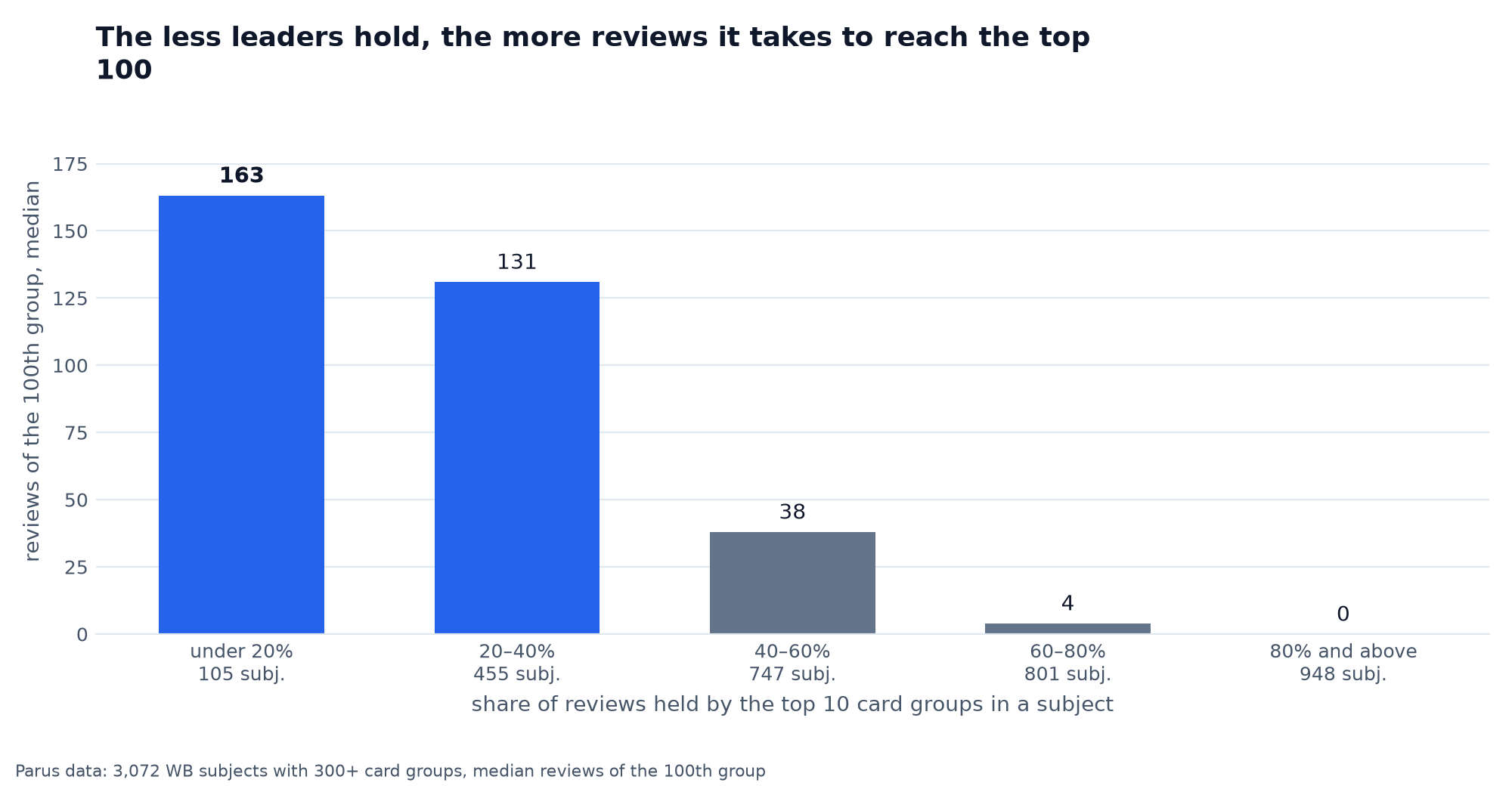
We split subjects into five groups by the top 10's share and calculated the median entry threshold for each.
| Top 10's share of sales | Subjects | Median threshold index |
|---|---|---|
| under 20% | 105 | 54 |
| 20–40% | 455 | 44 |
| 40–60% | 747 | 13 |
| 60–80% | 801 | 1 |
| 80% and above | 948 | 0 |
The picture cuts both ways. Where the leaders have taken almost everything, breaking into the top hundred is easy: the threshold is about zero. That doesn't get you far. Demand sits with the top 10, and the 100th spot sells almost nothing. Where the market is split among many, sales are spread wider, but the threshold is dozens of times higher too: a median of 54 against 1.
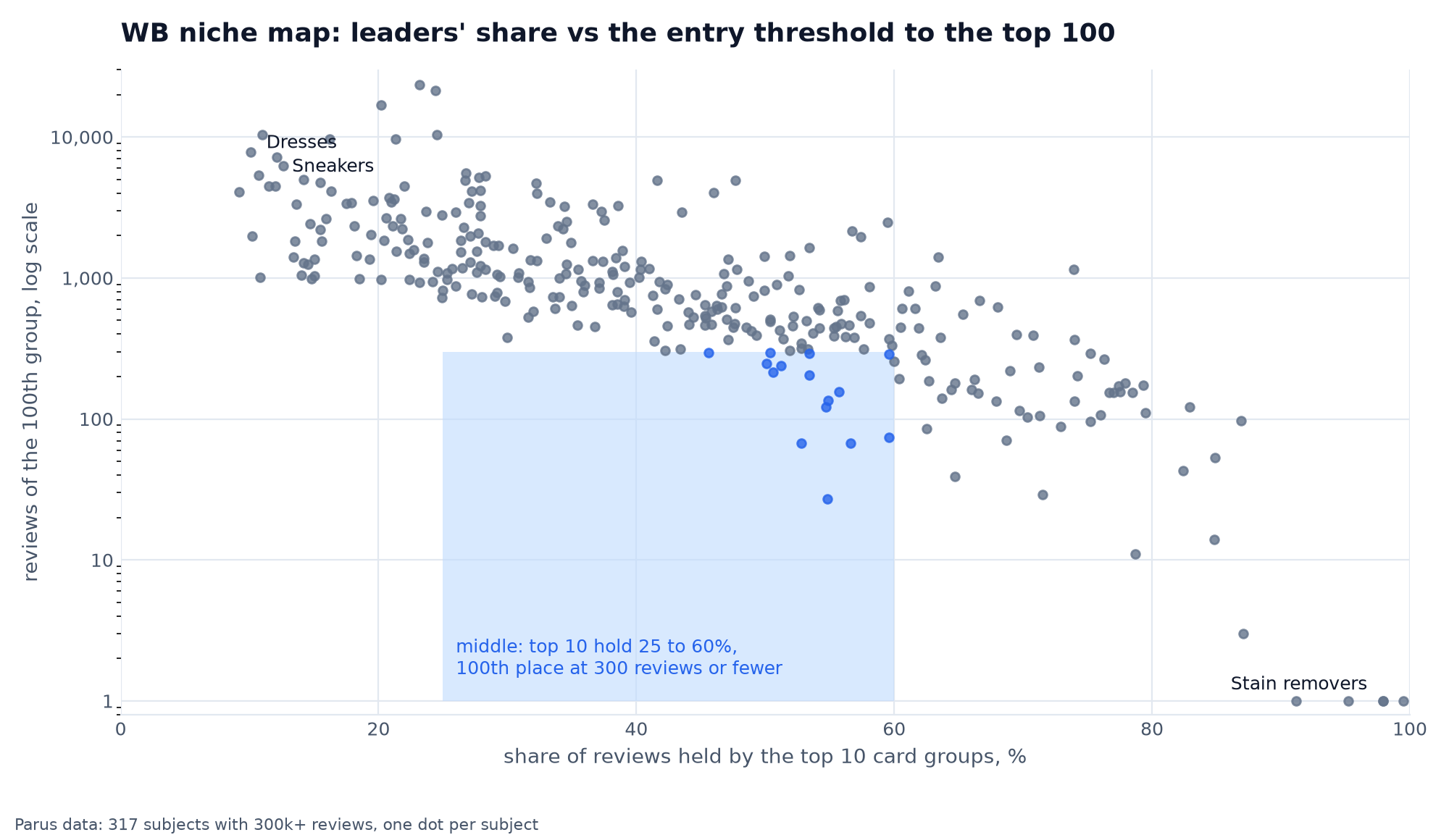
For 318 subjects with a demand index of 2.3 or more, the median top 10 share is 41.6%. Large niches are, on average, neither monopolized nor split evenly.
Closed niches: demand exists, but the leaders own it
The most concentrated subjects among the large ones: a handful of brands have grabbed nearly all the sales.
| Subject | Product groups | Top 10 share | Entry threshold index |
|---|---|---|---|
| Stain removers | 833 | 97.9% | 0.3 |
| Home perfume | 511 | 78.5% | 51 |
| Wet wipes | 4,666 | 75.2% | 32 |
| Patches | 6,624 | 75.2% | 97 |
| Cosmetic masks | 10,962 | 73.9% | 385 |
| Pillows | 4,962 | 68.0% | 208 |
| Mops | 2,276 | 65.3% | 185 |
Stain removers have a demand index of 23, and 97.9% of confirmed sales belong to ten products. Customers go for a known brand, and a newcomer in this subject will have to fight it off with price or advertising. That's possible, but it costs money, which a beginning seller usually doesn't have.
Open niches: many sellers and a high entry bar
At the other end are subjects where the top ten hold 9–14% of confirmed sales. Customers choose among thousands of products, and leaders change places.
| Subject | Product groups | Sellers | Top ten share | Threshold index | Median price of the top 100 |
|---|---|---|---|---|---|
| Dry pet food | 43,223 | 1,778 | 9.2% | 1,400 | 616 ₽ |
| Dresses | 19,902 | 6,318 | 10.1% | 2,600 | 1,472 ₽ |
| Tea | 37,746 | 4,879 | 11.0% | 3,400 | 250 ₽ |
| Sneakers | 290,731 | 9,044 | 12.1% | 2,400 | 1,302 ₽ |
| Trousers | 10,922 | 4,029 | 12.6% | 2,100 | 1,761 ₽ |
| Motor oil | 74,203 | 1,976 | 13.5% | 605 | 1,060 ₽ |
| Backpacks | 81,199 | 12,710 | 13.6% | 1,100 | 1,432 ₽ |
An open niche doesn't mean an easy one. Sneakers have 290,000 product groups and a threshold index of 2,400: the 100th product stands 24 times above the level within a newcomer's reach. This kind of market suits a seller with a range and their own design, launched not as a single card but as a dozen. One new sneaker model with no sales history will get lost.
The middle zone: where a newcomer has the easiest shot
The most interesting spot is between the two extremes. We picked large subjects (demand index of 2.3 or higher) where the top 10 hold 25–60% and the threshold index is no higher than 100. Leaders exist, but they haven't taken everything, and breaking into the top 100 is realistic.
| Subject | Demand index | Top 10 share | Threshold index | Median price, top 100 |
|---|---|---|---|---|
| Fabric softeners | 5.3 | 56.6% | 22 | 544 ₽ |
| Vacuum sealer bags | 4.5 | 59.6% | 96 | 432 ₽ |
| Toothpaste | 3.6 | 53.4% | 68 | 462 ₽ |
| Sugar substitutes | 3.3 | 50.6% | 72 | 313 ₽ |
| Sports flashlights | 3.3 | 54.9% | 45 | 948 ₽ |
| Oat flakes | 3.3 | 59.6% | 25 | 260 ₽ |
| Modeling clay | 2.9 | 52.8% | 22 | 238 ₽ |
| Press-on nails | 2.8 | 54.7% | 40 | 252 ₽ |
| Nail art decor | 2.8 | 54.8% | 9 | 202 ₽ |
| Thermal socks | 2.5 | 50.1% | 82 | 557 ₽ |
| Adhesive plasters | 2.5 | 45.6% | 99 | 309 ₽ |
| Instant porridge | 2.5 | 50.4% | 98 | 328 ₽ |
| Hair straighteners | 2.3 | 51.2% | 79 | 1,730 ₽ |
This isn't a ready-made "what to sell" list. It's an example of what niches with a reasonable entry point look like. Before you order stock, check the margin for each one: modeling clay and nail art decor have a median price in the top 100 of around 200 to 240 ₽, and after WB's commission and logistics, not much is left of it. You can run the numbers in the unit economics calculator.
What you can't sell on Wildberries
Before you pick a niche, check whether you can sell it at all. WB splits restrictions into three types.
Fully banned products. The list has been in force since 10 July 2026 and sits on legal.wildberries.ru. It covers alcohol, weapons and their replicas, ammunition, knuckle dusters, smoking products, pyrotechnics, matches, and solvents with a concentration of 80% or more. WB fines you for a card or an inbound supply of such a product.
Products restricted by sales model. Some bans are lifted for the «Витрина» (DBS), «Витрина экспресс» (EDBS) and «Самовывоз из магазина продавца» (C&C) models, because WB delivery isn't involved there. For example, household pyrotechnics of classes I to III, solvents and fire starter fluid can only be sold this way. «Маркетплейс» (FBS) and the WB warehouse have more restrictions. WB shows which model is available for a category in its table by product line.
Products that need documents. Clothing, footwear, cosmetics, perfumery, dietary supplements, toys, water and much more can only be sold with Chestny ZNAK codes, we covered how that works in the article on product marking on WB. Children's products, food and cosmetics need a certificate or declaration of conformity. You can't sell someone else's brand without the rights holder's permission.
There's one more restriction for the self-employed: they can't resell other people's goods or trade in goods subject to mandatory marking. More detail in the article on self-employed sellers on WB.
How to check a niche yourself: four steps
- Demand and leaders. In Parus Seller, open "WB Trends" and expand a product card from your niche. The breakdown shows how many brands share the niche's demand and what share of it the top three product cards hold, and the "Break down the … niche" button opens all of its products.
- Price. Look at the median price of the first hundred. If it's below 300 ₽, check that there's still a profit left after WB's commission and logistics.
- Documents. Check the marking, certification and available sales model against WB's rules.
- Search demand. Check the queries for the product in Yandex Wordstat or in WB's search analytics. Sales show the past, queries show whether people are searching for the product now.
If you have no time to check the niche, register as a seller and prepare the cards yourself, you can leave it to our team: we open a turnkey Wildberries store and choose the product on the same data as in this article. How to go through this path on your own is covered in the article How to open a Wildberries store from scratch.
FAQ on what to sell on Wildberries
What should a beginner sell on Wildberries? A product from the middle zone: clear demand, where the leaders hold less than 60% of sales and the entry threshold for the top 100 is low. It's easier to start without marking and certification, but that's not the main criterion. What matters most is that a margin remains after commission and logistics.
What can you sell on Wildberries with minimal investment? Small, lightweight products: WB's logistics costs depend on volume, so small items are cheaper to ship and store. But at a price of around 200 ₽, commission and delivery eat up most of the revenue, so work out the unit economics before you buy stock.
What are the most popular products on Wildberries? By confirmed sales over all time, the leaders are supplements, T-shirts, creams, sneakers and sweets. Popularity here also means maximum competition.
Can you sell on Wildberries without being a sole proprietor (IP)? Yes, as a self-employed person, but only your own manufactured products without marking. You can sell an item as a one-off through WB Resale.
How do you tell a niche is taken? If the ten best-selling products have collected more than 80% of the subject's sales, customers have already chosen their brands. You can still enter, but you'll pay for it with price and advertising.
Once the niche is chosen, what happens next depends on how the product lives on WB: positions, reviews, stock and ads. Parus Seller shows all of this in one window and calculates profit for every SKU. First two months free with promo code PARUS60, no card required: connect your store.