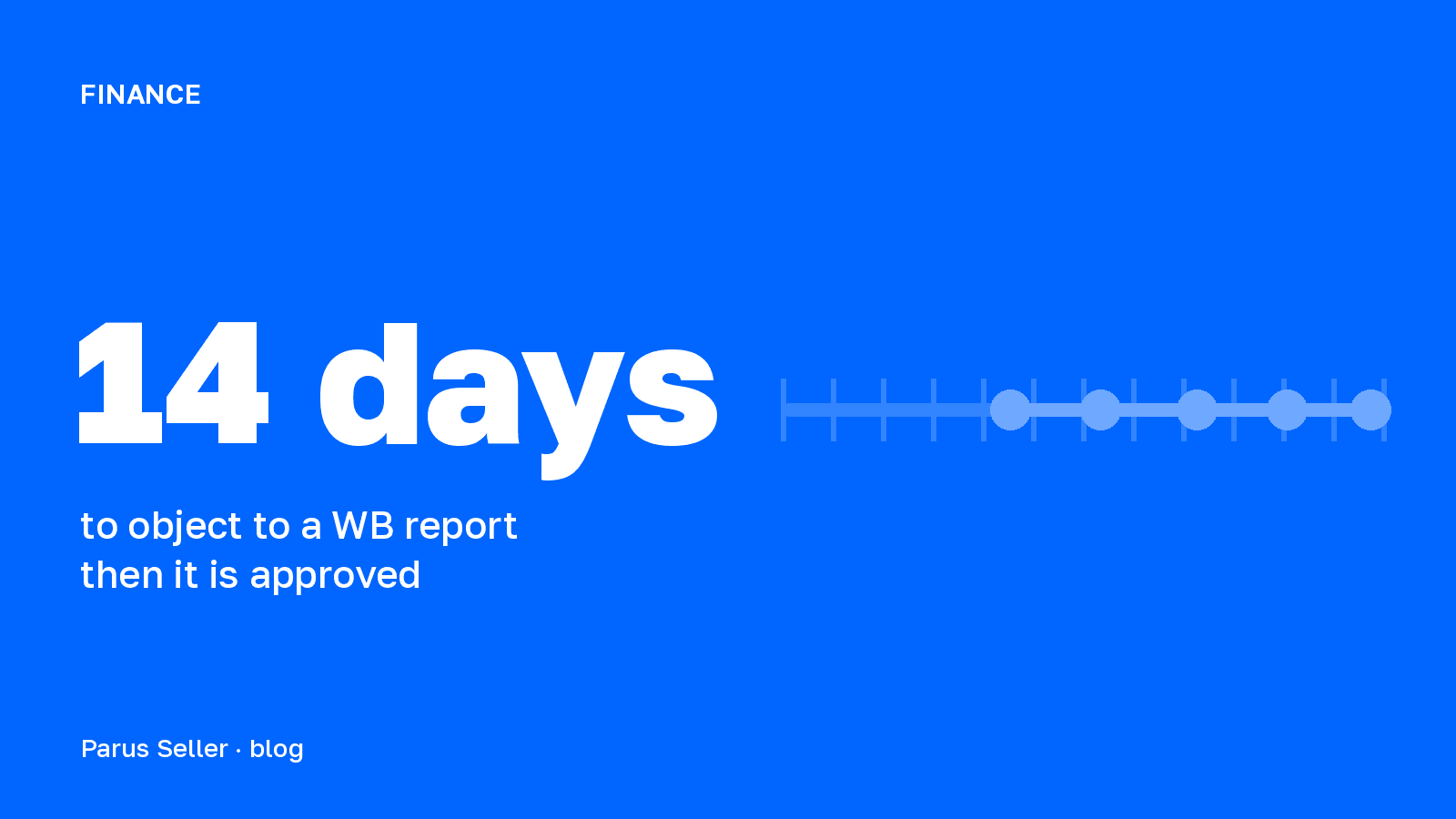
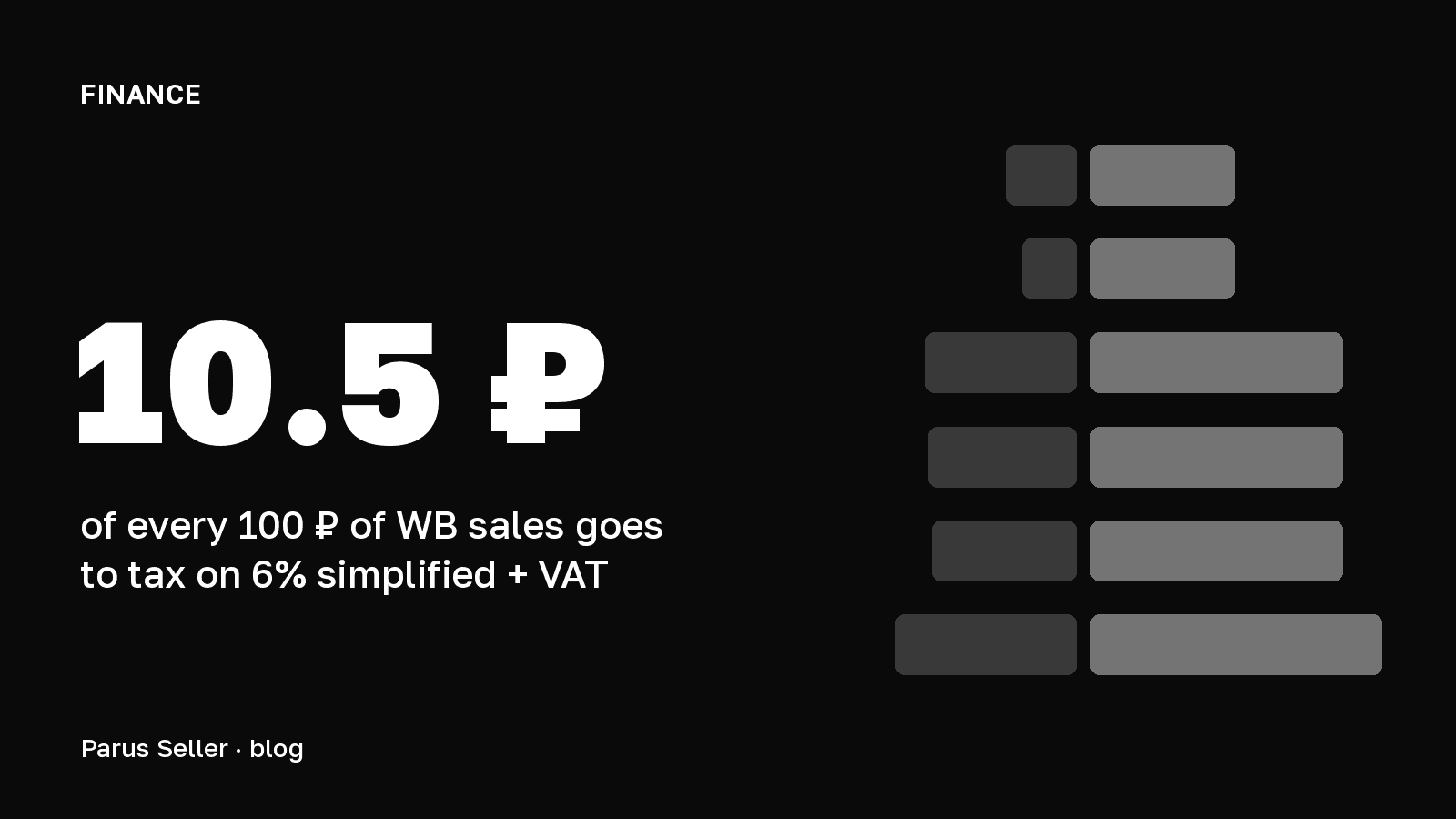
What tax a sole proprietor (IP) on WB pays in 2026: almost always the simplified tax, either on revenue at 6% or on revenue minus costs at 15%, and both are calculated from the price the buyer paid, not from the WB payout. If last year's income was above 20 million ₽, or this year's income has crossed that line, VAT is added on top: 5% (up to 272.5 million ₽) or 7% (up to 490.5 million ₽). A sole proprietor's own contributions for 2026 are 57,390 ₽ plus 1% of income above 300 thousand ₽.
A self-employed seller (NPD) has a cap of 2.4 million ₽ a year, and beyond it you need a sole proprietorship. We already compared NPD and a sole proprietor at small turnovers in the article on self-employed sellers on WB. This one is about the next step: sales in the tens and hundreds of millions, where VAT appeared in 2026. We took the cost shares from the breakdown of a store with 6 million ₽ a month and calculated the tax burden at six turnovers. Rates and thresholds were checked against the Federal Tax Service (FNS) "Changes 2026" page and the articles of the Tax Code.
In short: in our model a sole proprietor on the 6% simplified tax without VAT pays 6 ₽ of every 100 ₽ of sales in tax and contributions, and with 5% VAT already 10.5 ₽ out of 11.2 ₽ of pre-tax profit. On the 15% simplified tax the same turnovers cost 2.3 to 7.6 ₽. The VAT threshold is 20 million ₽ in 2026, 15 million ₽ in 2027 and 10 million ₽ from 2028. The model is built on the cost shares of one store, and your margin will give a different answer.
Which tax a sole proprietor on WB should choose in 2026
In practice a sole proprietor on WB chooses between the two variants of the simplified tax. The patent does not fit marketplace sales: Article 346.43 of the Tax Code does not treat selling goods by samples and catalogues through computer networks as retail trade. The general regime with 22% VAT remains for those who have outgrown the simplified tax limits.
| Regime | Rate | Calculated from | Income limit in 2026 |
|---|---|---|---|
| Simplified tax on revenue | 6% | buyer price in the WB report | 490.5 million ₽ |
| Simplified tax on revenue minus costs | 15%, at least 1% of income | buyer price minus costs | 490.5 million ₽ |
| VAT on the simplified tax | 0, 5 or 7%, or 22% with deductions | sale price | by income, see below |
| Patent | does not apply to a marketplace | 20 million ₽ |
Sources: nalog.gov.ru/new2026, Tax Code Art. 346.18, 346.20, 346.43, 164
A region can lower the simplified tax rate for certain types of activity, which the FNS page also states. One more condition of the simplified tax: the residual value of fixed assets must not exceed 218 million ₽. For a seller without their own warehouse this limit almost never applies.
The main question is a different one: what share of your sales goes to costs you can deduct. On the 6% simplified tax the tax is taken from turnover, and the commission, logistics and purchasing do not reduce it. On the 15% simplified tax the tax is taken from the difference. Leaving contributions aside, the rates break even where costs are 60% of income: 15% of the remaining 40% equals 6% of the whole. For the store in our calculation they are 87.4%.
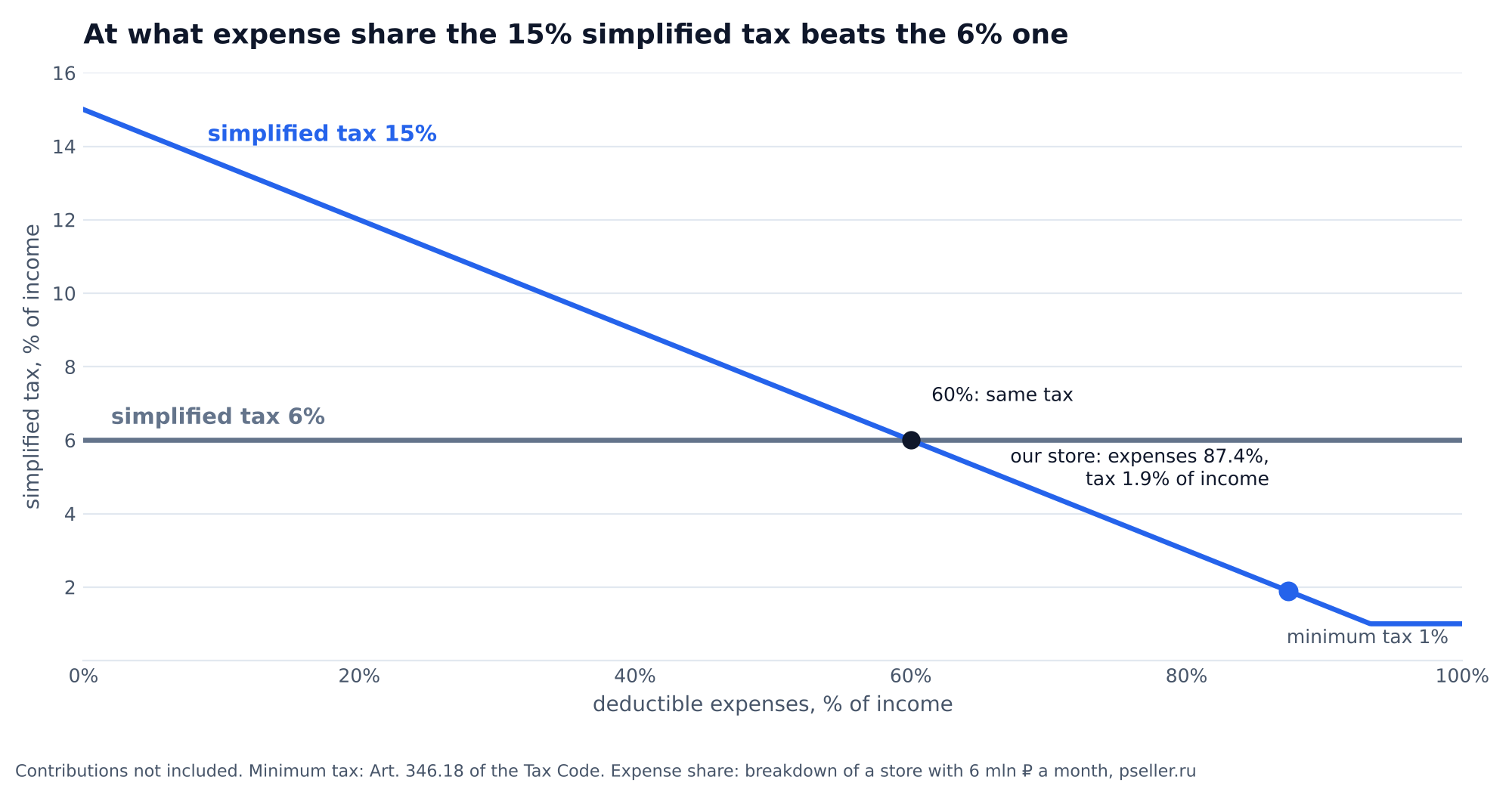
Contributions are not included here, and they move the crossing point by fractions of a percent. For a marketplace seller costs are almost always above the 60% line: WB deductions alone took 51.3% of the buyers' money at our store.
How much tax a sole proprietor on WB pays: from 5 to 300 million ₽
In our model a sole proprietor on the 15% simplified tax pays 1.6 to 2.6 times less than on the 6% one at every turnover. The reason is the margin. The phone case store from the breakdown of how much Wildberries takes spent 51.3% of the buyers' money on WB deductions, 8.7% on advertising and 28.9% on purchasing. Before tax it kept 11.2% of sales.
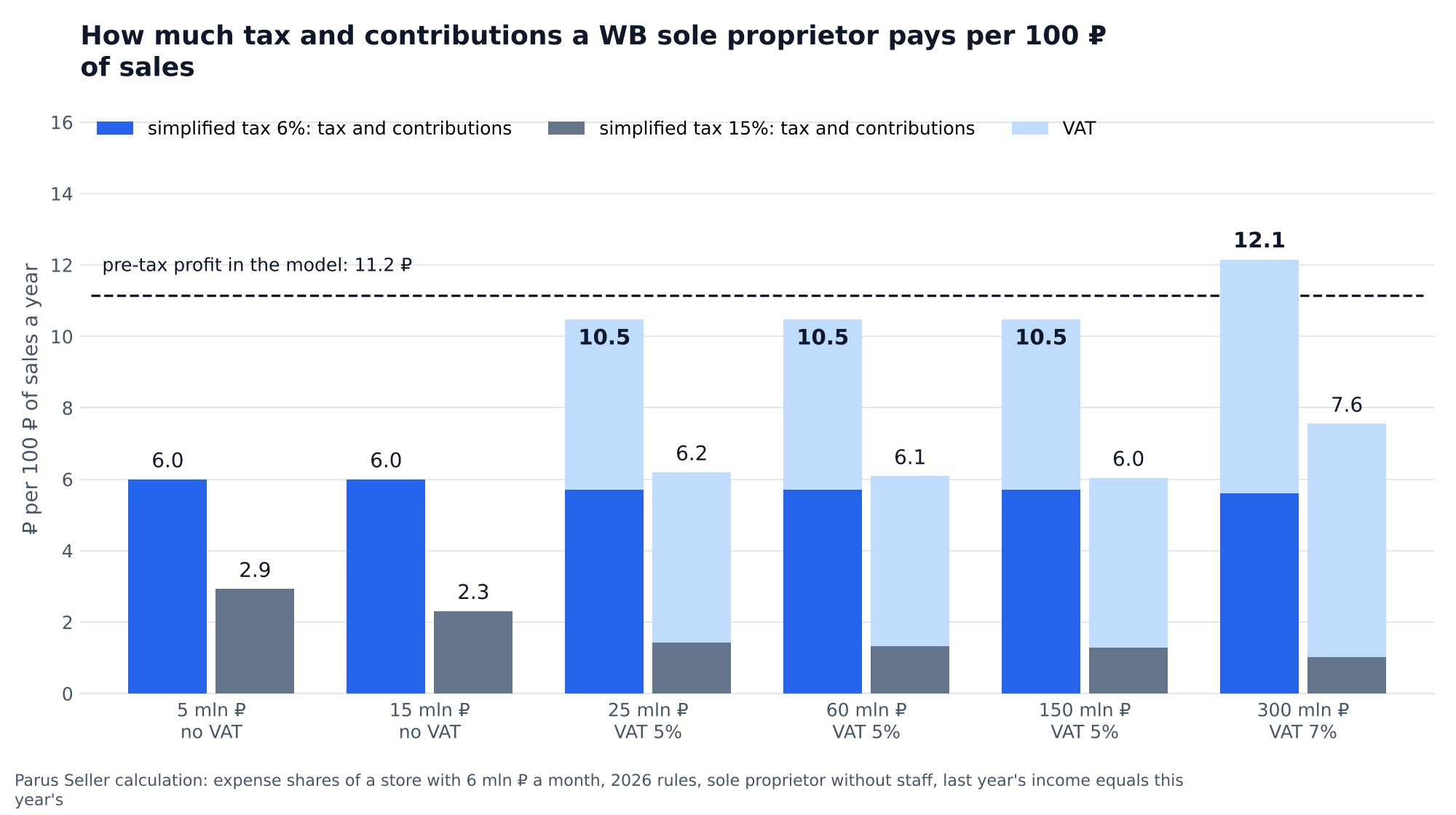
Here is how we counted. Turnover is the buyer price for the year. We take VAT out of it at 5 or 7% and leave the shelf price unchanged. Income for the simplified tax equals turnover without VAT. On the 6% simplified tax we reduce the tax by the full contributions, as Article 346.21 of the Tax Code allows a sole proprietor without staff. On the 15% simplified tax we count WB deductions together with advertising and purchasing as costs, 87.4% of turnover in total. WB fines and other deductions, another 1.5%, we left out of costs: they are not in the list of Article 346.16 of the Tax Code.
| Annual turnover | VAT | Total at 6% | Total at 15% | Profit at 6% | Profit at 15% |
|---|---|---|---|---|---|
| 5 million ₽ | none | 300 thousand ₽ | 146 thousand ₽ | 258 thousand ₽ | 411 thousand ₽ |
| 15 million ₽ | none | 900 thousand ₽ | 347 thousand ₽ | 774 thousand ₽ | 1.33 million ₽ |
| 25 million ₽ | 5% | 2.62 million ₽ | 1.55 million ₽ | 170 thousand ₽ | 1.24 million ₽ |
| 60 million ₽ | 5% | 6.29 million ₽ | 3.65 million ₽ | 408 thousand ₽ | 3.04 million ₽ |
| 150 million ₽ | 5% | 15.71 million ₽ | 9.06 million ₽ | 1.02 million ₽ | 7.67 million ₽ |
| 300 million ₽ | 7% | 36.45 million ₽ | 22.67 million ₽ | loss of 2.98 million ₽ | 10.8 million ₽ |
"Total" = simplified tax + the sole proprietor's own contributions + VAT. Last year's income is taken as equal to this year's, no staff
The sharpest step in the table is between 15 and 25 million ₽. Turnover grew by two thirds, while profit on the 6% simplified tax fell from 774 to 170 thousand ₽: 5% VAT takes 4.8 ₽ of every 100 ₽ of sales. At a turnover of 300 million ₽ and a 7% rate, a store with this margin runs at a loss on the 6% simplified tax. On the 15% simplified tax this row triggers the minimum tax of 1% of income under Article 346.18 of the Tax Code.
The model keeps cost shares the same at every turnover, and that is a simplification. If your pre-tax margin is 30% rather than 11%, the gap between the regimes will be smaller. Work out your own cost share from your reports and check the choice with an accountant. You can switch the simplified tax object only from a new year, by notifying the tax office before 31 December.
When a sole proprietor on the simplified tax pays VAT on WB sales
VAT starts at income above 20 million ₽. If income for 2025 was higher, VAT is charged from 1 January 2026. If the threshold is crossed during 2026, then from the first day of the following month. Up to 20 million ₽ the exemption applies automatically: no notice to the tax office, no VAT invoices and no VAT return are needed.
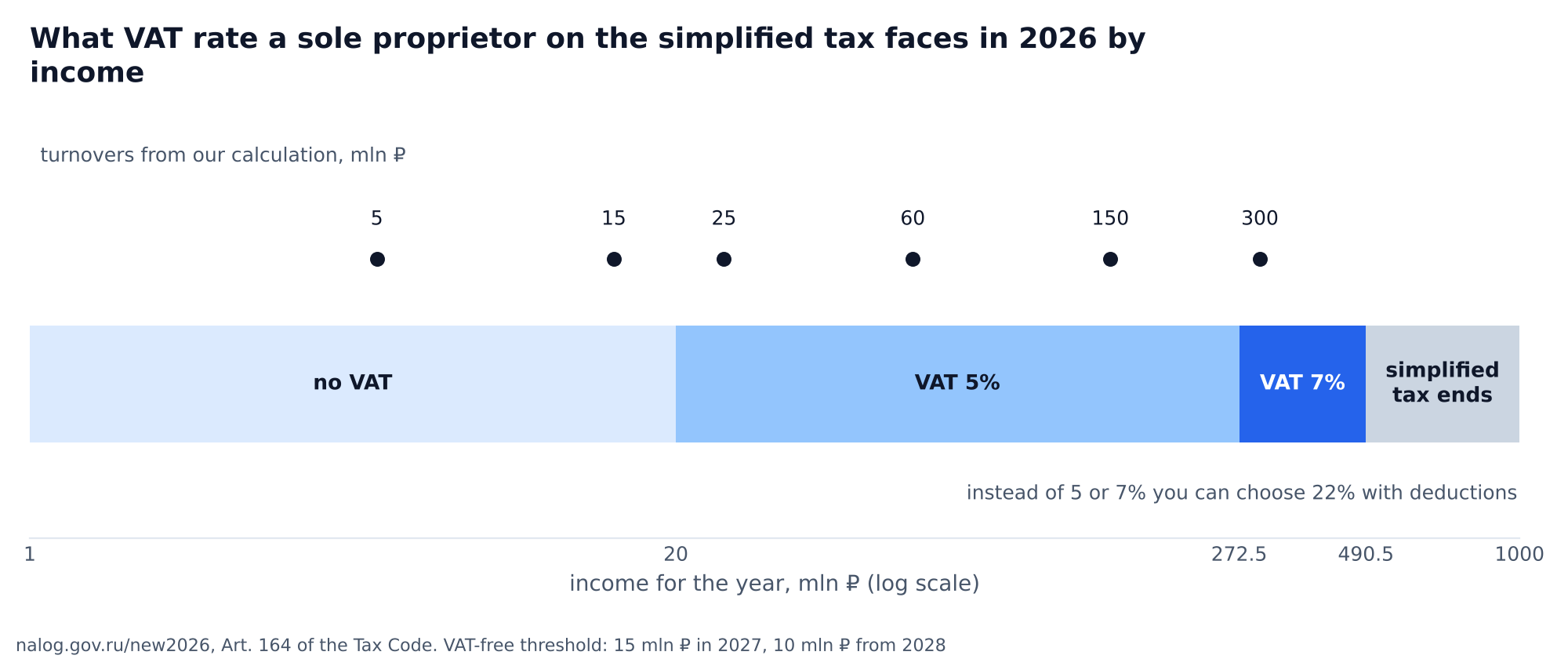
The simplified tax gives you a choice. The reduced rates of 5 and 7% under Article 164 of the Tax Code give no deductions: input VAT goes into the cost of purchases and services. The 22% rate does give deductions. For a reseller who buys goods from VAT payers it may work out cheaper. Once you pick 5 or 7%, you have to keep the rate for 12 quarters in a row. The FNS describes the exception like this: those who first moved to these rates from 2026 can drop them in favour of 22% within four quarters.
The threshold will keep falling: 15 million ₽ in 2027 and 10 million ₽ from 2028. The seller with a turnover of 15 million ₽ from our table pays no VAT in 2026, but will pay it in 2028. Which rate to choose given your purchases is a call to make with an accountant: calculating deductions requires your incoming VAT invoices.
How much a sole proprietor pays in own contributions in 2026
The fixed part of a sole proprietor's contributions for 2026 is 57,390 ₽, payable by 28 December. On top comes 1% of income above 300 thousand ₽, payable by 1 July of the following year, and this part is capped at 321,818 ₽. Both amounts are set in Article 430 of the Tax Code, the deadlines on the FNS page about contributions.
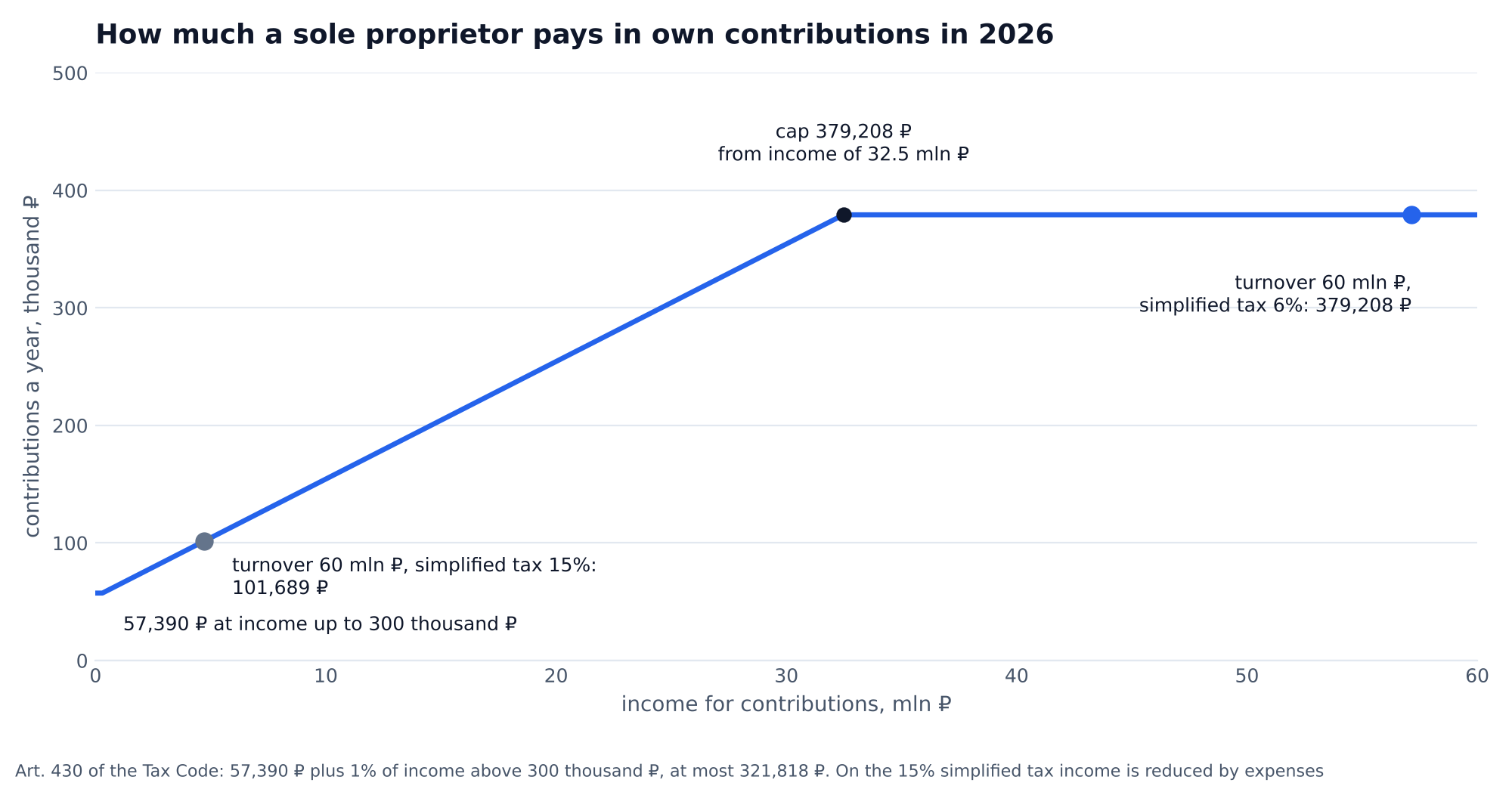
The income used for contributions depends on the regime. On the 6% simplified tax it is all income, so from income of 32.5 million ₽ contributions hit the cap of 379,208 ₽. On the 15% simplified tax the income for the 1% is reduced by costs, and at a turnover of 60 million ₽ our model gives contributions of 101,689 ₽. For a seller on 6% contributions are almost free: the tax is reduced by them ruble for ruble. Once you hire staff, the tax can only be cut by half, and you will also pay contributions for the employees.
From what amount to pay tax on WB and when
The simplified tax is calculated from the "Продажа" (Sale) column of the weekly report, that is, from the buyer price. The WB payout is smaller by all the marketplace deductions, and tax on it understates the base. The FNS explained this in a letter that we covered in the article on the Wildberries weekly report.
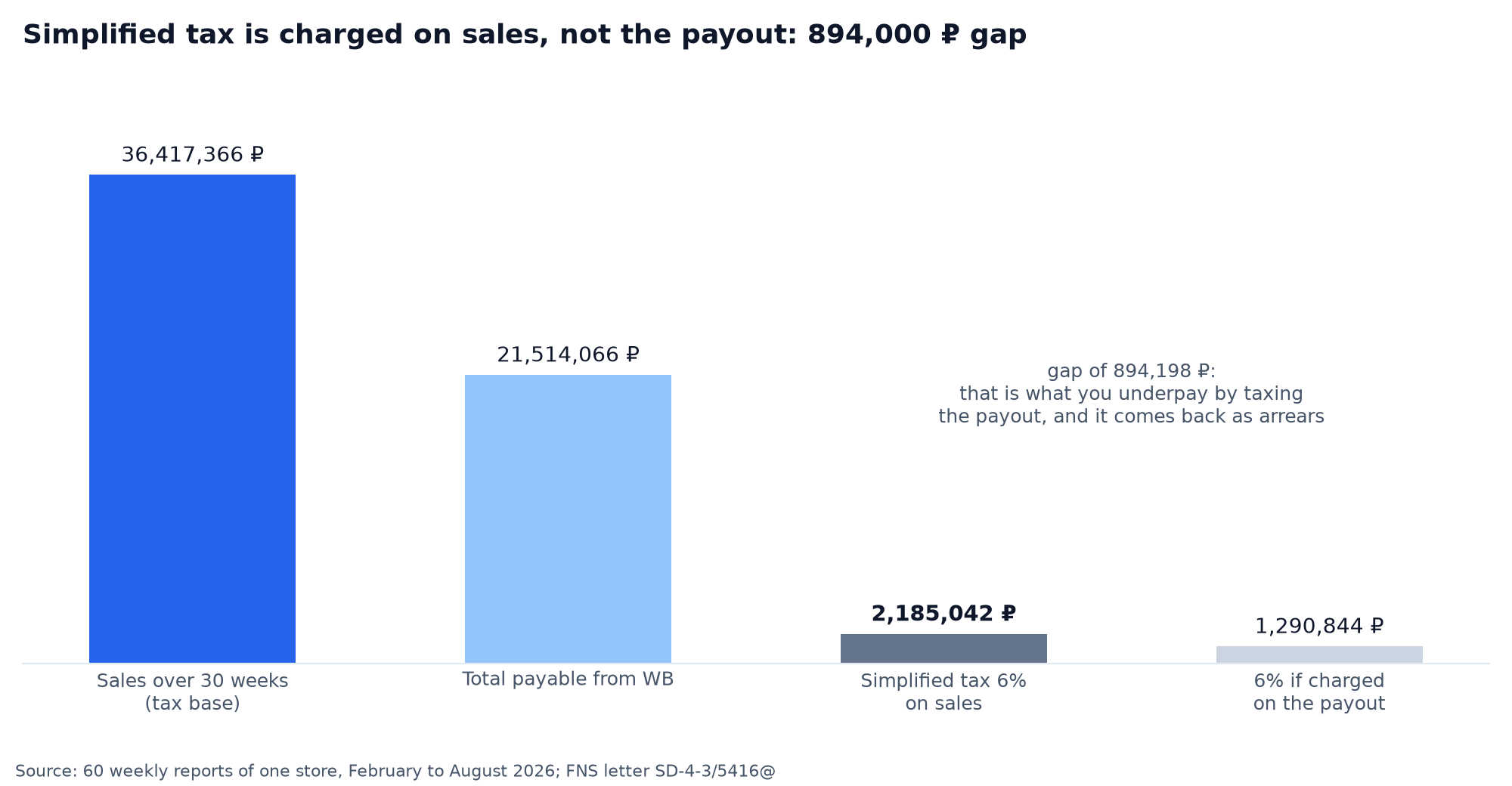
Over 30 weeks of one store the difference came to 894,198 ₽ of underpayment. That is how much the tax office will charge on top, plus late-payment interest, if you take 6% of the payout. The deadlines under Article 346.21 of the Tax Code are: advance payments by the 28th of the month after the quarter, that is, by 28 April, 28 July and 28 October. A sole proprietor pays the tax for the year by 28 April of the following year.
How to move from self-employment to a sole proprietorship on WB
Moving from NPD to a sole proprietorship does not require a new account on WB. Under the WB instructions, after exceeding the 2.4 million ₽ cap you have 20 calendar days to register as a sole proprietor and choose a regime. The type of business is changed in the «Настройки» (Settings) section, in the seller details. We described this in detail in the article on self-employed sellers on WB.
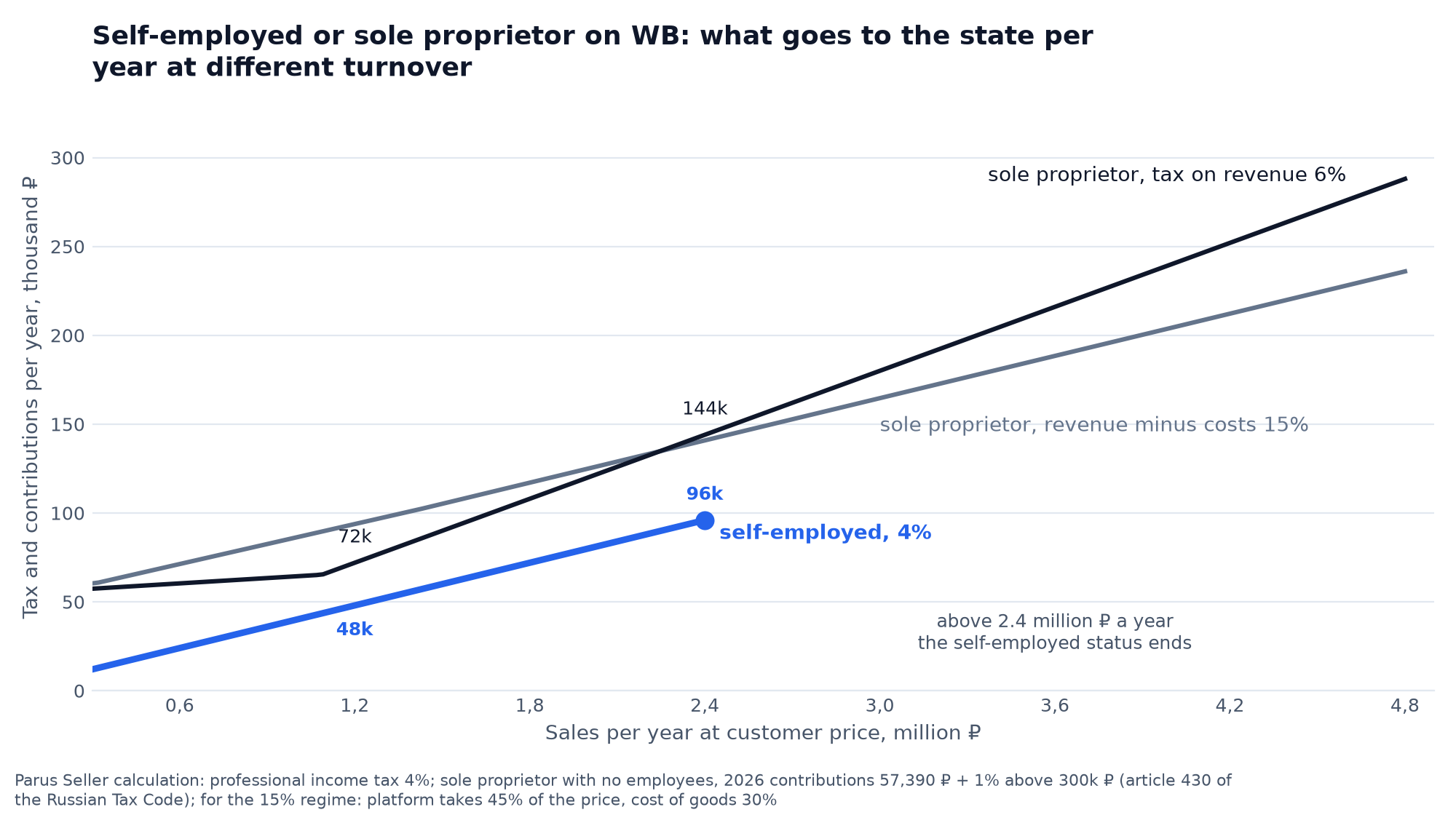
It is best to choose the simplified tax variant right when registering the sole proprietorship. Our calculation gives a simple rule for resale: if deductible costs including purchasing are above 60% of sales, 15% is usually more profitable. If you are just starting out, see how to open a store on Wildberries.
FAQ about a sole proprietor on WB
What tax does a sole proprietor on WB pay? Most sole proprietors on the marketplace use the simplified tax at 6% of income or 15% of the difference between income and costs. Above 20 million ₽ of income a year, VAT of 5 or 7% is added. The patent does not apply to marketplace sales.
From what amount does a sole proprietor pay tax on WB? From the price the buyer paid, that is, from the "Продажа" (Sale) column of the weekly report. The WB commission, logistics and storage do not reduce the base on the 6% simplified tax. On the 15% simplified tax you can deduct them as costs.
Does a sole proprietor on the simplified tax have to pay VAT on Wildberries? Yes, if income for 2025 or since the start of 2026 is above 20 million ₽. Below that threshold the exemption applies with no application needed. In 2027 the threshold is 15 million ₽, from 2028 it is 10 million ₽.
How much in contributions does a sole proprietor on WB pay in 2026? 57,390 ₽ fixed by 28 December and 1% of income above 300 thousand ₽ by 1 July of the following year, but no more than 321,818 ₽. On the 15% simplified tax the income for this 1% is counted after costs.
How do you calculate a sole proprietor's tax on WB? On the 6% simplified tax, multiply sales since the start of the year by 0.06 and subtract the contributions and advance payments already made. On the 15% simplified tax, subtract costs under Article 346.16 of the Tax Code from sales and multiply by 0.15, but no less than 1% of the year's sales. If you pay VAT, take it out of sales first.