A seller is a merchant on a marketplace: an entrepreneur who lists their own goods on Wildberries, Ozon or another platform and is responsible for selling them. The platform gives the seller a storefront, warehouses and buyers with delivery. The seller decides what to sell and at what price, and pays for WB's services through the commission and tariffs. On WB a seller can be self-employed, a sole proprietor or a company. A model store with 6 million ₽ a month in turnover kept 309,000 ₽ of net profit after commission, logistics, advertising and taxes.
The word comes from English, and in Russian «селлер» simply means a merchant. The query «кто такой селлер» ("who is a seller") is typed into Yandex about 2,000 times a month, and a few hundred more times people add "on marketplaces" or "in plain words". All figures below come from our breakdowns of WB reports, open Federal Tax Service data and the WB page for sellers, with a link next to each.
In short: a seller sells their own goods through a marketplace and is personally responsible for product cards, supplies to the warehouse, advertising and buyer reviews. To start you need self-employed, sole proprietor or LLC status and a 5,000 ₽ payment. A model store with 6 million ₽ a month earned 309,000 ₽ net. Three seller companies out of four ended 2025 with a profit, and the top quarter earned from 5.6 million ₽ for the year.
Who is a seller in plain words
A seller is the owner of a store inside a marketplace. In this model the marketplace does not own the goods: it rents sellers a place on the storefront, stores goods in its warehouses, delivers them to the pickup point and accepts payment. Everything about the product itself stays with the seller. The seller buys or makes the goods, takes the photos, sets the price, watches the stock and answers buyers.
WB shows the scale of the infrastructure a seller gets on its page for sellers. As of 6 October 2026 it lists these figures:
| What Wildberries provides | How much | What is left to the seller |
|---|---|---|
| Buyers a month, in 11 countries | 82 million | make a product card that people find and buy |
| Order pickup points | 96,000 | collect returns that WB sent to their pickup point |
| Warehouse space | 5.4 million m² | bring the goods and watch the stock |
A seller is like a tenant in a huge shopping mall: the flow of people and the till are there, but the goods and the revenue are the seller's own responsibility.
How a seller differs from a supplier, a manager and a reseller
A seller sells in their own name and gets paid for every sale. The other three words describe different people, although they are often mixed up.
| Who | What they do | Where the money comes from |
|---|---|---|
| Seller | sells their own goods on a marketplace as a sole proprietor, an LLC or self-employed | WB payout for goods buyers have bought |
| Supplier | in ordinary trade sells goods wholesale to a merchant; out of old habit sellers themselves are also called "WB suppliers" | payment for a batch from a wholesale buyer |
| Marketplace manager | a hired employee who runs someone else's store | salary, median 95,000 ₽ in hh.ru vacancies |
| Seller on WB Resale | a private person selling their own item through the app | payment for one item, no sole proprietor status |
The confusion with a manager is understandable: a manager does almost the same work, only for a salary and in someone else's account. How much they are paid and at what turnover hiring pays off, we calculated in the article on the marketplace manager. Many sellers started out as managers: experience in someone else's account is good preparation for opening your own store.
The main difference is who gets the result. A manager receives a fixed salary, while a seller keeps the store's profit, and it grows with turnover without a ceiling. Resale works differently: it is a section of the app for one-off sales of personal items, without a seller account; details are in our breakdown of WB Resale.
What a seller does on WB every day
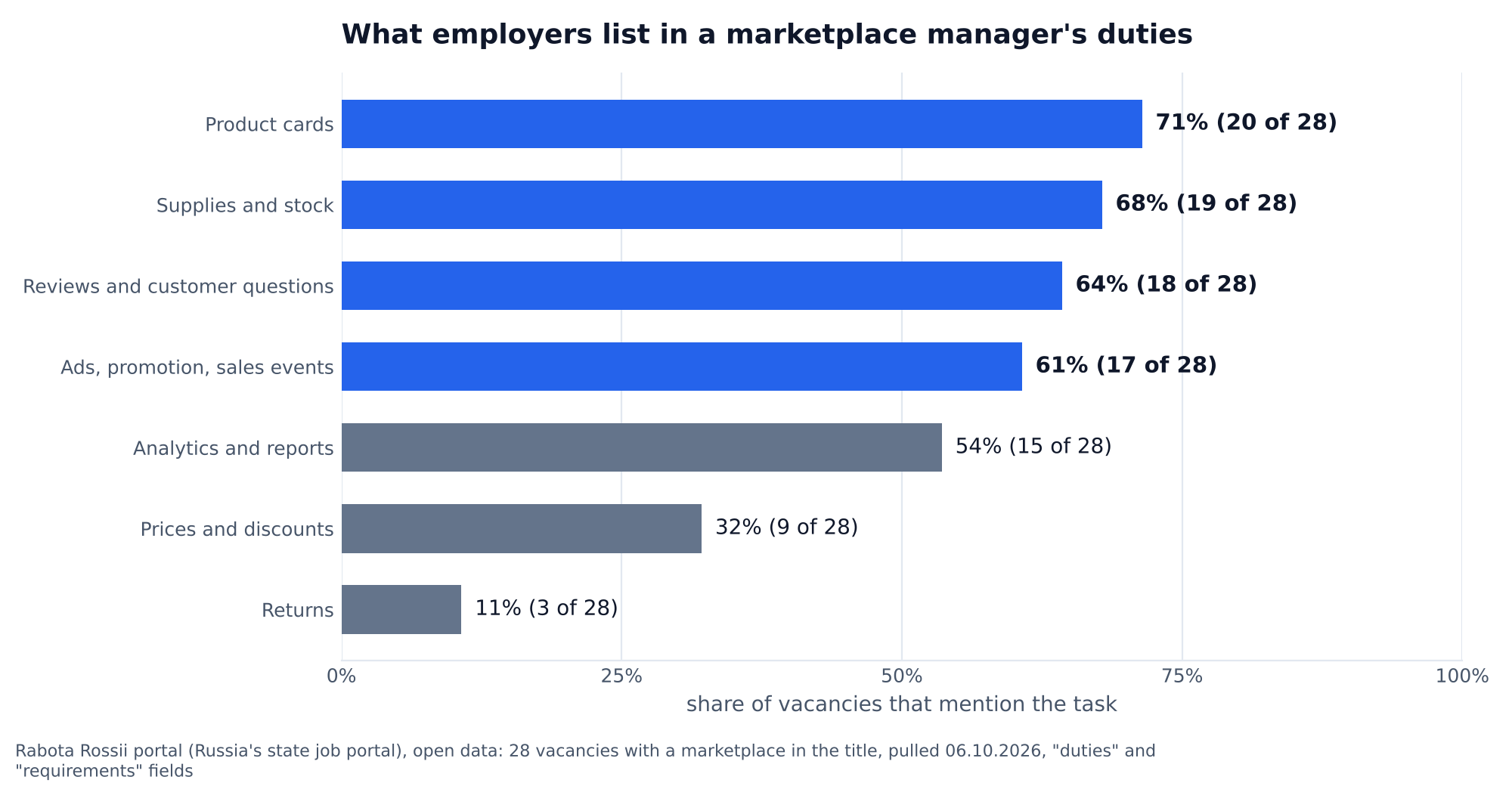
A seller has six ongoing jobs: product cards, supplies, advertising, reviews, reports, payouts. As the store grows, part of the work goes to a manager, and the list of duties in vacancies shows well what the seller's own work consists of.
| Job | What it involves | Detailed breakdown |
|---|---|---|
| Product card | title up to 60 characters, up to 30 photos, attributes for filters | WB product card |
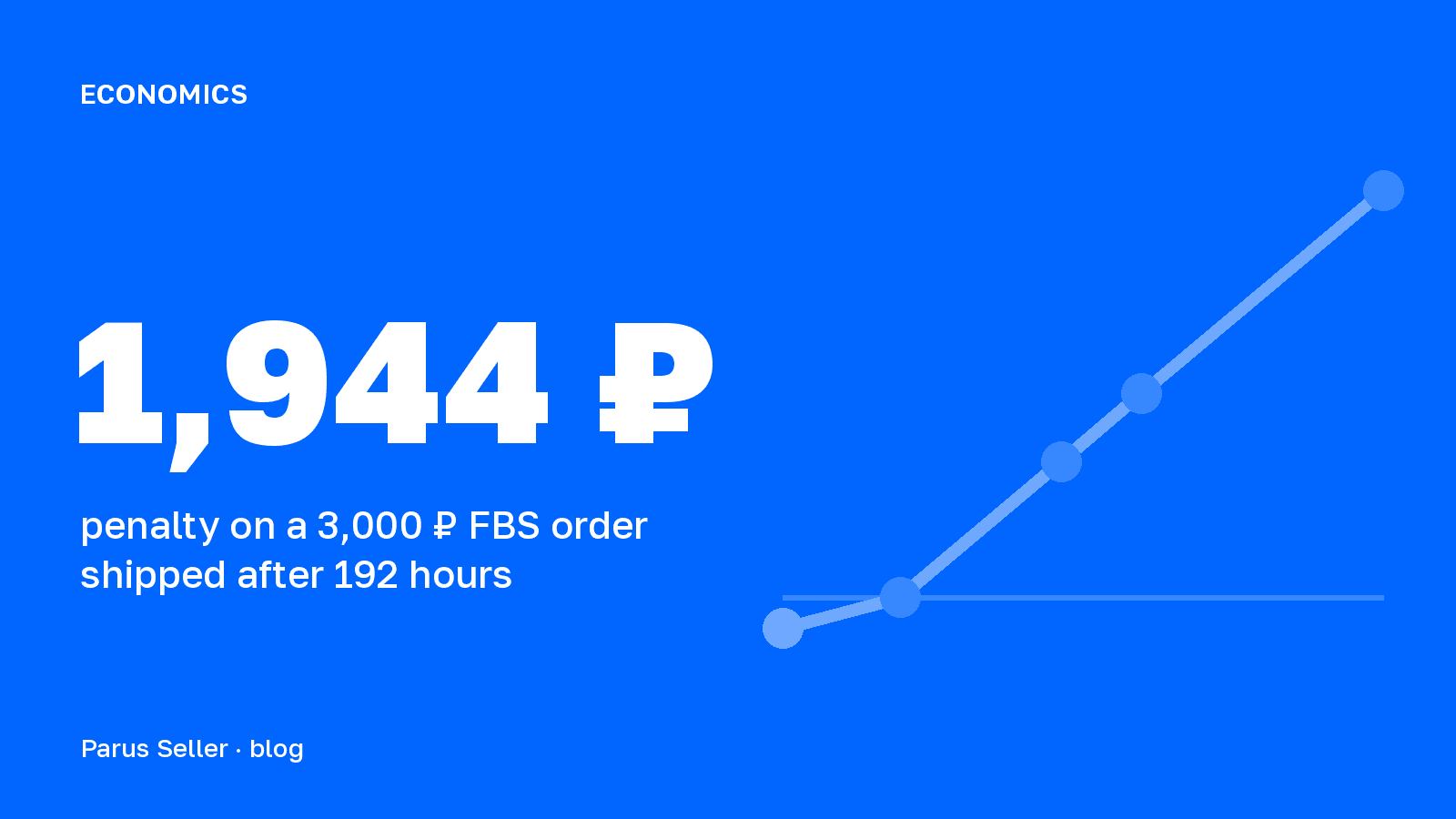
| Supplies | on FBW take a batch to a WB warehouse, on FBS pack an order within 192 hours | supply to WB |
| Advertising | bids per impressions or clicks, minimum campaign budget 1,000 ₽ | WB advertising |
| Reviews | one "1" at a 4.7 rating is offset by 13 fives | replying to reviews |
| Reports | the weekly report arrives on Monday for the previous week | weekly report |
| Payouts | money arrives 16 to 25 days after the end of the sales week | WB payouts |
Every day a seller checks new orders and stock, replies to reviews and keeps an eye on ad spend. On Monday the report for the previous week arrives, and it is worth checking against expectations. Every few weeks a new supply is put together, and product cards are reworked when conversion drops.
What you need to be to become a seller: self-employed, sole proprietor or LLC
A private individual without a status will not get a seller account on WB. According to the WB registration instruction, which we covered in the article on the WB Partners account, self-employment, a sole proprietorship or a legal entity will do.
| Form | What you can sell | Tax | Main restriction |
|---|---|---|---|
| Self-employed | only goods you made yourself, without Chestny Znak marking | 4% on sales to individuals | income up to 2.4 million ₽ a year, no hired staff |
| Sole proprietor | any permitted goods | simplified tax 6% or 15%, contributions 57,390 ₽ plus 1% | from 2026 VAT once income exceeds 20 million ₽ |
| LLC | any permitted goods | simplified tax or the general regime, plus accounting statements | makes sense with several owners or large turnover |
In practice most people choose a sole proprietorship. According to our data from Federal Tax Service registers, of 366,832 WB sellers 81% are sole proprietors and 19% are companies. Self-employment suits people who sew, knit or make goods themselves, and then runs into the cap: see the article on self-employed sellers on WB. How to choose between the 6% and 15% simplified tax and from what income VAT is added, we calculated in the breakdown of a sole proprietorship for WB.
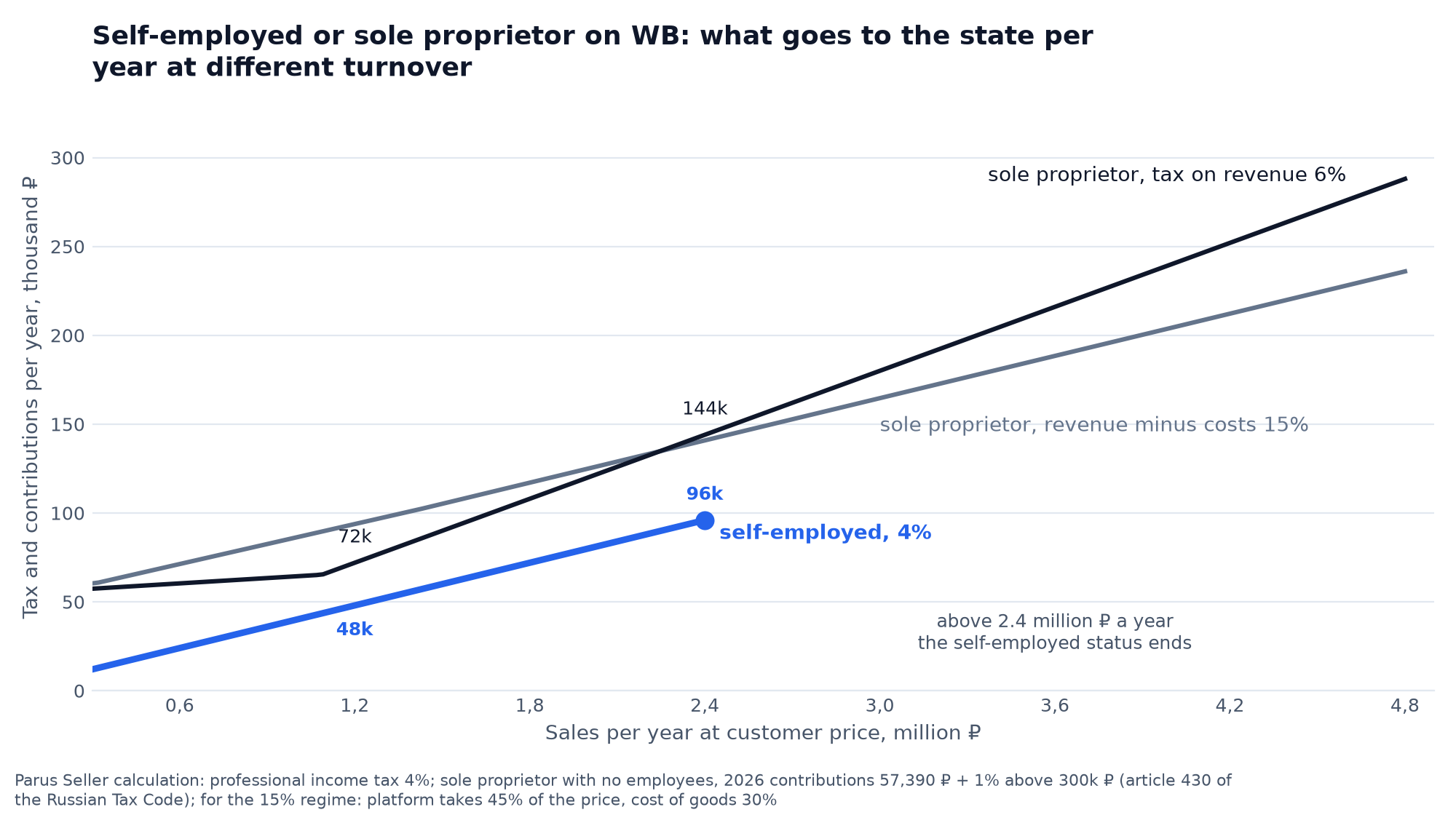
With sales of 1.2 million ₽ a year a self-employed person pays 48,000 ₽, a sole proprietor on the simplified tax on revenue 72,000 ₽. But choosing by tax only makes sense if the product fits the self-employment restrictions.
How much Wildberries takes from a seller's sale
WB's commission by category ranges from 3 to 45%, with a median of 34% from the platform's warehouse. But the rate is one line out of ten. We took our breakdown of a month of a phone case store with 6 million ₽ turnover from the article on how much Wildberries takes from a seller and recalculated each line per 100 ₽ paid by a buyer. The store is a model one, and the line shares come from real WB reports.
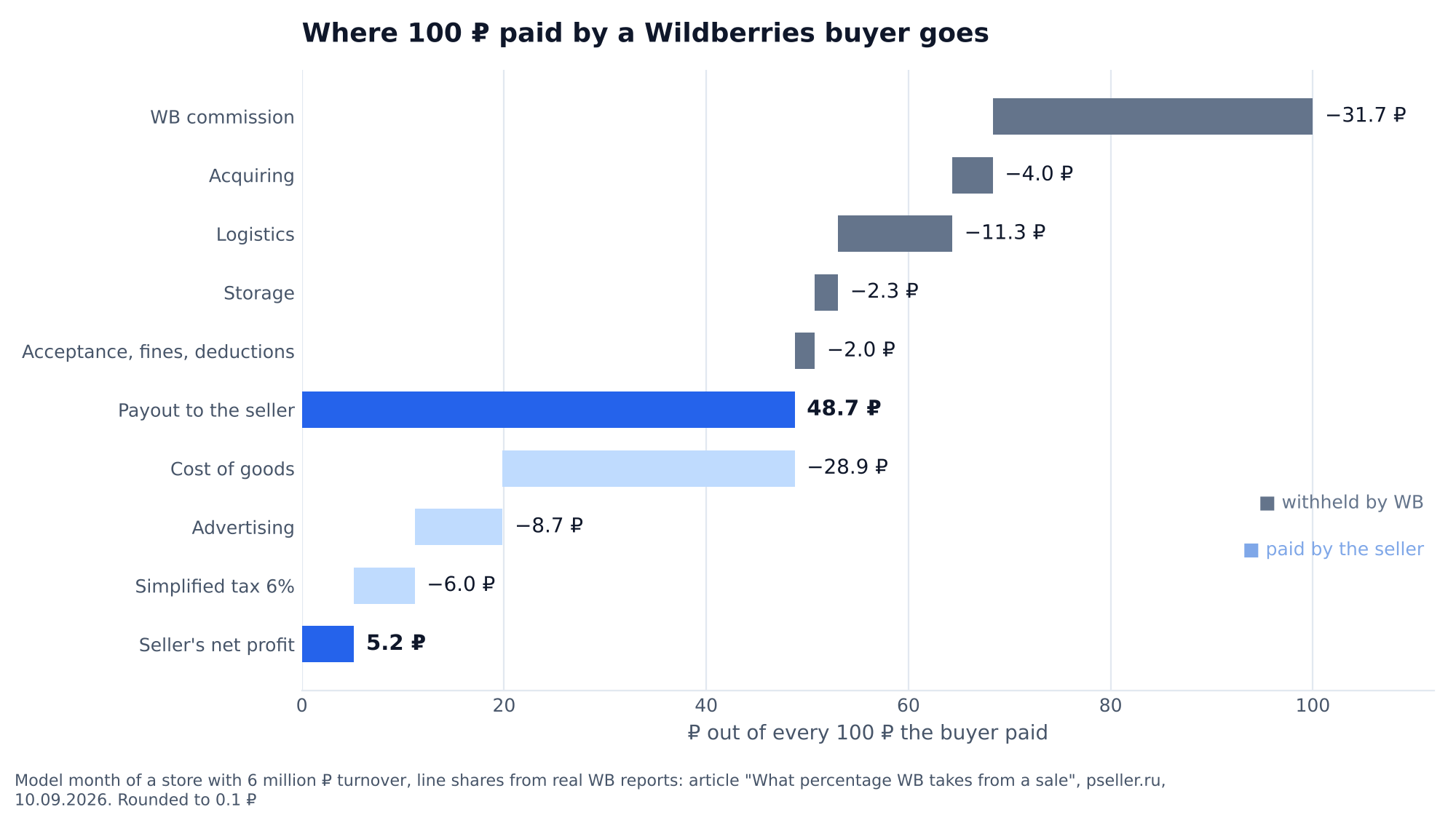
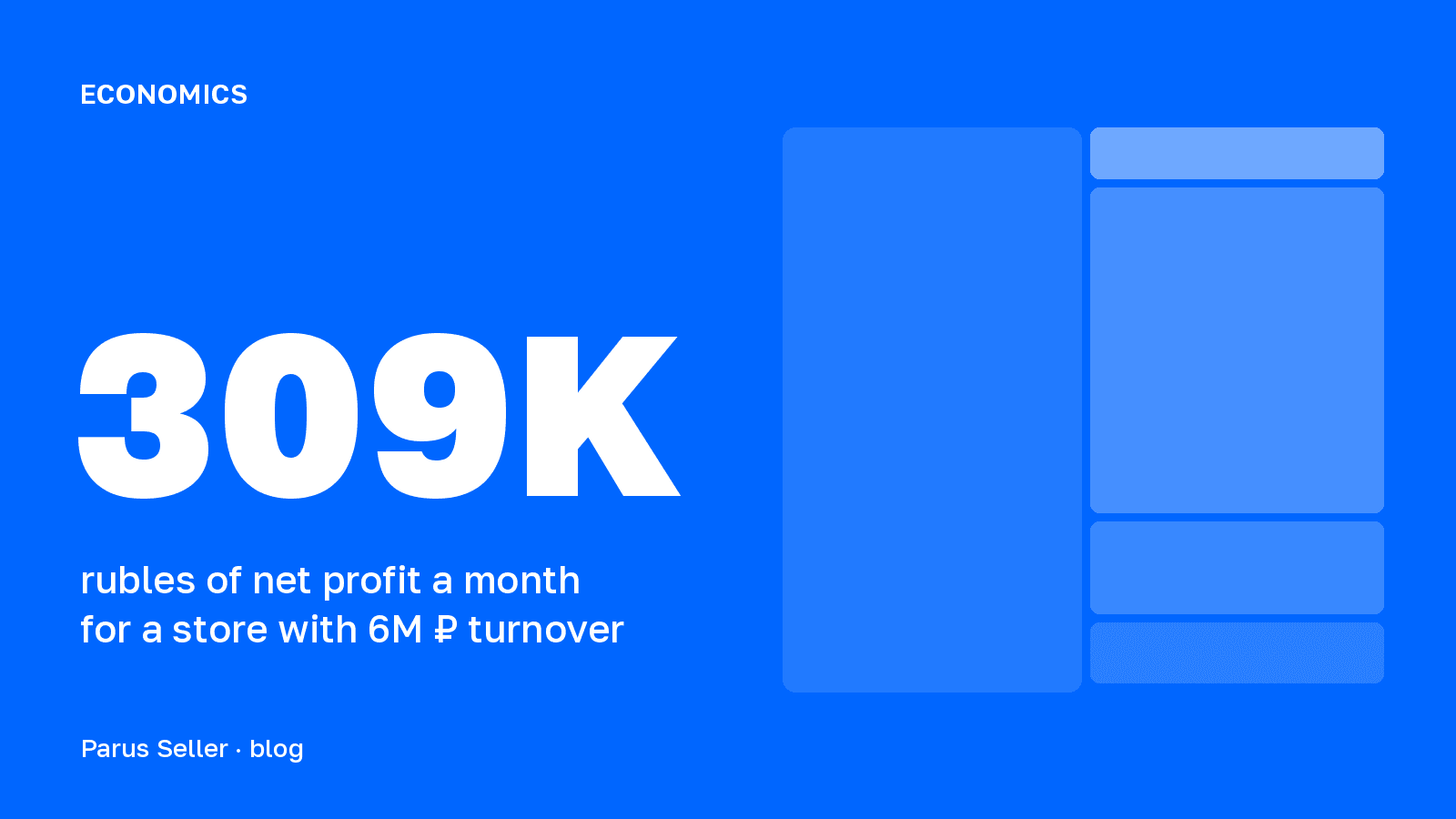
Out of every 100 ₽ the platform kept 51.3 ₽ before the payout. The largest line is WB's fee, 31.7 ₽, although the category rate is 38.5%: WB passed part of its commission to the buyer as the WB loyalty discount. The second heaviest line is logistics, 11.3 ₽. The seller received 48.7 ₽, but this is not yet their money. Out of it they paid for the goods, then advertising, then tax. In the end 5.2 ₽ out of every 100 ₽ was left net, which on a turnover of 6 million ₽ a month is 309,000 ₽.
A seller's profit grows with turnover: with this structure every extra million of sales a month adds about 52,000 ₽ net. In another category the shares will be different, so it is better to calculate your own figure for your own product.
How much a seller earns on WB
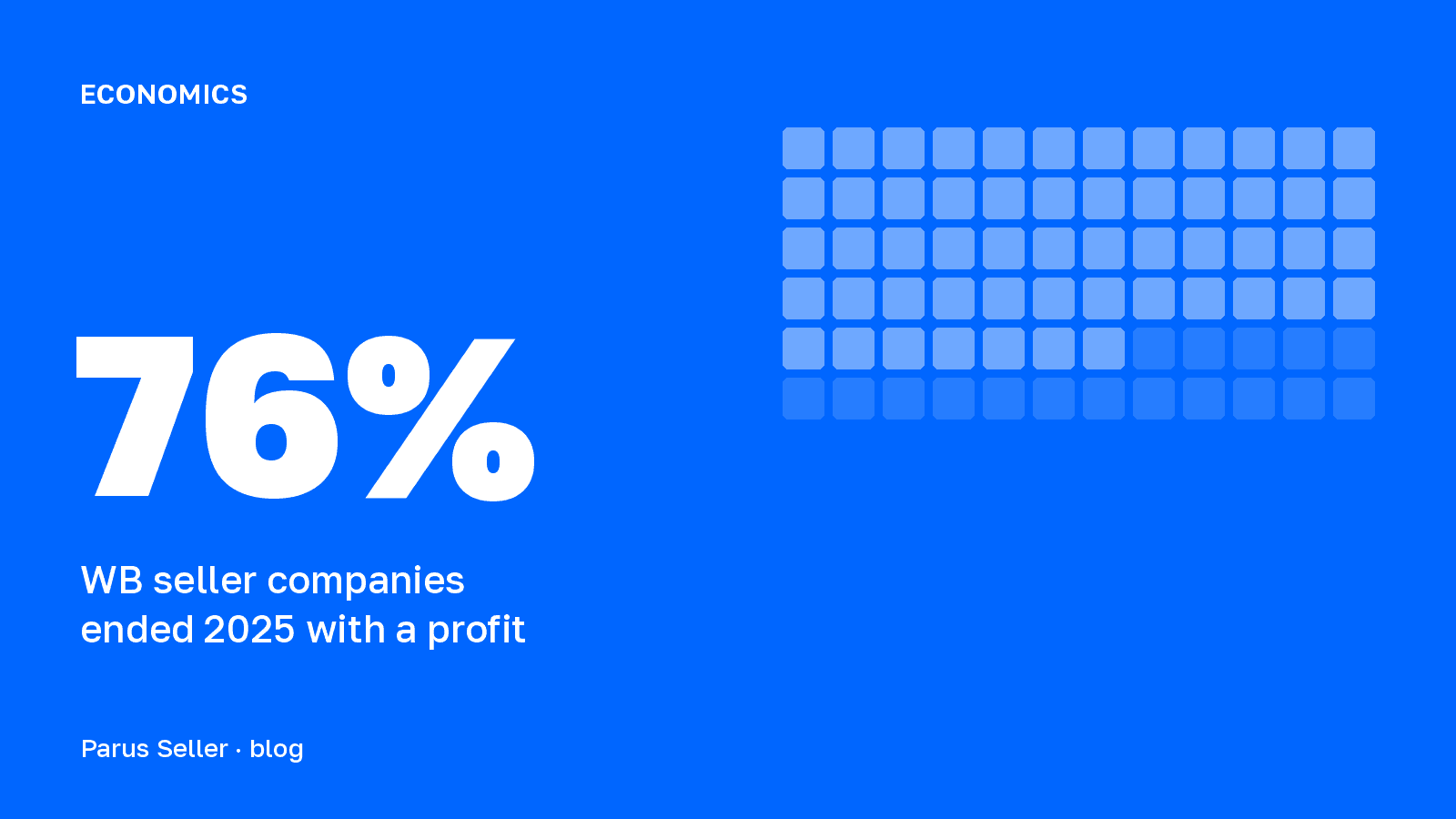
A typical company selling on Wildberries had about 26 million ₽ in revenue and 840,000 ₽ in profit for 2025, which is about 70,000 ₽ a month. These are medians from Federal Tax Service data for WB seller companies, which we analysed in the article on how much people earn on WB. Three companies out of four ended the year with a profit. The top quarter earned from 5.6 million ₽ for the year, which is over 460,000 ₽ a month, and the top 10% from 27 million ₽.
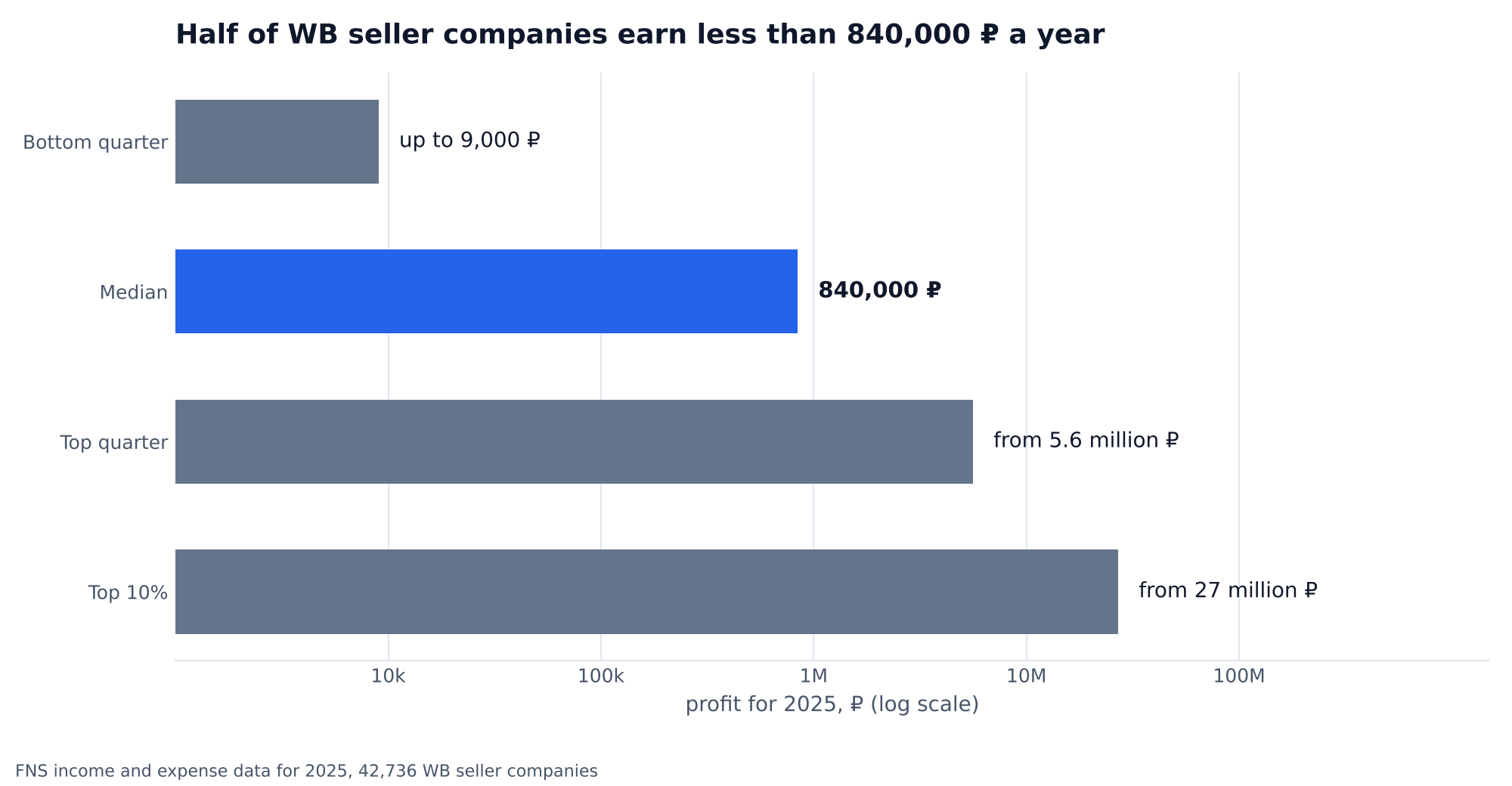
An important caveat. The figures cover only LLCs and joint-stock companies: sole proprietors do not file accounting statements, and they make up four out of five WB sellers. How much a typical sole proprietor earns cannot be found in open data. What is visible is that growth pays off: the larger the turnover, the more often a company is in profit. With income up to 10 million ₽ a year two companies out of three are profitable, and among companies from 120 million ₽ seven out of eight.
How to become a seller on Wildberries
You can become a seller on WB in a few days if you already have the goods. The full path is described in the article on how to open a Wildberries store; here is the short version.
| Step | What to do | Time or cost |
|---|---|---|
| 1. Product | check demand, competitors and the buyout rate in the category | the longest step |
| 2. Documents | Chestny Znak marking, a certificate or a declaration, if needed | before buying stock |
| 3. Registration | WB Partners by phone number and tax ID, accept the offer agreement | 5,000 ₽ payment, activation in about a day |
| 4. Product card | photos, title, attributes | from one day |
| 5. First supply | FBS is easier to start with, the goods stay with you | money 16 to 25 days after the sales week |
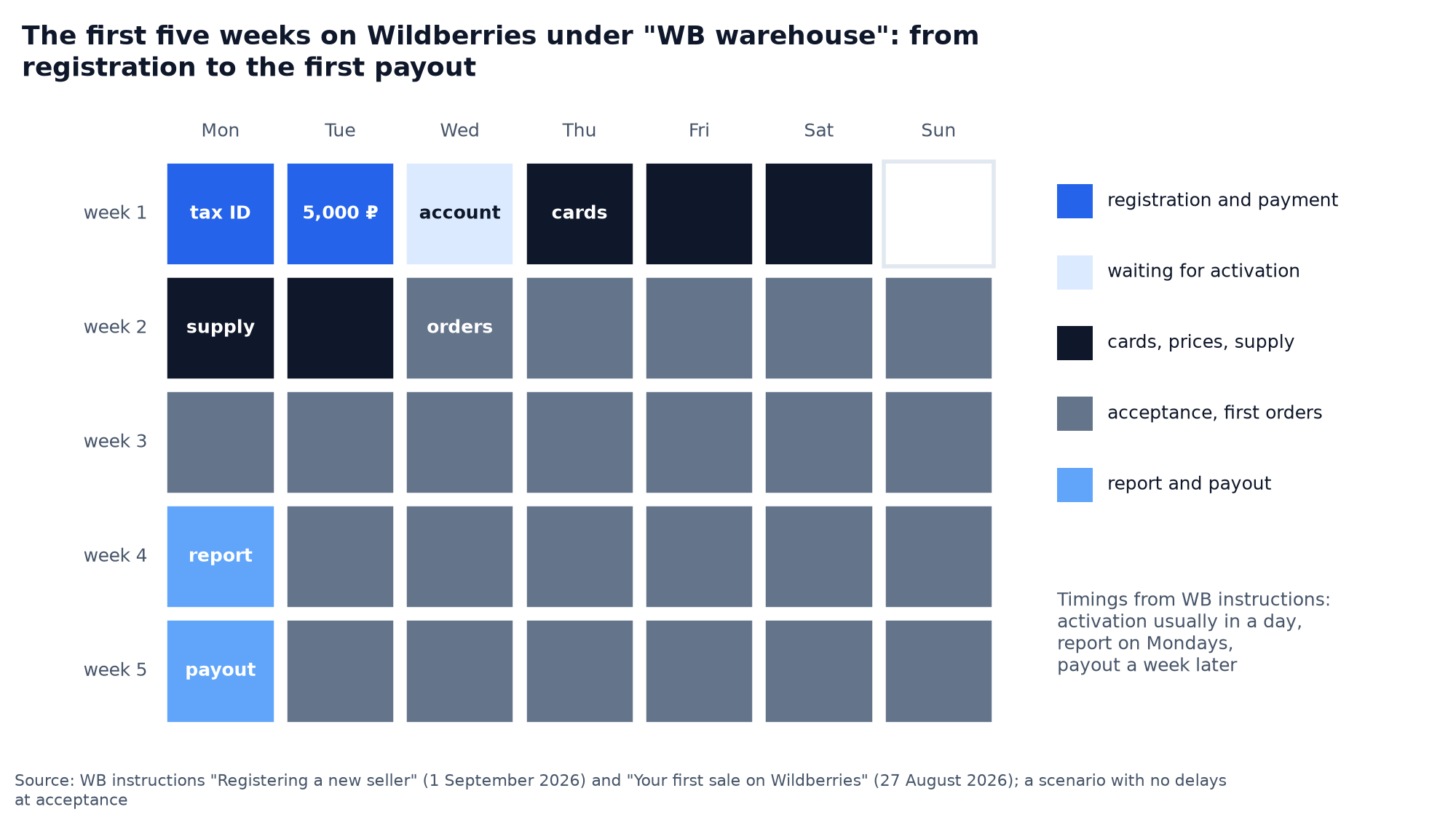
From registration to the first payout takes about five weeks under the deadlines in WB's instructions. It is wiser to start with one product and a small batch: it will show the real buyout rate, search positions and the cost of an order with advertising.
Seller's glossary: what the words you will hear mean
Half of a newcomer's difficulty is jargon. Here are words from the seller account and reports, each with a one-line definition.
| Word | In plain words | Read more |
|---|---|---|
| FBW (FBO) | the goods sit in a WB warehouse, the platform stores, packs and delivers them | supply to WB |
| FBS | the goods stay with you, you pack the order and hand it to WB, the platform delivers it | FBS on WB |
| DBS | the goods stay with you, and you also deliver them to the buyer | DBS on WB |
| WB loyalty discount (СПП) | a discount for regular buyers that WB pays for itself | WB loyalty discount |
| Buyout | the share of orders that buyers picked up and paid for | buyout rate |
| Non-buyout | an order the buyer refused: the seller pays for two trips | returns on WB |
| Sell-through | how many days it takes to sell the stock in a warehouse | storage on WB |
| Unit economics | profit from one sale after all costs | unit economics |
| Ad spend share (ДРР) | the share of revenue that went back into advertising | WB advertising |
| Commission | WB's percentage of the seller's price, depends on the category and model | commission by category |
| Warehouse coefficient | a multiplier on logistics and acceptance tariffs at a given warehouse | warehouse acceptance |
| Offer agreement | the contract with WB that a seller accepts at registration | WB offer agreement 2026 |
| Chestny Znak | mandatory marking for clothing, footwear, cosmetics and other categories | Chestny Znak on WB |
FAQ about sellers
Are a seller and a merchant the same thing? Yes. «Селлер» is the English word seller, which stuck to merchants on marketplaces. In the account and in its instructions WB writes «продавец» ("seller").
Who are sellers on Wildberries? Entrepreneurs and companies that sell their own goods through WB. According to our data from Federal Tax Service registers, 81% of WB sellers work as sole proprietors and 19% as companies.
What does a seller on a marketplace do? Chooses and buys goods, creates product cards, sends supplies or packs orders, runs advertising, replies to reviews and checks reports against payouts.
Can you become a seller without being a sole proprietor? Yes, as self-employed, but only with goods you made yourself, without marking and with income up to 2.4 million ₽ a year. A private individual without a status will not get an account.
How much money do you need to become a seller? There is one mandatory payment to the platform, 5,000 ₽. The rest of the budget depends on the product and the batch size, and it is best calculated from the profit on one sale.